Wildlife conservation
Sundarbans: Tigress returns to the wild, roams within its own territory
It was 12:00 noon on Sunday. It was drizzling. Amidst the rain, a launch cruised along the Shela River, which flows past the Chandpai Range of the Sundarbans East Forest Division, and came to a halt. The spot was located a short distance beyond the Andharmanik Eco-Tourism Centre.
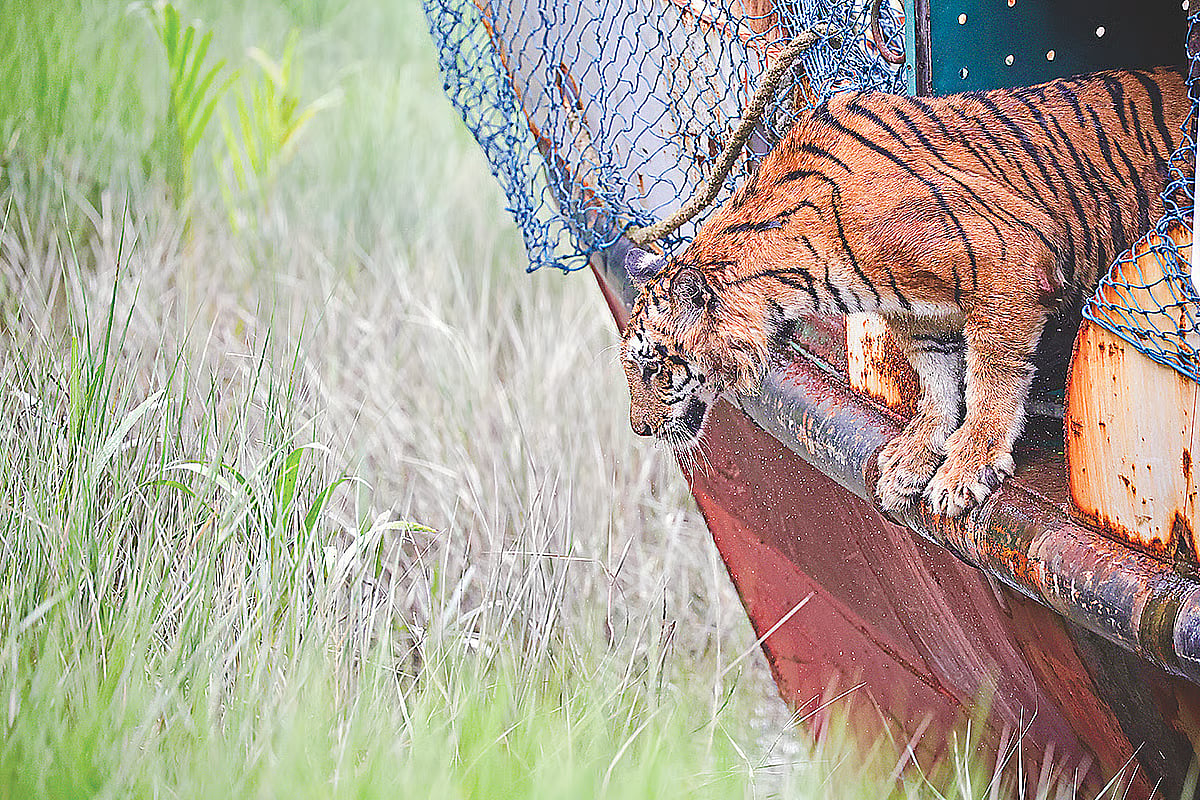
The launch drew everyone’s intense interest. This was because preparations were underway aboard the vessel to release a tigress back into the Sundarbans—now fully recovered after being rescued earlier this year from a trap set by poachers.
The cage aboard the launch measured five feet in length, three and a half feet in height, and three feet in width. The tigress sat curled up inside it. Even after the cage door was opened, she merely looked around and lay down inside, stretching her body. She seemed completely unbothered.
The wait grew longer for the crowd of over 100 people positioned on both sides of the launch, all eager to capture the moment of the tigress’s return on camera.
Despite various efforts by the forest department staff, the tigress refused to budge. Finally, the moment arrived. At around 1:00 pm, the tigress took a short leap out of the cage and disappeared into the forest. Everyone breathed a sigh of relief. Concurrently, this marked the first successful rescue and release operation by the forest department in the history of wildlife conservation in the country.
The Minister of State for the Ministry of Environment, Forest and Climate Change, Shaikh Faridul Islam, and the Chief Conservator of Forests, Md. Amir Hosain Chowdhury, along with other forest officials and wildlife researchers, were present on the occasion.
The forest department first received reports of the tigress being caught in a trap on 3 January, in the forest adjacent to Shorkir Khal (canal), under the Baidyamani Forest Patrol Post in the Chandpai Range of the eastern Sundarbans.
Following the release of the tigress, State Minister Shaikh Faridul Islam said, “Despite numerous constraints, the tigress has been nursed back to health and returned to the forest—this is our greatest joy. History has been made in the Sundarbans today. We believe the tigress will thrive here.”
The forest department first received reports of the tigress being caught in a trap on 3 January, in the forest adjacent to Shorkir Khal (canal), under the Baidyamani Forest Patrol Post in the Chandpai Range of the eastern Sundarbans.
The following day, the animal was tranquilised using a dart gun. The trap was then cut away, and the animal was transferred in an iron cage to the rehabilitation centre of the Wildlife Management and Nature Conservation Division in Khulna. Relevant forest officials confirmed that the tigress is approximately 10 to 11 years old.
Roaming within its own territory after release
At around 1:00 pm, three hours after the release, a team entered the forest to monitor the situation. The team was led by Professor MA Aziz from the Department of Zoology at Jahangirnagar University—who is a member of the committee formed regarding the tigress’s treatment and subsequent action plan—and Md. Rezaul Karim Chowdhury, Divisional Forest Officer (DFO) of the Sundarbans East Forest Division.
Despite numerous constraints, the tigress has been nursed back to health and returned to the forest—this is our greatest joy. History has been made in the Sundarbans today. We believe the tigress will thrive here.Shaikh Faridul Islam, Minister of State for the Ministry of Environment, Forest and Climate Change
Professor MA Aziz later told Prothom Alo, “After the tigress was released into the forest, we walked about 150 metres inside, tracking her footprints. Although she appeared slightly hesitant initially, her pugmarks indicate that she is quickly identifying her own territory (home range).”
Expressing optimism that the tigress would swiftly adapt to her surroundings, he added that since this is her old habitat, she would recognise it within a few days.
“As a tiger researcher, today is a day of great joy and pride for me. I have been involved with the forest department from the very beginning in determining the course of action for this tiger. We have successfully executed the entire process, from rescue to release,” Professor MA Aziz remarked.
He noted that this incident—where a tiger was rescued, underwent prolonged medical treatment, recovered completely, and was returned to the wild—is a historic first in the country’s wildlife conservation annals.
‘Healing the wound was the biggest challenge’
At the time of her rescue, the tigress had sustained damage to the skin, muscles, and veins across an area of about three inches on her front left leg. Due to her repeated pulling against the rope of the trap, the wound had become gangrenous. The animal was emaciated and reduced to skin and bone when rescued.
Md. Rezaul Karim Chowdhury, Divisional Forest Officer of the Sundarbans East Forest Division, told Prothom Alo, “The tigress’s left leg was so severely damaged that we were deeply concerned. Because of this, the recovery process took a long time. After administering antibiotics, the wound began to heal; however, once it started drying up, she would scratch it and cause it to bleed again. This posed a major challenge for us.”
He mentioned that regular contact was maintained with wildlife experts to understand the tigress’s behaviour and dietary needs.
Rezaul Karim expressed his gratitude to the Khulna Wildlife and Nature Conservation Division and senior forest officials for their contributions to the care and treatment of the tigress at the Khulna Wildlife Rescue Centre.
Describing how the tigress’s wound was eventually healed, Nirmal Kumar Paul, Divisional Forest Officer (DFO) of the Khulna Office under the Wildlife Management and Nature Conservation Division, said that following the advice of an expert, honey was applied under the bandages, and the leg wound began to heal around March. Consequently, muscle tissue began to regenerate over the affected area.
After the tigress was released into the forest, we walked about 150 metres inside, tracking her footprints. Although she appeared slightly hesitant initially, her pugmarks indicate that she is quickly identifying her own territory (home range).Professor MA Aziz from the Department of Zoology at Jahangirnagar University
“We have released her in the exact range where we had spotted her through camera trapping two years ago. Over the last six months, her territory may or may not have been occupied by another animal. A challenge remains in this regard. There is nothing we can do here; the tigress will have to face that challenge herself. Since she is a female tiger, the threat to her is relatively lower. We hope she will overcome this hurdle,” Nirmal Kumar Paul added.
Shortage of modern vehicles and equipment must be addressed
According to the forest department, the tigress was initially fed liver. As her health improved, she was introduced to live prey. The decision to release the tigress was made after she demonstrated the agility to hunt and consume live prey, such as wild boars, within seconds.
Following this protocol, the tigress was sedated at the Khulna Wildlife Rescue Centre at around 3:00 am on Sunday. She was then placed inside a custom-made cage, and medication was administered to reverse the sedation. Once she regained consciousness around 5:00 am, she was transported by road from Khulna to the Mongla Fuel Jetty and loaded onto the launch. Subsequently, she was taken via the Shela River and released into the forest adjacent to the Andharmanik Eco-Tourism Centre.
Md. Mofizur Rahman Chowdhury, an official of the Khulna Wildlife Management and Nature Conservation Division, stated, “We face a shortage of modern vehicles and equipment for wildlife rescue operations.”
Stating that the cage in which they transported the tiger was not ideal, he said, “It is better to use automated vehicles rather than conducting releases manually.”
“If we can overcome these limitations, we will be able to replicate such success stories more frequently,” Mofizur Rahman Chowdhury added.