Bangladesh tops labour market in Malaysia, setbacks remain
Malaysia is one of the top five destinations for Bangladesh’s manpower exports and a major source of remittance income. At one time, Indonesians made up the largest share of foreign workers in the country; that position has now been taken over by Bangladeshis.
Alongside those with valid documents, a significant number of Bangladeshis are residing in Malaysia illegally. Such migrants are frequently detained in operations conducted by the country’s Immigration Department. This has created fear and discomfort even among Bangladeshis who are living there legally. These findings emerged during a recent visit to the country.
According to Malaysian media reports, 182 Bangladeshis were arrested in November alone. Earlier, in September, 377 people were detained in a single operation. In almost all operations carried out by the Malaysian Immigration Department, Bangladeshis are among those arrested. Those detained are later deported.
A Bangladeshi holding a senior position at a Malaysian technology company, speaking to Prothom Alo on condition of anonymity, said, “You will find Bangladeshis everywhere. Perhaps half of them are undocumented. Because of this, those of us who have been living here legally with our families for a long time feel embarrassed. We even face questions at the workplace. Yet, if workers could be sent legally with proper training, much more income could have been earned.”
In the last week of November, a group of Bangladeshi workers from Cumilla were met near the Sultan Abdul Samad Jamek Mosque area in Kuala Lumpur. They told Prothom Alo that they had not yet found jobs. Each of them had come through brokers, spending Tk 500,000. They are trying to find work at factories outside the capital.
Tasneem Siddiqui, founding chair of the Refugee and Migratory Movements Research Unit (RMMRU) in Dhaka, said, “Instead of token manpower exports, initiatives should be taken to legalise undocumented Bangladeshis. Malaysia has done this before. This would increase the flow of remittances to the country. If the labor market is once again handed over to syndicates, workers will not be able to actually take up jobs. The government needs to take the right decision.”
History of Bangladeshis in Malaysia
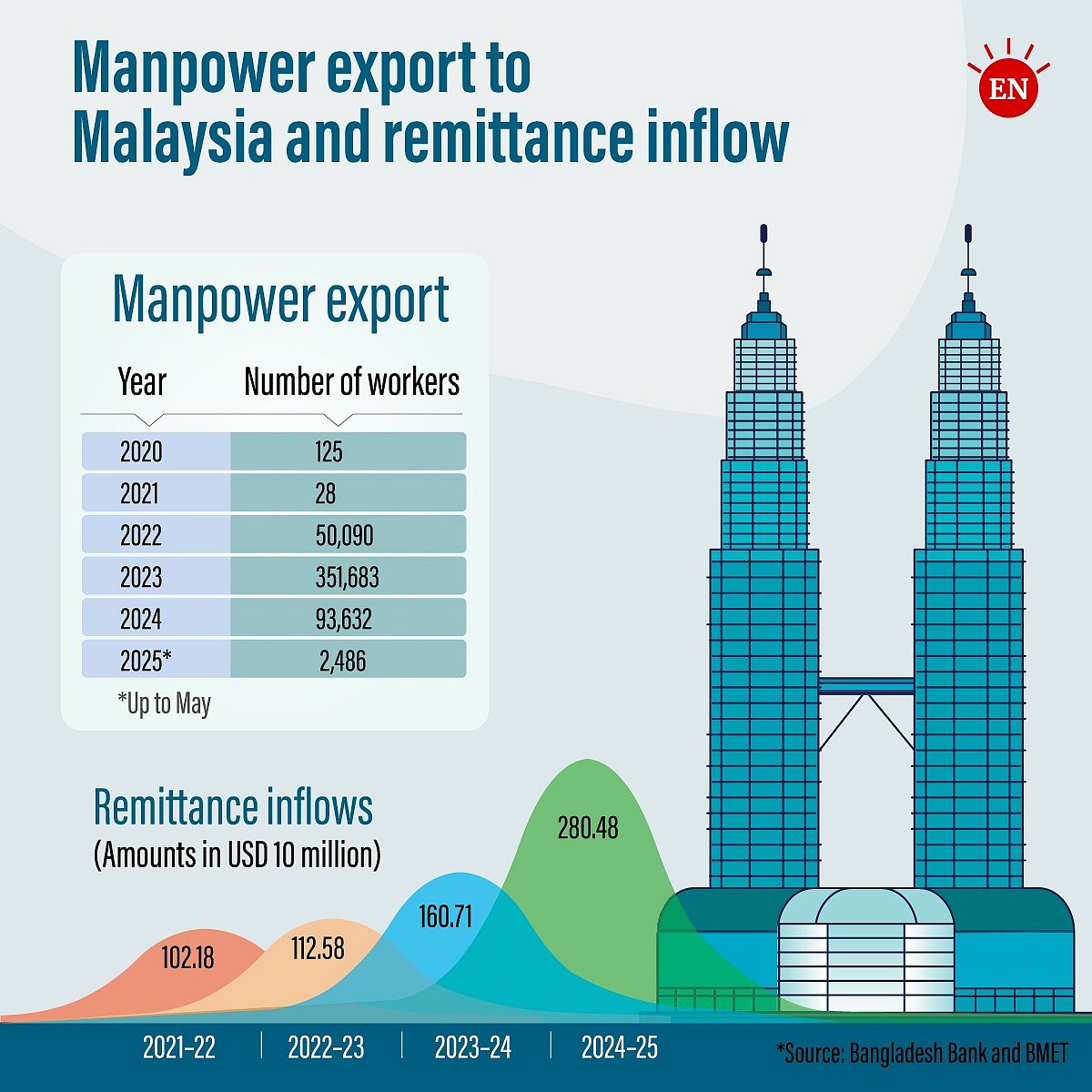
Bangladesh’s journey in overseas labor markets began in 1976. In 1978, the first 23 Bangladeshi workers went to Malaysia. A formal manpower recruitment agreement between Bangladesh and Malaysia was signed in 1992. From 1990 to 2023, the export of Bangladeshi workers to Malaysia steadily increased. In 2023 alone, a record 351,683 Bangladeshis went to Malaysia. On 31 May 2024, the labor market was closed, though it has since been reopened under various conditions.
Bangladeshis work in Malaysia’s construction, industrial, agricultural, and service sectors. At present, Bangladeshis make up the largest share—37 per cent—of foreign workers in the country. As of the end of June this year, the number of Bangladeshis holding valid work permits stood at 803,332. These figures were reported by the Malaysian daily The Star.
However, Bangladeshis living in Malaysia say that the actual number is nearly double. Many entered the country on student visas and never returned. A report by the International Organization for Migration (IOM) states that up to 2024, around 2.5 million people traveled to Malaysia for visit purposes and did not return to their home countries—38 per cent of them were Bangladeshis.
The housing business is booming in Kuala Lumpur, Penang, and other states, creating strong demand for construction workers. The service and manufacturing sectors are also expanding. Both documented and undocumented Bangladeshis work predominantly in these sectors. Because Malaysia has a fixed minimum wage, many companies hire undocumented workers to cut costs, and Bangladeshis make up the largest share of this workforce.
Malaysia’s minimum monthly wage is 1,700 Ringgit (Malaysian currency,) which is roughly Tk 51,000. Workers are required to work eight hours a day and 45 hours a week. In addition, up to four hours of overtime per day is permitted if desired. There is demand for workers in construction, factories, palm plantations, as electricians, plumbers, painters, in supermarkets, and in various other jobs.
‘My Second Home’ programme
Bangladeshis currently rank fourth in the ‘Malaysia My Second Home’ (MM2H) programme, which offers the opportunity to establish a second residence in the country. As of 2024, a total of 3,604 Bangladeshis have participated in the programme. With an investment of Tk 36 million, a five-year visa is granted, while higher investment qualifies applicants for a 20-year visa. The condition is investment in the housing sector, which has further boosted Malaysia’s real estate business.
Manpower export and remittance trends
Due to its proximity, relatively lower costs, and cultural similarities, Malaysia remains one of the most preferred destinations for Bangladeshi workers. For example, 50,090 workers went to Malaysia in 2022; 351,683 in 2023; and 93,632 in 2024 before restrictions were imposed. By May this year, 2,486 workers had gone.
Positive remittance flow
Because of the large number of migrant workers, Malaysia is also a big source of remittances to Bangladesh. Remittance inflows from Malaysia stood at USD 10.2 billion in fiscal year 2021–22, USD 11.2 billion in 2022–23, USD 16.0 billion in 2023–24, and USD 28.0 billion in 2024–25. In the current fiscal year 2025–26, remittances amounted to USD 2.6 billion in July and USD 2.7 billion each in August and September.
Mominul Islam from Chuadanga, who works at a shop in Kuala Lumpur’s Times Square, said he previously worked at a shoe store in Bangladesh, where it was difficult to support his family on his salary. He therefore took a loan of Tk 500,000 and moved to Malaysia. He now earns a monthly salary of 2,200 ringgit (about Tk 66,000). He has already repaid his loan, is doing well in Malaysia, sends a good amount of money home every month, and is able to support his family while also saving.