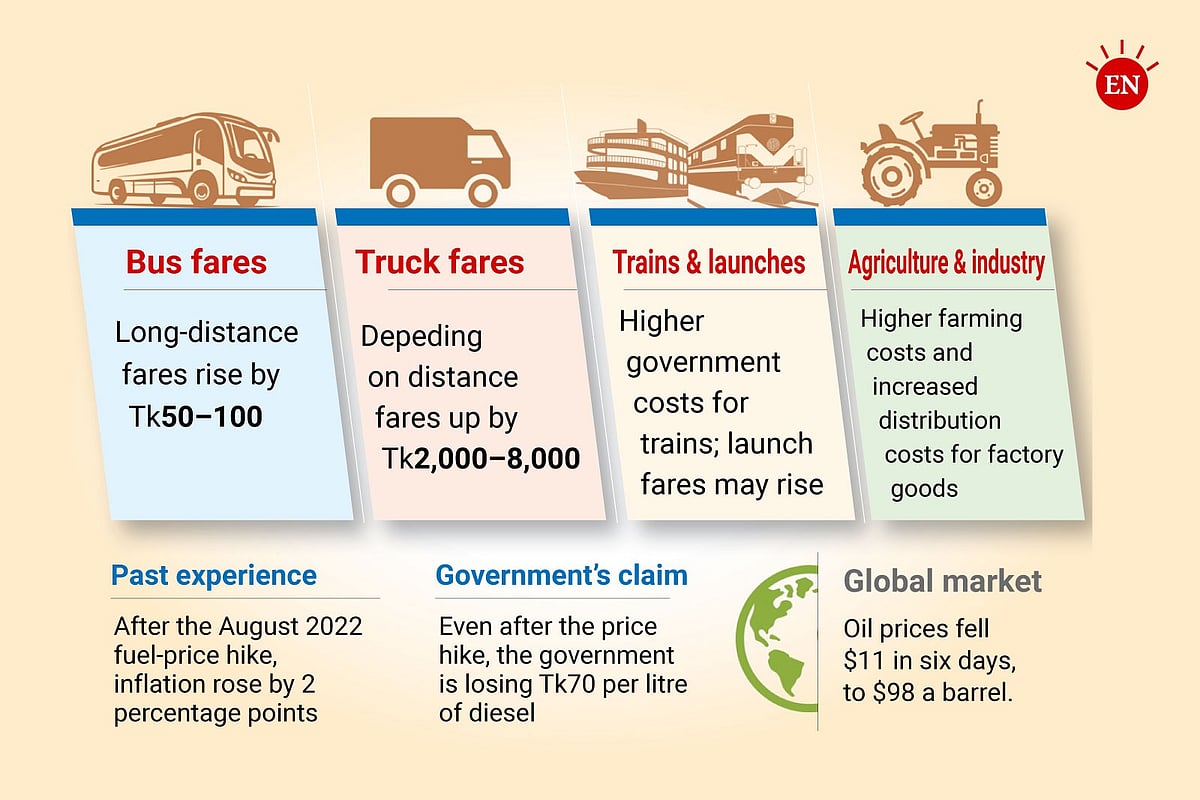
The day after diesel prices were raised, passengers at the Gabtoli bus terminal in the capital were being charged Tk 50 to Tk 100 more in fares, depending on the distance.
Meanwhile, a rice mill owner in Kushtia said that while he had paid Tk 20,000 to transport a truckload of rice to Dhaka the previous day, the same shipment cost Tk 22,000 yesterday.
This is how the impact of the fuel price hike has begun to be felt in the transport sector. Analysts say the higher fuel prices will raise transport fares as well as agricultural production costs. The cost of supplying goods from factories will also increase. In some cases, factory production costs will rise as well.
Rural households that use kerosene lamps during power cuts or load-shedding will face higher expenses. Motorcycle and car owners will also have to spend more.
Overall, there is a risk of higher inflation. The main burden will fall on poor, lower-income and low-income households.
Selim Raihan, a professor of economics at the University of Dhaka, told Prothom Alo that inflation had remained high for several years and ordinary people’s purchasing power was under pressure. Even a modest increase in bus fares, or higher prices for rice and vegetables and increased cooking costs, could put significant pressure on the monthly budgets of low-income households, he said. According to him, low-income workers in cities, farming households dependent on diesel-powered irrigation and workers in the informal sector face the greatest risks.
Selim Raihan further said that raising prices might make the government’s calculations somewhat easier. But it could come at a cost in various ways, including higher inflation, reduced purchasing power and greater inequality.
Previous price hikes
The biggest one-time increase in fuel prices came in August 2022. The Awami League government, which was ousted in the July mass uprising, raised the price of diesel by 42.5 per cent at the time, an increase of Tk 34 a litre. Amid widespread criticism, however, the price was cut by Tk 5 a litre just 23 days later.
Bus, truck and launch fares rose immediately after the fuel price hike. Transport and production costs also increased. Inflation rose by 2 percentage points at the time, from 7.5 per cent to 9.5 per cent.
Inflation has remained high in Bangladesh since 2022 and is still above 8 per cent. Meanwhile, fuel prices in the global market are volatile. Citing the need to reduce losses, the government raised fuel prices by Tk 20 a litre last Sunday. Diesel now costs Tk 135 a litre, petrol Tk 160, octane Tk 165 and kerosene Tk 155.
Earlier, on 18 April, diesel prices were raised by Tk 15 a litre, petrol by Tk 19, octane by Tk 20 and kerosene by Tk 18. In June, the prices of petrol, octane and kerosene were raised by another Tk 5 a litre each.
The Energy Division says it currently spends Tk 205 to import each litre of diesel. Even after the latest price increase, it is still incurring a loss of Tk 70 per litre.
State Minister for Power, Energy and Mineral Resources Anindya Islam Amit said the government had been forced to raise fuel prices because of the continued rise in global oil prices amid the Middle East crisis. Speaking to journalists at the Secretariat yesterday, he said there was no alternative to adjusting fuel prices at this moment. The government would not want to take such an unpopular decision unless it had no other option, he said.
Meanwhile, global oil prices fell on Monday. Despite the missile and drone attacks by Iran-backed Houthis on Saturday, there are expectations that oil supplies from Saudi Arabia will remain normal. Investors are watching the situation closely.
Fuel is generally traded in two ways. One is the spot market, where oil is purchased for immediate delivery, which tends to be more expensive. The other is the futures market, where oil is bought and sold for future delivery. On Monday, the November futures price of oil in the international market fell 2.11 per cent to $98 a barrel. It had been $109 on 15 September.
‘The pressure has increased on us’
A visit to the counters at Gabtoli bus terminal yesterday found that buses on various routes were charging Tk 50 to Tk 100 more, depending on the distance. Both air-conditioned and non-air-conditioned buses were charging the additional fare.
Md Ramzan, a passenger travelling to Magura, had bought a ticket from Eagle Paribahan at the terminal. “I came to Dhaka yesterday (Sunday) for Tk 500. Just a day later, they are charging Tk 100 more,” he said. “The fare had already gone up once a few days ago. Now it has gone up again. The government has raised fuel prices, so they have raised fares too. The pressure has increased on us.”
Higher fares are being charged at different rates depending on the distance. Asked about this, Bangladesh Bus-Truck Owners Association chairman GR Shahid told Prothom Alo that bus owners would incur losses if they did not charge higher fares. The situation might continue for two or three days, he said. A new fare schedule would be finalised and announced soon.
Meanwhile, a committee of the Bangladesh Road Transport Authority (BRTA) met yesterday afternoon to determine new fares. According to sources at the meeting, it proposed increasing fares by 20 paisa per kilometre for long-distance buses and 18 paisa per kilometre for city buses. The Road Transport Ministry will announce the decision. A decision may come by today, Tuesday.
When diesel prices rise, fares for launches and other water vessels also increase. The cost of running trains rises as well. However, any decision to raise train fares rests with the railway authorities.
Truck fares have also increased. Reports indicate that carriers are demanding an additional Tk 2,000 to Tk 8,000 for relatively short routes. Nurul Islam, manager of Borkot Bhandar, a wholesale ginger and garlic business in Khatunganj, Chattogram, told Prothom Alo that the business had paid Tk 32,000 on Sunday to bring a truckload of goods from Kushtia. After the fuel price hike, the same journey was costing Tk 40,000—an additional Tk 8,000.
Nurul Islam said traders could not absorb higher transport costs from their own pockets. “The additional cost will be added to the price of the goods,” he said.
Higher transport costs
At Khatunganj yesterday afternoon, there was also a conversation with truck driver Mohammad Najmus Zaman. He had arrived in Chattogram that morning carrying goods from Satkhira. According to his calculations, the round trip from Satkhira to Chattogram requires around 230 litres of diesel. The additional fuel cost for the round trip will now be Tk 4,600.
Hafizur Rahman, proprietor of Orpa-Apsara Transport Agency in Benapole, told Prothom Alo that the charge for transporting 10.5 tonnes of garments in a covered van from Benapole to Kanchpur in Dhaka had risen to Tk 22,000. Previously, the fare was Tk 18,000 to Tk 19,000.
A large rice mill owner in Kushtia, speaking to Prothom Alo yesterday on condition of anonymity, said a truck could carry 265 sacks of rice. The truck fare for transporting the rice to Dhaka had been Tk 20,000. Yesterday, it increased by Tk 2,000 to Tk 22,000.
Irrigation costs to rise
Diesel is important to Bangladesh’s economy. In addition to transportation, it is used at various stages of agriculture, industry and power generation. An increase in diesel prices raises irrigation costs.
According to government figures, the country has 1.3 million to 1.5 million diesel-powered irrigation machines. The agriculture and irrigation sector accounts for 15 per cent of diesel demand.
Higher diesel prices also increase the cost of running generators and various types of machinery. Those costs are eventually passed on to consumers through higher product prices.
Were there alternatives?
Analysts say repeatedly raising fuel and electricity prices could increase poverty in the country. Research by various organisations has already indicated that poverty has risen. In such circumstances, the government needs to focus on reducing its expenditure.
Some believe the high rate of taxes on fuel should also be reconsidered. The National Board of Revenue (NBR) collects duties and taxes equivalent to 25 per cent on refined petroleum products and 27.5 per cent on crude oil.
Bangladesh Petroleum Corporation (BPC) sources said duties on imported fuel had previously been calculated based on the tariff value, or customs-assessed value. As a result, even when global prices rose, the burden of duties and taxes did not increase.
The Finance Ministry issued an order in 2014 to continue this system in the public interest. The NBR, however, wanted duties and taxes to be imposed on the import price. During the interim government’s tenure, duties began to be calculated on the import price from June last year. This increased the duties and taxes paid by BPC on each litre of fuel.
According to BPC sources, the government currently receives Tk 38 in duties and taxes on each litre of diesel at the prevailing import price.
Mohammad Fazlul Hoque, administrator of the Federation of Bangladesh Chambers of Commerce and Industry (FBCCI), the country’s apex trade body, told Prothom Alo that it was worth considering whether raising fuel prices was the only solution.
Reducing wastage and “system losses” in fuel supply and distribution could create opportunities to cut costs, he said. Raising prices may be an easier option than improving efficiency, but its economic and social impacts could be greater.