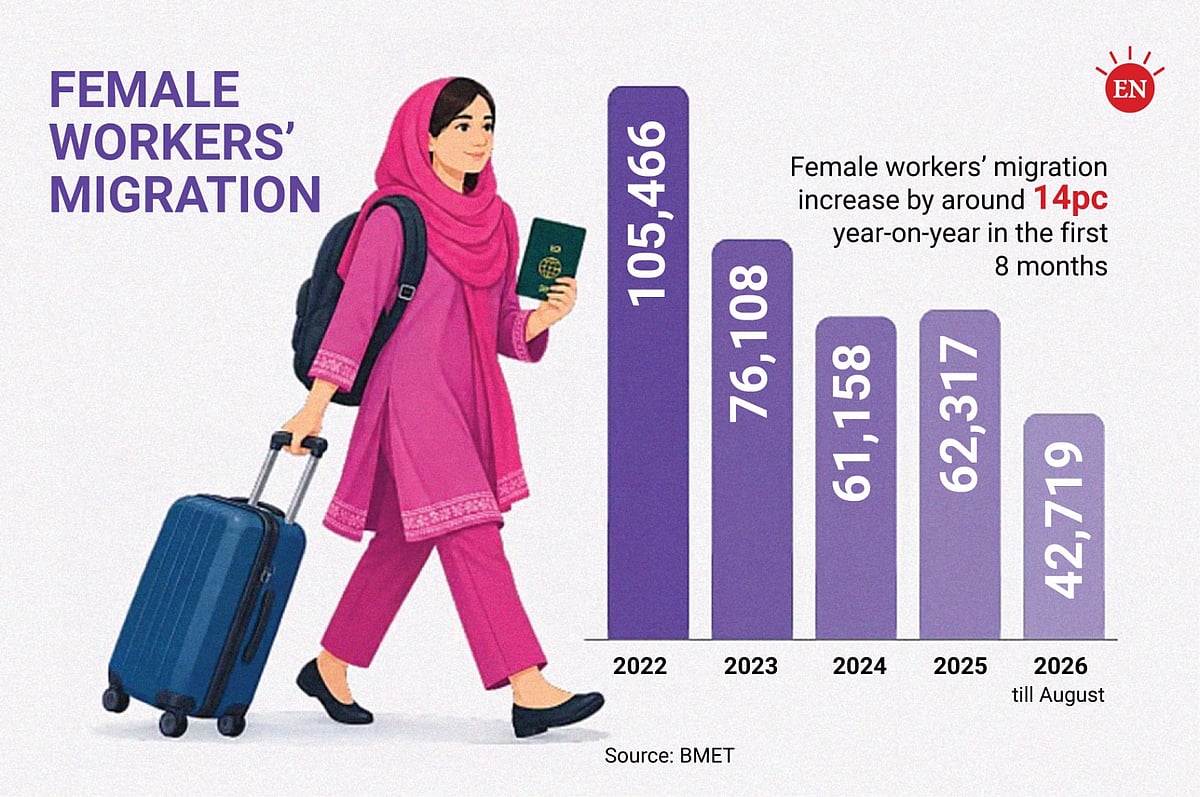
More than 42,000 women from Bangladesh went abroad for work in 48 countries during the first eight months of this year. More than 90 per cent of them went to just two countries—Saudi Arabia and Jordan. With no new sectors or destinations being developed beyond domestic work, overseas employment for Bangladeshi women remains largely dependent on the Middle East.
According to data from the Bureau of Manpower, Employment and Training (BMET), 105,466 female workers went abroad in 2022. The number fell to 62,317 in 2025, a decline of nearly 41 per cent in three years. However, during the first eight months of this year, the number of women going abroad increased by 5,214, or around 14 per cent, compared with the same period last year.
Many female workers returning from abroad have reported physical and psychological abuse, sexual harassment, being made to work in multiple households, long working hours, and not receiving proper wages or adequate food.
People involved in migration say such allegations are discouraging women from going abroad. At the same time, new overseas labour markets for women beyond domestic work have not been developed through skills training.
They say many female workers leave without knowing the language or having adequate training in cooking or household work. Employers, or kafils, sometimes make them work in multiple households and subject them to abuse. Saudi Arabia is also turning towards alternative labour markets and recruiting workers from African countries. However, there is little point in sending female workers abroad without ensuring their safety.
Anjana, from Manikganj, returned to Bangladesh from Saudi Arabia on 20 March. She had spent only one month and three days there, working for just five days. She said she spent the rest of the time at the recruiting agency’s office in Saudi Arabia, where she was beaten and abused. She eventually returned home after her family sent her money to buy a plane ticket.
Anjana has worked at different times in Lebanon, Jordan, the United Arab Emirates and Saudi Arabia since 2012. She said she had never experienced anything like this before. According to her, recruiting agencies receive money for every female worker they send to Saudi Arabia, so their profit comes from sending workers by any means possible. Some workers are sent even without proper employment arrangements, she said.
State Minister for Expatriates’ Welfare and Overseas Employment Md Nurul Haque told Prothom Alo that legal assistance had been introduced in 13 countries to reduce women’s fears about working in the Middle East, while a safe house was operating in Saudi Arabia. These measures have reduced abuse, he said.
The government is also focusing on skilled labour markets such as Japan and Hong Kong alongside the Middle East, the state minister said. Caregiving and housekeeping training is being provided at technical training centres, he added.
Ensuring women's safety is essential
Sumaiya Islam, executive director of Bangladesh Nari Sramik Kendra, told Prothom Alo that women are sometimes taken abroad with promises of one type of job but are made to perform multiple jobs. There are also allegations of sexual abuse, she said. Women should not go abroad unless their safety can be ensured, she added.
Sanjida Akter, from Narsingdi, returned from Saudi Arabia a year ago. During the two months and 25 days she spent there, her employer made her work not only at the employer’s home but also at the homes of the employer’s mother and in-laws.
She told Prothom Alo that she was given only bread to eat and that it was impossible to live without rice. When she fell ill, she was sent back to the recruiting agency’s office in Saudi Arabia, where she was subjected to various forms of abuse. Unable to endure the situation, she paid for her own ticket and returned home empty-handed. She does not want to go abroad again.
For five consecutive years from 2015 to 2019, more than 100,000 female workers went abroad from Bangladesh every year. The number fell in 2020 because of the Covid-19 pandemic. Although it increased in the following two years, it declined again in 2023.
Organisations such as BRAC, Refugee and Migratory Movements Research Unit (RMMRU), Ovibashi Karmi Unnayan Program (OKUP) and Bangladesh Nari Sramik Kendra provide various services to returning female workers. Officials from these organisations said many women return with various health problems. They reported cases of women being taken abroad on false promises, made to work 14 to 16 hours a day, paid low or irregular wages, and denied regular meals.
There have also been allegations of physical and psychological abuse. There have been cases of suicide at different times, while some women have fled and later been detained by police before being sent back to Bangladesh.
Abuse driving women away
OKUP works with returning female workers in Char Bhadrasan of Faridpur. The organisation says few opportunities have been created for women in sectors other than domestic work.
There is now greater awareness of the fact that women regularly return after facing abuse abroad. As a result, women are becoming less willing to go abroad on the basis of false promises, the organisation said.
Almost every household in Char Bhadrasan has had a female member migrate abroad for work. Now, however, they no longer want to go. Instead, male workers from the area are migrating abroad.
A study conducted by OKUP last year found that 94 per cent of female workers who returned involuntarily had experienced regular physical and psychological abuse abroad. Forty-seven per cent had faced sexual harassment, while 82 per cent had been required to work from early morning until midnight.
Based on its experience with workers in 42 countries, BRAC says countries such as Nepal, Indonesia, the Philippines and Vietnam have made significantly more progress in protecting their citizens. They have even suspended the deployment of workers when necessary. Bangladesh, however, has yet to reach that stage.
OKUP Chairperson Shakilur Islam told Prothom Alo that female workers were returning after suffering abuse and exploitation and were not receiving justice despite being victimised. Others had become aware of the risks, he said. Together, these factors had made women reluctant to migrate, while Bangladesh had failed to develop better labour markets or diversify employment opportunities for women.