Dhaka-Beijing relations won't be affected by any other country: Chinese ambassador
In the wake of the United States' suggestions that Bangladesh should move away from a “China-oriented” approach, Chinese Ambassador Yao Wen has said that the relationship between Dhaka and Beijing will not be affected because of any other country.
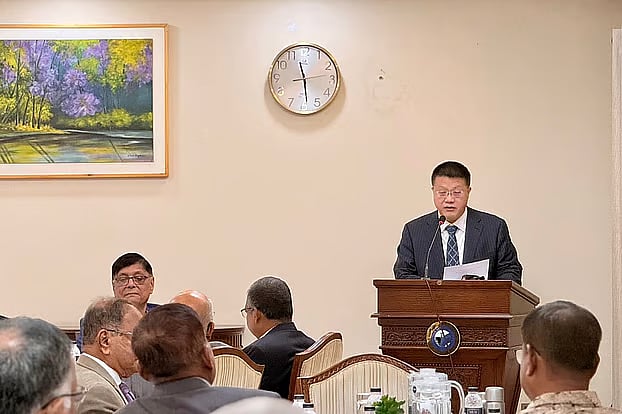
He made these remarks today, Wednesday, during an exchange of views with Bangladesh’s retired ambassadors at the Foreign Service Academy in the capital.
According to him, the relationship between Bangladesh and China exists for the welfare of the peoples of both countries.
Bangladesh conducts its foreign policy completely independently, not under the guidance of any foreign nation, he said adding, therefore, this relationship will not be undermined through any third country.
The Association of Former Ambassadors (AOFA), as part of its regular activities, organised this exchange with the Chinese ambassador.
After delivering his speech, the ambassador participated in a question-and-answer session. He was asked about the Dhaka–China relationship in response to remarks made by the potential US ambassador to Bangladesh regarding the same issue.
Last week, Brent Christensen, the US nominee for ambassador to Bangladesh, appeared before the US Senate Foreign Relations Committee.
During the hearing, Washington expressed concern about the Bangladesh–China relationship. In the question-and-answer session, Christensen said that if he were ultimately confirmed for the post in Dhaka, he would raise with Bangladesh the issue of China’s growing presence in the country.
When asked about the hearing during today’s event, Chinese Ambassador Yao Wen said, “We appreciate Bangladesh’s independent and self-reliant foreign policy. This has been followed by successive governments of Bangladesh. The country’s foreign policy has been conducted without the direction of any foreign power. China’s position is to support Bangladesh in following its own independent and sovereign path. You do not need to act under the instruction of any foreign force. We fully support Bangladesh’s stance in this regard.”
Highlighting the depth of bilateral relations, he said, “In my view, China–Bangladesh relations are for the welfare of the people. We are impressed by Bangladesh’s government, political parties, and the people on the streets. We have full trust in the people of Bangladesh. Look at Bangladesh’s political parties—Professor Muhammad Yunus visited China last March. Apart from that significant visit, leaders from the BNP, Jamaat-e-Islami, and the National Citizen Party (NCP) have also made important trips to China. In addition to these, leaders of several other political parties have also visited China. They all seek greater cooperation between our two countries. That is the strength of China–Bangladesh relations—this partnership is based on the interests of the peoples of both nations.”
Yao Wen further noted that although China and the United States are global competitors, Bangladesh–China relations are rooted in regional peace and development, and are not directed against any third party.
He said, “Therefore, our cooperation will not be driven by anyone else. Even after the elections, this cooperation will continue to advance for the welfare of the Bangladeshi people. It will become even more sustainable. This relationship will not be harmed by any foreign power.”
The event was conducted by AOFA President Abdullah Al Ahsan, with additional speeches by Shahed Akhtar and Golam Mohammad. GAUSUL Azam Sarkar, the organisation’s secretary-general, gave the vote of thanks.
The Rohingya crisis is beyond China’s capacity to resolve
During the exchange of views, the Chinese ambassador was asked about resolving the Rohingya crisis. Bangladesh has long sought a solution to this protracted issue. Analysts have often said that China can play a crucial role in persuading Myanmar to take back more than 1.3 million Rohingya refugees.
Yao Wen said that China has played an important role in seeking a solution to the Rohingya crisis. Both Bangladesh and Myanmar have requested China’s involvement, and China has made efforts to facilitate the repatriation of the Rohingyas.
However, he noted, “It is not possible for China alone to resolve this issue—it is beyond China’s capacity. This is an extremely complex crisis involving many stakeholders. When we tried to advance the repatriation process in 2023, various obstacles affected our efforts. Some countries and organisations do not want the repatriation to take place.”
Emphasising the need for all stakeholders to play their part, he added that China will continue to fulfill its role in the process.
'Work underway on Teesta project'
During the discussion, Chinese Ambassador Yao Wen was asked whether there had been any progress on the Teesta River Basin project, for which Bangladesh had sought Chinese funding during the Awami League government.
Yao Wen said that China understands the importance of this project for Bangladesh and for the people living in the country’s northern region. In January 2023, China had proposed to the former government an integrated river management plan for the Teesta project. The plan was divided into two parts:
Construction of embankments to control flooding, and Development of a satellite township featuring economic activities.
The ambassador said that for about two and a half years—until September this year—China had not received any response from the Bangladeshi side regarding the project. However, in September, the interim government responded with a proposal related to the Teesta project, and Chinese experts have since started working on it.
Yao Wen mentioned that the project could cost around 1 billion USD and would take seven to eight years to complete once construction begins.
When asked about China’s economic zone in Bangladesh, the ambassador said they were “working hard” on the project in Chattogram. He expressed hope that all necessary documentation before the start of infrastructure development would be finalized by November, Yao Wen added.
Bangladesh–China–Pakistan Relations
Chinese Ambassador Yao Wen said that China wants to play a role in building a strong and prosperous Bangladesh.
He added that since SAARC has become ineffective, a trilateral partnership among Bangladesh, China, and Pakistan could play a new and constructive role in advancing regional development.
When asked about the Global Governance Initiative (GGI) announced by Chinese President Xi Jinping, the ambassador explained that the initiative was introduced at the Shanghai Cooperation Organization (SCO) Summit in September this year, taking into account the current international situation.
He said, “It is well known that a certain country, through its policies, has created instability in the world and shown disregard for international law. As a result, countries of the Global South and other developing nations are turning to China, calling on it to help safeguard international law and promote unity in the world.”