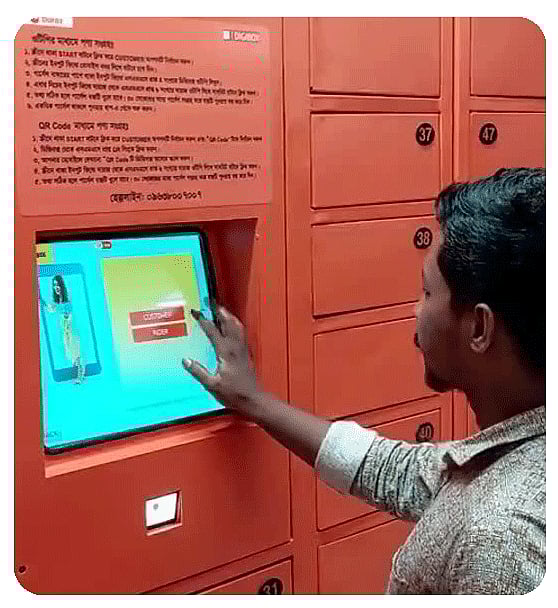
During the Covid-19 pandemic, customers faced various difficulties in getting products through online and e-commerce platforms. It was then that entrepreneur Rezwanul Haque Jami began thinking about reducing the traditional methods and costs of product delivery in the country. Using Internet of Things (IoT) technology, he built a digital locker out of wood in his home garage in 2022. He succeeded with it, which boosted his confidence.
Around that time, he unexpectedly met his old colleague Morshedul Alam after 10 years at a tea stall in Gulshan. While chatting, Jami shared his plan about doing something in the logistics sector. He also told him about the success of the digital locker. The two friends agreed on this startup idea. That very day, their new startup "DigiBox" was essentially born.
The initial investment in this venture was Tk 3 million, which they raised themselves. They started the business with five digital locker stations. So far, the company has made a profit of Tk 25 million. However, instead of distributing the profit, they reinvested everything in office operations and building new digital locker stations.
Where it all began
In 2012, Morshedul Alam founded an international voice gateway company Mos5Tel. At that time, Rezwanul Haque was working at another company, Tusuka Technotrade. That is when they met. Eventually, Rezwanul Haque became a partner in Mos5Tel. Alongside that, they also established separate businesses. Morshedul set up two logistics companies named TAS Logistics and SAMSA at the airport and Chattogram Port container terminal. Rezwanul founded BDtickets.com and OLX.com.bd.
In 2023, they took a 4,000-square-foot office in Bachila Garden City in Mohammadpur, Dhaka, for DigiBox. Next to it was the factory where the digital lockers were produced. At that time, they used to make two lockers per month on average. Now, DigiBox operates with a total team of 31 people.
Currently, there are digital locker stations in 55 locations across the country, with around 5,500 locker boxes. Of these, 36 stations are in Dhaka. The other stations are in Rangpur, Rajshahi, Bogura, Sylhet, and Chattogram districts. So far, the company has served more than 700,000 customers. All metro stations in the capital now have DigiBox locker facilities. Each point can serve an average of about 300 customers per day.
DigiBox CEO Rezwanul Haque told Prothom Alo, “In the future, we plan to offer digital locker services in Nepal, Sri Lanka, and Africa. Next month we plan to launch a box-to-box service. In December, ‘Digi Plaza’ will be launched in Mohammadpur, Dhaka, where products can be collected 24 hours through camera-vision technology.”
How DigiBox provides its service
The orange-colored digital lockers are now commonly seen at all metro stations and various locations in Dhaka. Customers get 72 hours to collect products stored in these lockers. The delivery cost ranges from Tk 22 to Tk 45. However, the order must be placed through the e-commerce platform Daraz Bangladesh. At the time of ordering, customers must select the DigiBox delivery option. The deliveryman from the e-commerce platform will then place the product in the DigiBox selected by the customer. The customer will receive an SMS.
The DigiBox has a screen similar to an ATM booth. There are two options: “Rider” and “Customer.” When the deliveryman places the product, he uses the rider option. For customers, there is the customer option. After entering an email or phone number, an OTP code will be sent to that email or phone. After entering the code, the box containing the customer’s product will open, and the customer can collect the item.
Any e-commerce or online platform can register with DigiBox for product delivery. No upfront payment is required. Besides Daraz, BRAC Bank, Shahjalal Islami Bank, Thousand Fix, and Australian International School are currently using this digital locker service.
DigiBox Chairman Morshedul Alam said, “Bangladesh’s e-commerce and online market is about USD 750 million. The delivery market alone is worth USD 75 million. About 500,000 deliveries take place daily in this sector. Our goal is to handle 50,000 deliveries per day by 2028.”