Tax-free income threshold raised to Tk 375,000; year-round tax return filing introduced
The tax-free income threshold for individual taxpayers has been increased to Tk 375,000, up from the current Tk 350,000.
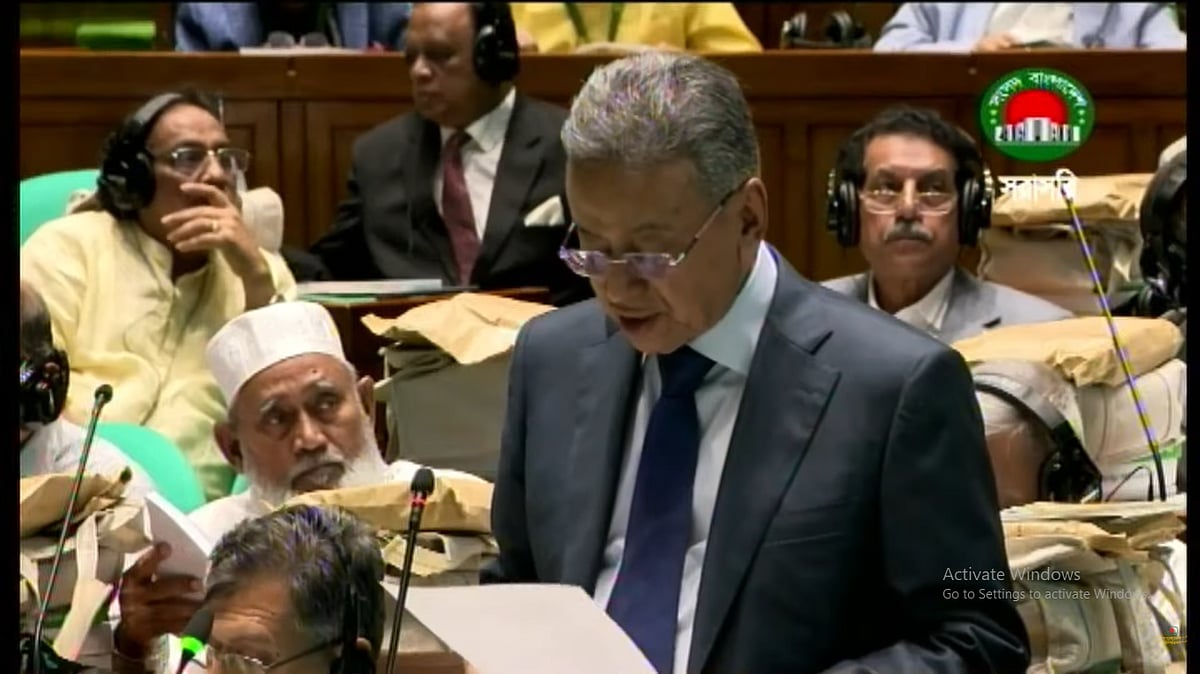
Finance Minister Amir Khasru Mahmud Chowdhury announced the measure while presenting the national budget in Parliament on Thursday.
The revised threshold will remain in force not only for the upcoming fiscal year but also for the 2027–28 financial year.
The increase follows a similar measure proposed in last year’s budget by the then finance adviser of the interim government, Salehuddin Ahmed. The incumbent Bangladesh Nationalist Party (BNP) government has opted to retain and extend the policy.
Analysts believe the move will provide some relief to lower- and middle-income households grappling with rising living costs.
As in previous years, certain categories of taxpayers will continue to enjoy higher tax-free thresholds. The limit has been set at Tk 425,000 for women taxpayers and taxpayers aged over 65; Tk 500,000 for third-gender taxpayers and persons with disabilities; and Tk 525,000 for gazetted freedom fighters and gazetted July Warriors injured during the July 2024 mass uprising.
In addition, parents or legal guardians of persons with disabilities will be entitled to an extra Tk 50,000 in tax-free income for each dependent child or ward.
Bangladesh currently has around 12.8 million Taxpayer Identification Number (TIN) holders, of whom approximately 4 to 4.2 million submit income tax returns annually. Tax liabilities are calculated after applying the applicable tax-free income threshold.
5pc tax slab abolished
The government has also restructured the personal income tax regime. The existing 5 per cent tax rate applicable to the first Tk 100,000 above the tax-free threshold has been abolished.
Under the proposed framework, taxpayers earning more than Tk 375,000 annually will be taxed as follows: 10 per cent on the first Tk 300,000 above the tax-free threshold; 15 per cent on the next Tk 400,000; 20 per cent on the following Tk 500,000; 25 per cent on the next Tk 2 million; and, 30 per cent on all remaining income.
The revised structure may result in a somewhat higher tax burden for certain taxpayers.
Tax returns can be filed throughout the year
From the next fiscal year, taxpayers will be allowed to submit income tax returns throughout the year, replacing the existing system concentrated around a fixed filing season. The earlier a return is submitted, the greater the tax benefit.
Under the budget proposal: taxpayers filing during the first quarter (July–September) will receive a rebate equal to 5 per cent of the tax payable or Tk 25,000, whichever is lower.
Those filing during the second quarter (October–December) will pay the standard tax due, with no incentive or penalty.
Taxpayers filing during the third quarter (January–March) will be required to pay an additional amount equal to 2 per cent of the tax payable or Tk 3,000, whichever is higher.
Those filing during the final quarter (April–June) will pay an additional amount equal to 5 per cent of the tax payable or Tk 5,000, whichever is higher.
Real income erodes
The last increase in the tax-free income threshold came in the 2023 budget, when it was raised from Tk 300,000 to Tk 350,000. Since then, however, the threshold has remained unchanged despite persistent inflationary pressures.
Over the past three years, inflation has averaged around 10 per cent annually, pushing many taxpayers who were previously close to the tax-free threshold into the tax net while simultaneously increasing their cost of living.
According to the Bangladesh Bureau of Statistics (BBS), inflation stood at 9.42 per cent in May, the highest level recorded in the past 16 months.