77pc voters see roads, culverts and employment as development: CPD survey
Nearly three-quarters of the country’s voters, or 77 per cent, believe that development is ensured if roads and culverts are built and employment is created. In other words, voters’ perception of development remains centred on infrastructure construction. This view also influences their voting decisions in national elections.
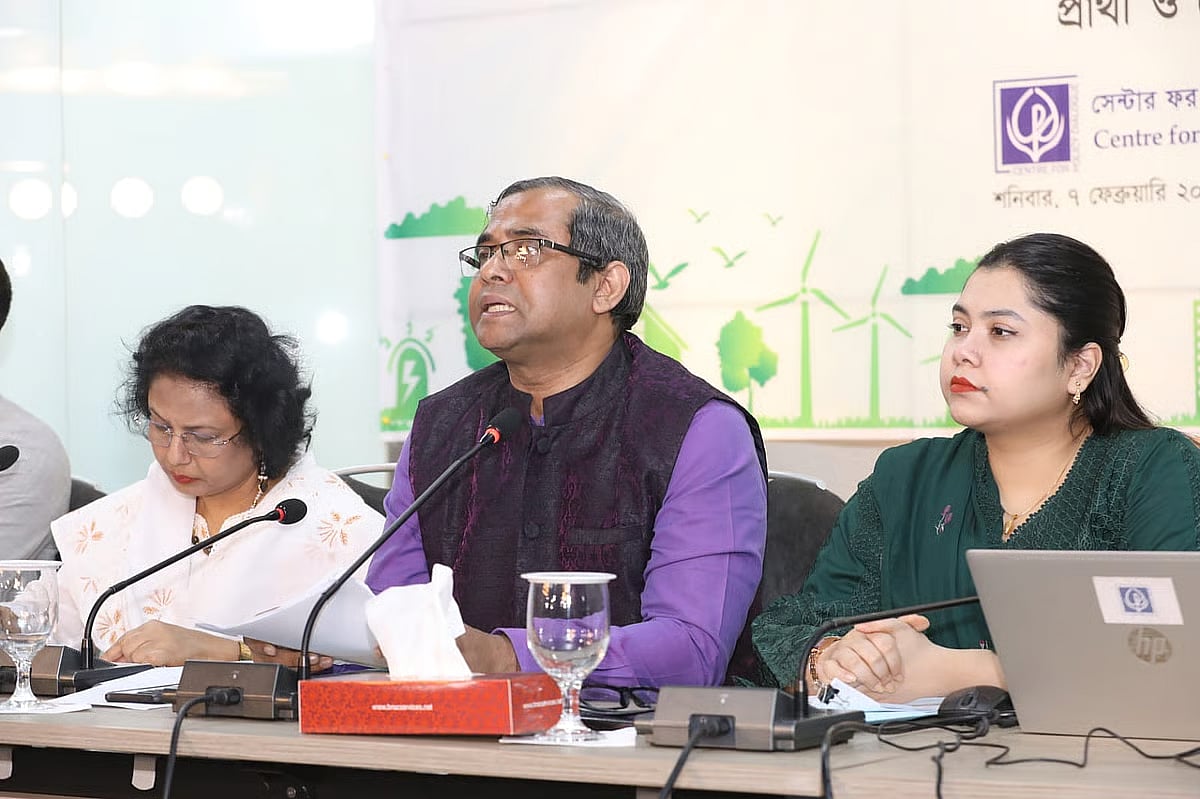
The findings appeared in a recent survey conducted by the think-tank Centre for Policy Dialogue (CPD). The results were presented today, Saturday, at a media briefing titled “Scenario and expectations of a green sustainable economy in constituencies: findings from candidate and voter surveys”, held at the BRAC Centre Inn in the capital’s Mohakhali area.
At the media briefing, the survey findings were presented by CPD research director Khandaker Golam Moazzem. CPD senior research associate Helen Mashiat was present, along with programme associates Sami Mohammad, Maliha Sabah and Noor Yana Jannat.
The CPD survey shows that most voters still view development primarily through roads, bridges, culverts and other visible infrastructure projects. As these projects are directly or indirectly linked to employment generation, voters consider them to be important indicators of development.
The study found that nearly 86 per cent of the voters in urban areas closely associate development with the construction of bridges and roads. This perception is particularly strong in the Chittagong Hill Tracts, coastal areas, climate-vulnerable regions and other marginalised areas.
Alongside voters, representatives of political parties were also found to hold broadly similar views on development. In some cases, party representatives demonstrated a relatively broader understanding of development, but voters’ perceptions remain largely infrastructure-centric.
CPD senior research associate Helen Mashiat said 95 per cent of voters in Bangladesh hold an optimistic view that it is possible to build a green society.
Helen Mashiat said this one-sided tendency in the understanding of development could, in the long run, sideline important issues such as sustainable development, environmental protection and climate adaptation. In her view, alongside employment and infrastructure, greater emphasis needs to be placed on education, health, the environment and quality of life in development discussions.
Opinions were collected from 450 election candidates, their nominated representatives and 1,200 voters from various climate-vulnerable areas across 150 constituencies for the survey. The study analysed the views, expectations and concrete plans of voters and candidates across three pillars: environment, green economy and social development.
Preference for simple solutions to protect the environment
The survey found that nearly 61 per cent of voters emphasised tree plantation and reducing plastic use as ways to protect the environment. Political candidates also suggested almost the same set of solutions. According to the researchers, this reflects a behavioural tendency among voters: they tend to view actions that are personally easy to undertake as the primary solutions to environmental protection.
The survey also showed that 47 per cent of voters are aware of renewable energy, while the figure stands at around 42 per cent among candidates. However, the research noted that there remains a lack of understanding of renewable energy as a central component of environmental protection and sustainable development.
The research shows that both voters and candidates give the least importance to social issues compared to environmental and economic concerns. For many voters, the pressure of poverty, income insecurity and employment is so overwhelming that social issues are pushed to the background.
On social development, voters’ priorities remain limited to two basic areas: health and education. According to the CPD, this reflects the reality that a large section of the population is still struggling to meet its most basic needs.