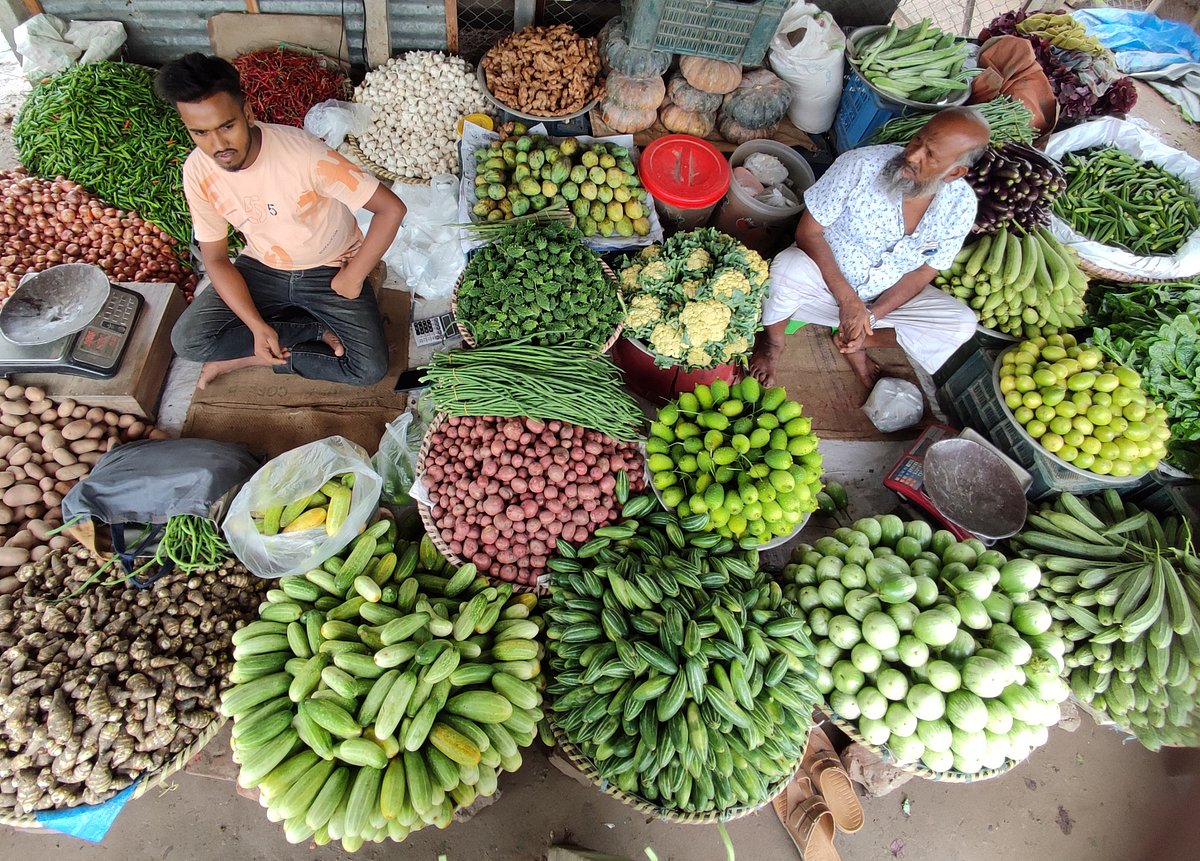
Market prices: Vegetables cost 26pc higher
Pointed gourd (potol) is one of the cheapest vegetables in the market now. A curry of hilsa with the pointed gourd is popular in the monsoon. But this year, buying hilsa is hardly possible as its price has skyrocketed. The price of pointed gourd is not low either.
According to the government agency Department of Agricultural Marketing (DAM), a kilogram of pointed gourd now costs between Tk 60 and Tk 80, which is 75 per cent higher than the same period last year.
It is not only pointed gourd, most vegetables are pricier this year. An analysis of DAM’s daily price lists for Dhaka Division shows that on 21 August this year, the average price of 16 vegetables was 26 per cent higher than on 21 August last year.
Every year, vegetable fields are damaged by rains and floods in July and August, pushing up prices. Commerce Secretary Mahbubur Rahman also acknowledged this.
On Thursday, he told Prothom Alo, “Every year, at this time towards the end of the monsoon, vegetable prices remain somewhat higher. Before the Robi (winter) crops arrive, we have to accept this. Still, we are making every effort to keep the market stable.”
However, DAM’s statistics indicate that this year’s price hike is sharper than the normal seasonal increase. On the other hand, the Bangladesh Meteorological Department (BMD) says rainfall in August this year has been below normal.
Alongside vegetables, prices of fish and meat have also increased on average. According to DAM, the prices of five types of fish have risen by an average of 18 per cent, while in the meat and eggs category, the average increase is 7 per cent.
Vegetables, fish, and meat are staples for households. Their price hikes put additional strain on family budgets. Currently, rice, lentils, and oil are already expensive. Added to that, rising vegetables and fish prices are worsening household pressures.
The wholesale price of vegetables at Karwan Bazar at night differs greatly from their retail price. In some cases, the markup is 30 per cent, in some 50 per cent, and in some even 100 per cent or more.
On Thursday, Prothom Alo talked to Shahadat Hossain, a resident of Shewrapara, in a local alley where vegetables are sold on cycle vans.
He was buying three medium-sized eggplants for Tk 60. He said he had not bought a single hilsa in the first 19 days of August because prices were exorbitant and the season was nearly over. Finally, on Thursday, he bought a half-kilo hilsa for Tk 800.
“A half-kg hilsa could be bought for about Tk 400 earlier. Now the price has doubled. The price of eggplant has also doubled to Tk 120 a Kg. Limited-income people can buy neither fish, meat, and eggs, nor vegetables. Then what will they eat?” Shahadat Hossain asked.
How much for which vegetable?
DAM’s Dhaka Division price list shows that this year, the minimum price of 14 out of 16 vegetables is Tk 50 or more. These are: eggplant, ridge gourd (chichinga), taro root (kachu), yardlong beans (borboti), bottle gourd (each), pointed gourd, okra, cucumber, bitter gourd, taro stalks (kachur loti), ash gourd (each), teasel gourd (kakrol), sponge gourd (jhinge), and snake gourd (dhundul). Last year, the minimum price of seven vegetables was Tk 50 or more.
After a trader brings vegetables, they are sold right on the truck to another buyer. Then another person buys again. With each handover, the price rises. After last year’s political change, these practices disappeared for some time.One middleman, requesting anonymity
This year, only two vegetables are available for under Tk 50 a Kg, pumpkin (Tk 40–50) and green papaya (Tk 20–30). Last year, nine types of vegetables had minimum prices between Tk 25 and Tk 45.
Outside of these, potato prices are significantly lower this year, Tk 20–25 per Kg compared to Tk 55–60 last year. However, farmers are reportedly incurring losses due to this price fall.
What are the reasons?
At night, middlemen bring vegetables to Dhaka’s Karwan Bazar. Talking to eight middlemen and commission agents there on Thursday night and Friday afternoon revealed several reasons for the price hike.
First, they said vegetable fields were damaged by rains, reducing supply and pushing up prices.
Ripon Ali, a middleman who brought yardlong beans from Bogura, told Prothom Alo at midnight Thursday, “The fields were ruined by rain. Water collected at the roots, causing rot. That’s why supply is short now, and prices are a little higher.”
To find out rainfall data for August, Prothom Alo contacted the BMD. Officials said that in August last year, rainfall was 46 per cent higher than normal. This year, though the month is not yet over, rainfall up to 21 August was 13 per cent below normal.
We know prices are rising. But to understand why, and what measures can be taken, extensive research is needed. So far, only temporary measures have been taken. To curb inflation and grasp the situation, a permanent strategy must be in place.Mostafa Abid Khan, Former Tariff Commission member
Md. Shahinul Islam, meteorologist at the Bangladesh Meteorological Department, said, “As it seems, normal rainfall has not yet occurred this month.”
Second, some traders pointed to the political upheaval last August, when the Awami League government fell through a student–public uprising. At that time, extortion, transport hurdles, and market “syndicates” disappeared for a while, bringing down vegetable prices. Now, the old situation has returned.
Third, the poor state of several highways was mentioned. Bad roads are delaying transport, pushing up truck rental costs somewhat.
One middleman, requesting anonymity, said, “After a trader brings vegetables, they are sold right on the truck to another buyer. Then another person buys again. With each handover, the price rises. After last year’s political change, these practices disappeared for some time.”
In a report sent to the Commerce Ministry on 29 June, the Bangladesh Trade and Tariff Commission (BTTC) stated that middlemen’s dominance, lack of proper information, extortion, and increased transport costs significantly affect retail vegetable prices.
Tk 80 at night, Tk 160 in the morning
The wholesale price of vegetables at Karwan Bazar at night differs greatly from their retail price. In some cases, the markup is 30 per cent, in some 50 per cent, and in some even 100 per cent or more.
For instance, on Thursday night, high-quality round white eggplants were sold wholesale for about Tk 80 a Kg. The same eggplants were being sold at a mobile stall right beside the Karwan Bazar wholesalers’ shops for Tk 160 a Kg on Friday afternoon.
At Joar Sahara market, about 10 km from Karwan Bazar, the same white eggplants were selling for Tk 180 a Kg.
Fish and meat prices have also risen
According to DAM, the average price of rui, catla, hilsa, pangas, and tilapia has increased by about 18 per cent.
The price of beef has not risen; it was already high though. Mutton prices have gone up slightly. The prices of local, sonali, and broiler chickens have also risen. Egg prices, although they had increased recently, are slightly lower compared to 21 August last year. Altogether, the average rise in the meat and egg category is 7 per cent.
On Friday, Prothom Alo published a report titled “Prices of commodities fall in world market, impact little in Bangladesh”. It said global prices of most commodities had fallen below pre-Russia–Ukraine war levels. Bangladesh, however, has gained little from this. Now it appears that the prices of domestically produced vegetables, fish, and meat have also risen considerably.
Speaking about this, former Tariff Commission member Mostafa Abid Khan told Prothom Alo, “We know prices are rising. But to understand why, and what measures can be taken, extensive research is needed. So far, only temporary measures have been taken. To curb inflation and grasp the situation, a permanent strategy must be in place.”
“The price hikes in vegetables, fish, and meat have a direct negative impact on the lives of low- and middle-income people. The wealthy may not feel any difficulty,” he added.