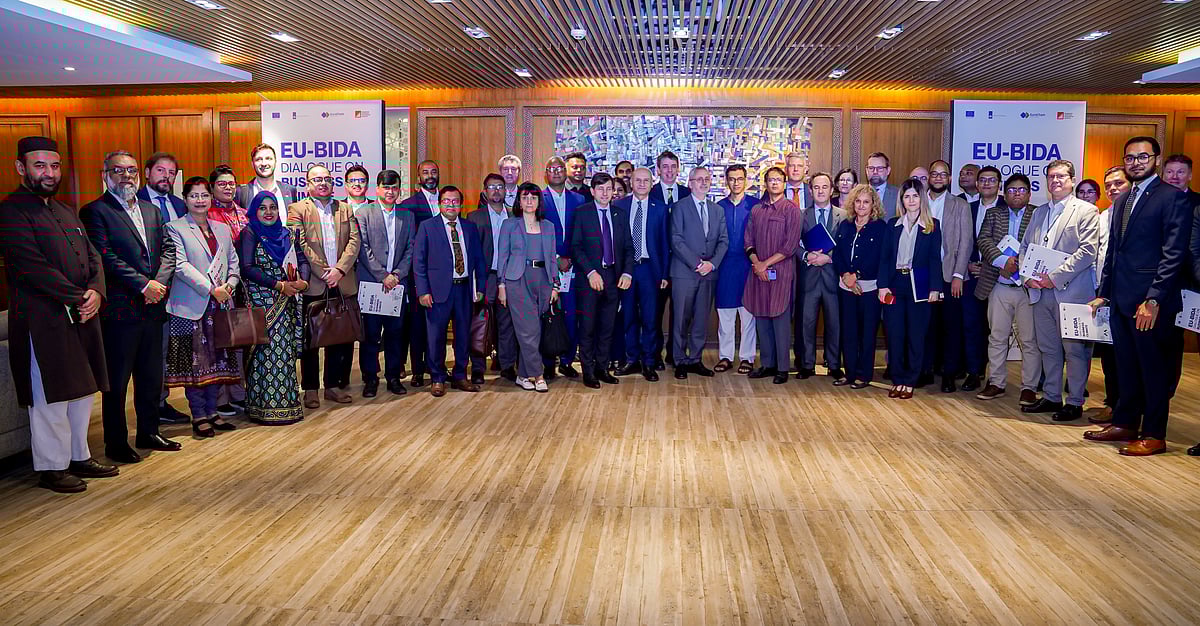
EU-BIDA dialogue on business climate highlights key reforms to boost investment
The European Union and the Bangladesh Investment Development Authority (BIDA) convened a high‑level EU–BIDA Dialogue on Business Climate at the BIDA Conference Room on Monday, with support from the Embassy of the Netherlands and facilitated by EuroCham Bangladesh.
The event brought together ambassadors from EU member states, senior government officials including the National Board of Revenue, Ministry of Commerce, Bangladesh Bank, Ministry of Shipping, Chittagong and Mongla Port Authorities, Sustainable and Renewable Energy Development Authority (SREDA), Power Division, Ministry of Industries, BSTI, Bangladesh Food Safety Authority, and the Ministry of Agriculture, and leading European private‑sector stakeholders across manufacturing, energy, logistics, infrastructure, innovation, and services industries.
Opening the dialogue, the EU ambassador Michael Miller emphasised that the European Union and Bangladesh are working towards an investment partnership designed to be mutually beneficial, noting that success will depend on teamwork, a level playing field, and impartial implementation.
Looking ahead, he announced plans to jointly organise with BIDA, the Ministry of Commerce, and EuroCham Bangladesh, the Bangladesh-EU Business Forum in 2026, positioning the current dialogue as the first step towards that landmark event.
The session on EU private-sector perspectives, moderated by Nuria Lopez, chairperson of EuroCham Bangladesh, underscored the shared commitment of European businesses and diplomatic missions to deepen FDI (foreign direct investment) flows and address Bangladesh’s trade deficit with the EU and the growing need to address it as the country moves beyond LDC status.
Speakers highlighted the need for stronger reforms across customs, logistics, standards, enforcement of compliance and regulations, and import procedures by presenting concrete case studies.
Collectively, the private sector stressed that greater regulatory predictability, transparency, and digitalisation are essential to attract quality European investment and support Bangladesh’s goal of becoming a competitive manufacturing hub.
Envoys from across Europe highlighted complementary priorities for strengthening Bangladesh’s investment climate.
Netherlands ambassador Joris van Bommel underscored the need for predictability, transparency and consistent regulation, supported by a modern image that reflects the countries true potential to unlock opportunities in water, agriculture, and logistics.
Drawing lessons from G2G Public-Private Partnership (PPP) projects, Danish ambassador Christian Brix Moller stressed governance safeguards, faster resolution of regulatory delays, and timely approvals.
Addressing the session, Italian ambassador Antonio Alessandro pointed to new sectors such as ceramics, leather, and design, emphasising innovation, technology transfer and the role of SMEs.
Spanish ambassador Gabriel Sistiaga Ochoa de Chinchetru emphasised that EU is a key and reliable partner of Bangladesh and called for stability, rule of law, and fair competition to deepen EU–Bangladesh ties.
Swedish ambassador Nicolas Weeks highlighted Sweden’s strong garment sector links and commitment to sustainable fashion, urging clearer regulations and transparency.
French ambassador Jean‑Marc Séré‑Charlet, insisted on the benefits of long‑term partnerships with Europe, highlighted untapped EU-Bangladesh trade and FDI potentials, urging stronger action on good governance and profit repatriation .
Commending ongoing reforms, German acting ambassador Anja Kersten stressed consistent implementation, vocational training for skilled youth, updated agreement for the avoidance of double taxation, and building a positive image of Bangladesh.
Nahian Rahman, head of business development at BIDA, outlined ongoing reforms shaped by investor feedback, including improved inter-agency coordination, transparent progress tracking, and consultations with political parties to ensure policy continuity.
Rear Admiral SM Moniruzzaman, chairman of the Chittagong Port Authority, highlighted modernisation efforts such as digitalisation, the Bay Terminal, and the Laldia project to enable larger vessels and round-the-clock operations.
BIDA executive chairman Ashik Chowdhury emphasised structural reforms, prioritised investor grievance resolution, and annual “result cards” to sustain momentum, stressing Bangladesh’s ambition to attract more European companies to establish local and regional operations.
Lutfey Siddiqi, special envoy on international affairs to the chief adviser, called for a clear reform roadmap and early engagement with the EU ahead of LDC graduation.
The session concluded with a shared commitment to collaborate in strengthening Bangladesh’s investment climate.