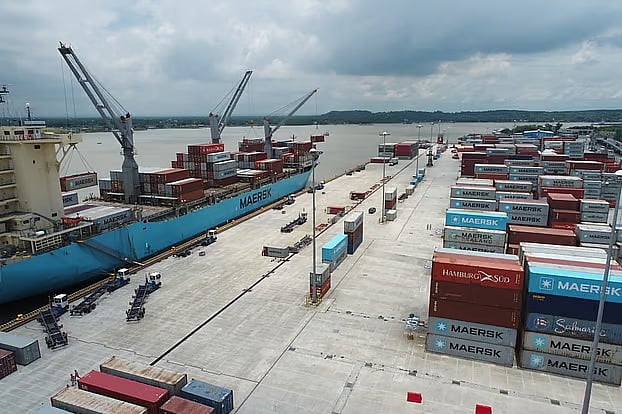
Chittagong Port: Capacity of Red Sea terminal increasing
A new container yard has been added to the fleet of the Red Sea Gateway Terminal (RSGT Chittagong), formerly known as the Patenga Container Terminal, at Chattogram Port.
Following approval from the National Board of Revenue (NBR), operations have already begun at this newly developed area, named the South Container Yard.
Additionally, a new shed has been introduced for unloading containers and delivering goods. Advanced container handling equipment is also being gradually installed. These developments are increasing the terminal’s overall capacity.
According to the Saudi company responsible for managing the terminal, the expansion in capacity has also widened the scope of services offered.
In June of last year, the terminal was handed over to RSGT—a Saudi port operating company—under a public-private partnership (PPP). This marks the first time a terminal in Bangladesh has been leased for long-term operation under such a partnership. However, due to several initial challenges, the company was unable to fully utilize the terminal's capacity at the start, which also resulted in a lower container handling rate. With the introduction of new facilities, the volume of goods being loaded and unloaded at the terminal is now steadily increasing.
According to port officials, after taking over the management of the terminal, the Saudi-based company was initially only handling the loading of export containers onto ships. However, after installing a scanner machine, the unloading of import containers from ships began in May of this year. Previously, due to the lack of adequate space for storing containers at the terminal, it was not possible to accommodate a large number of vessels. This was because, under the agreement, the company did not receive access to the South Container Yard on time.
After a lengthy process, the company was finally granted access to the South Container Yard last month. The yard has the capacity to store 5,000 twenty-foot equivalent units (TEUs) of containers at once. Since its opening, the rate of container handling at the terminal has increased. Last Wednesday, two container ships were docked at the terminal’s two jetties, and loading and unloading operations were actively underway.
According to data from RSGT, in August this year, a total of 24,607 TEUs were handled at the terminal. In comparison, during the same period last year, only 6,681 TEUs were handled. This marks an increase of nearly 268 per cent in container handling compared to the previous year.
RSGT has stated that the terminal’s capacity for handling LCL (Less-than-Container Load) containers—those containing goods from multiple importers—has also been expanded. A new shed has been added to manage up to 250 LCL containers simultaneously. With this addition, the terminal can now handle a total of 350 LCL containers at the same time.
At present, containers at the RSGT Chittagong terminal are being loaded and unloaded using the traditional method, i.e., with shipboard cranes. Although an order has been placed for four state-of-the-art ship-to-shore gantry cranes, it typically takes at least 18 months for delivery. RSGT has said that these modern gantry cranes are expected to join the terminal’s operations by March next year.
In the meantime, to improve operational efficiency within the container yard, the company has added rubber-tyred gantry (RTG) cranes. Four RTG cranes have already been delivered and will be put into operation next month. In the second phase, an additional 10 RTG cranes will arrive in October and are scheduled to go live in November. Altogether, all modern handling equipment is expected to be in place by May next year. RSGT has invested USD 63 million in this equipment upgrade.
In an official statement, Syed Aref Sarwar, Head of Commercial and Public Relations at RSGT Chattogram, said: “We are not just building a terminal—we are building trust, efficiency, and a future-ready logistics hub for Bangladesh and the wider region. Through rapid investment in the terminal, our goal is to deliver world-class services. This terminal is setting new benchmarks in port efficiency.”