After a long war with the United States, North and South Vietnam were reunified in 1975. At that time, the communist government nationalised large private industries and businesses as part of social and economic reconstruction. The result was the opposite. The economy suffered, famine appeared, and annual inflation rose to 454 per cent. Half of the country’s population fell below the poverty line.
With its back against the wall, Vietnam’s communist government shifted from its previous stance. In 1986, the government reformed its economic policies, known locally as Doi Moi. The country’s market was opened, and various tax exemptions and incentives were offered to foreign companies. This attracted new foreign investments, and the Southeast Asian country began to recover.
Once an agriculture-dependent economy, Vietnam has become a major hub for foreign investment over the past four decades. Foreign investment and export earnings are now the backbone of Vietnam’s economy. Over the last 15 years, the country’s economy has grown at an average rate of 6 per cent. In 2024, the country’s GDP was USD 433 billion, of which 93 per cent came from the export sector.
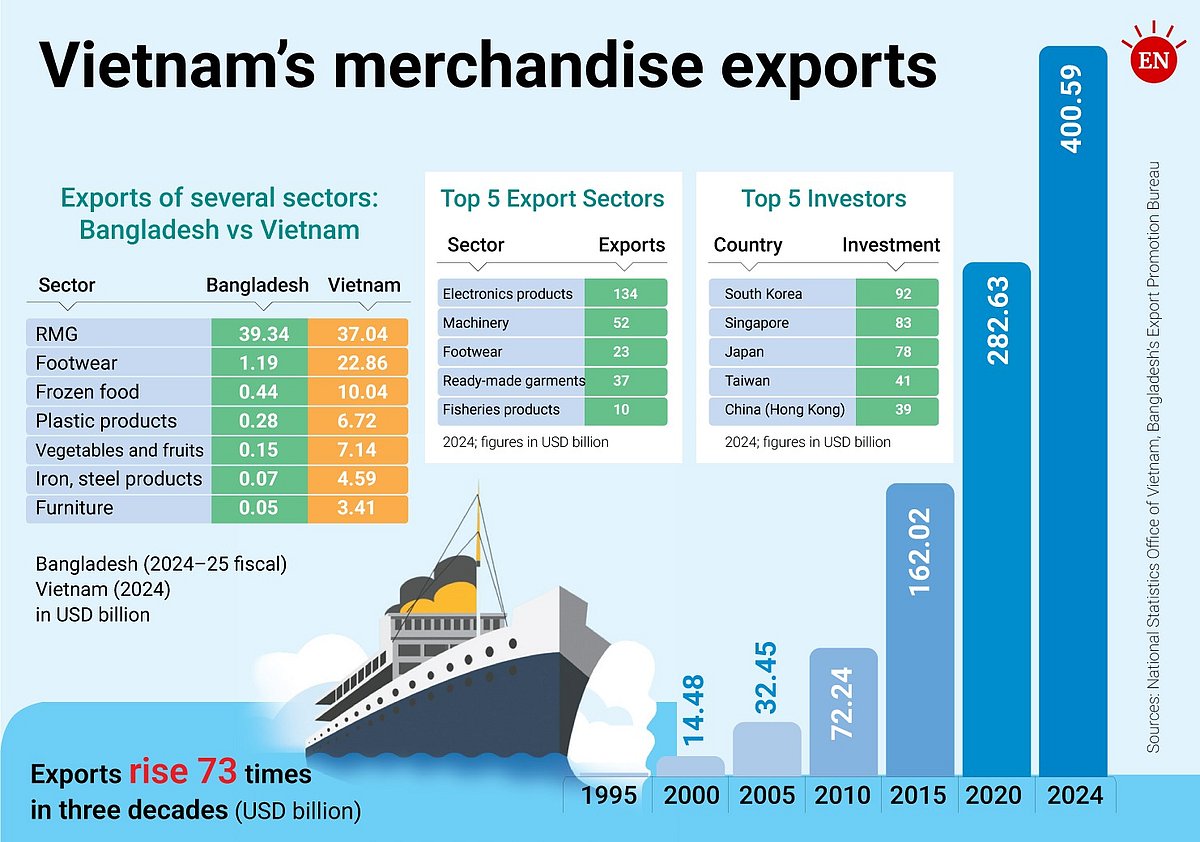
According to the country’s National Statistics Office, in 1995, exports from domestic and foreign companies in Vietnam amounted to USD 5.45 billion. Thereafter, exports doubled or more every five years. Last year, Vietnam’s merchandise exports reached the USD 400 billion milestone, meaning exports increased 73 times over 30 years.
Vietnam’s foreign investment journey began with the garment industry. Taking advantage of comparatively low-wage labour, companies like Nike and Adidas set up factories there. Later, Vietnam became a centre for electronics manufacturing. There was huge demand for skilled workers in the country. Domestic and foreign young technologists and engineers made the country’s major cities vibrant. Currently, the top export product is electronics.
Although the country’s export sector is not dependent on just one or two products like electronics or garments, it is highly diversified. According to the National Statistics Office, last year Vietnam exported USD 134 billion in electronics products (electronics, computers, mobile phones, cameras, etc.), USD 5.2 billion in machinery, USD 37 billion in garments, USD 23 billion in footwear, USD 10 billion in fish, USD 16 billion in wood and wood products, USD 13 billion in steel and steel products, USD 6 billion in plastic products, USD 5.66 billion in rice, and USD 5.62 billion in coffee.
What is the ‘Vietnam Model’?
What was behind Vietnam’s enviable success in attracting foreign investment (FDI) and boosting exports, which worked almost like magic? First is the Doi Moi program. Through this, people regained rights over land while both private and state initiatives in the economy were encouraged.
The three main features of Doi Moi economic and political reforms are: (1) Strong liberalisation of international trade; (2) Rapid decentralisation of the domestic economy and reduction of government intervention to lower the cost and barriers of doing business, and (3) Strengthening state investment while prioritising human development (education) and physical infrastructure.
Vietnam also focused on signing trade agreements with various countries. In 1995, it joined the ASEAN Free Trade Area. In 2000, it signed a free trade agreement with the United States. In 2007, Vietnam joined the World Trade Organization (WTO). It later signed multiple trade agreements with two industrialised neighbours, Japan and South Korea, further accelerating foreign investment inflows. Currently, Vietnam’s largest investors are Japan and South Korea, followed by China, Taiwan, and other countries.
Due to the communist government’s encouragement of foreign investment, long-term policy support, availability of technically skilled labour, and comparatively lower costs than China, Samsung made a major investment in Vietnam by establishing a smartphone factory in 2008. This investment became a game changer for Vietnam. Following Samsung’s lead, LG, Intel, and Foxconn also invested in the country. Samsung alone has so far invested USD 22.4 billion in six manufacturing plants and research and development centres. Last year, Samsung exported USD 540 million worth of products from Vietnam.
Diversified investment in Vietnam
Diversified foreign investment has played a major role behind Vietnam’s export success. So far, the country has received USD 502 billion in investment. These investments have come from 63 countries, including South Korea, Singapore, Japan, Taiwan, Hong Kong, China, the British Virgin Islands, the Netherlands, Thailand, and Malaysia.
According to the National Statistics Office of Vietnam, South Korea has invested USD 83 billion, Singapore USD 78 billion, Taiwan USD 41 billion, Hong Kong (China) USD 38 billion, and Chinese companies USD 31 billion in Vietnam. From 1988 to last year, 38,000 FDI projects were registered.
Vietnam remains attractive to foreign investors. In the first 10 months of this year, the country received USD 31.52 billion in FDI. Existing investors invested USD 12 billion across 1,206 projects, new investors invested USD 16 billion, and the remaining USD 5.5 billion went into the housing sector.
The impact of diversified investment is clearly visible in Vietnam’s export sector. For example, in 2005, smartphone exports were almost zero. Thanks to Samsung, smartphone exports reached USD 2 billion in 2010, USD 30 billion in 2015, and USD 54 billion last year. Similarly, footwear exports were USD 3 billion in 2005, USD 12 billion in 2015, and USD 22 billion last year.
Additionally, Vietnam exports machinery, cameras, plastic materials, coffee, furniture, toys, and several other products worth billions of dollars. Fifteen years ago, many of these products were not exported at all. For instance, machinery exports were zero in 2010 but reached USD 52 billion last year. Similarly, no cameras were exported 15 years ago, whereas camera exports reached USD 8 billion last year.
Context: Bangladesh
Bangladesh has many similarities with Vietnam. Both were agriculture-dependent economies. Vietnam was reunified in 1975 after a long war, while Bangladesh became independent four years earlier. In the 1990s, both countries began transforming their economies through the garment sector. However, Vietnam later attracted diversified foreign investment and advanced rapidly, while Bangladesh remained largely garment-dependent for four decades.
Even in garments, Bangladesh has not far surpassed Vietnam. In 2005, Bangladesh’s garment exports were USD 6 billion, while Vietnam’s were just under USD 5 billion. Last year, Bangladesh exported USD 39 billion worth of garments, while Vietnam exported USD 37 billion.
An example illustrates how far Bangladesh lags behind Vietnam. In 2005 or even 2010, Vietnam did not export furniture. By 2015, it exported USD 760 million worth of furniture, which increased to USD 3.41 billion last year. In contrast, Bangladesh exported USD 40 million worth of furniture in 2014–15 fiscal, rising slightly to USD 45.5 million last year.
Sources: The Economist, World Economic Forum, Vietnam Briefing, etc.