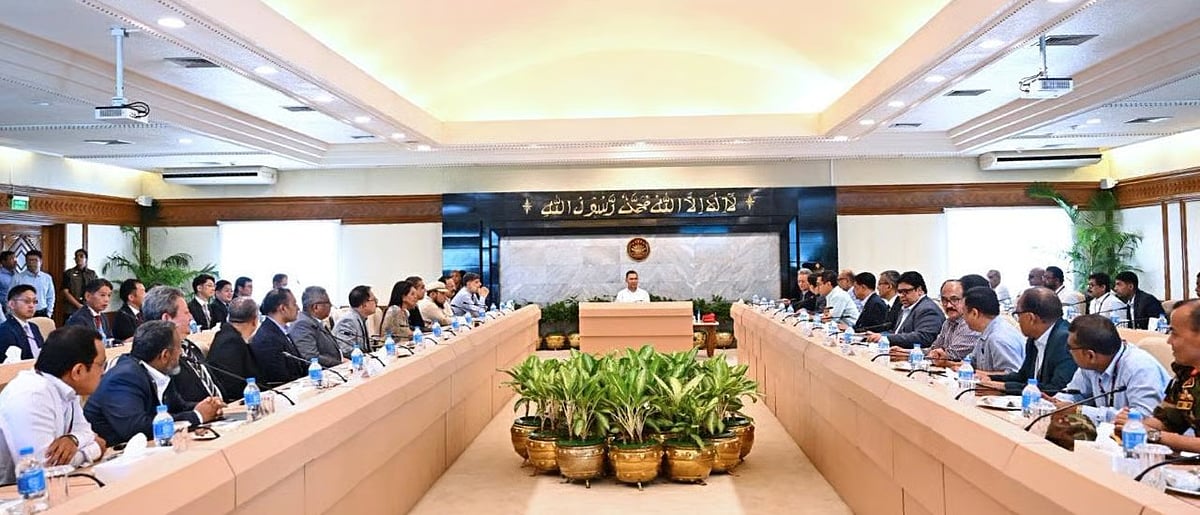
Meeting with industrialists
Prime minister seeks investment in closed factories
The government has launched an initiative to attract both domestic and foreign investment by utilising the land and infrastructure of closed or unprofitable state-owned industrial enterprises.
As part of this initiative, Prime Minister Tarique Rahman held a meeting on Saturday, at the prime minister’s office with leading industrialists and business leaders of the country. The prime minister had previously held two similar meetings.
Those present at Saturday’s meeting included Finance and Planning Minister Amir Khasru Mahmud Chowdhury; Minister of Commerce, Industries, and Textiles and Jute Khandakar Abdul Muktadir; prime minister’s adviser on Economy and Planning, Rashed Al Mahmud Titumir; Governor of Bangladesh Bank Md Mostaqur Rahman; Executive Chairman of the Bangladesh Investment Development Authority (BIDA) Ashik Chowdhury; and Principal Secretary to the Prime Minister ABM Abdus Sattar.
According to Bangladesh Sangbad Sangstha (BSS), the prime minister said that the principal responsibility of a political government is to remove obstacles and create pathways to overcome challenges. He noted that the Government alone cannot accomplish this task.
The prime minister said, “I would simply like to say this: let us all bring about change together. There are problems, and there are challenges. However, we have also realised that if everyone works together, it is possible to overcome these obstacles.”
During the meeting, the chairmen of five organisations operating under two ministries presented the current status of their factories. These organisations included the Bangladesh Chemical Industries Corporation (BCIC), the Bangladesh Sugar and Food Industries Corporation (BSFIC), the Bangladesh Steel and Engineering Corporation (BSEC), the Bangladesh Jute Mills Corporation (BJMC), and the Bangladesh Textile Mills Corporation (BTMC).
Among the industrialists the meeting were attended by Ahsan Khan Chowdhury, chairman of PRAN-RFL Group; Kazi Zahedul Hasan, managing director of Kazi Farms; Mostafa Kamal, chairman of Meghna Group; Simeen Rahman, chief executive officer of Transcom Group, and Zaraif Ayaat Hossain, head of Transformation; Tamara Hasan Abed, managing director of BRAC Enterprises; Md Aminul Islam, managing director of Nabil Group of Industries; Parvez Saiful Islam, chief executive officer of Square Food and Beverage; Arif Dowla, managing director of ACI; and SK Shamimuddin, chairman of Akij Venture Group, among others.
Officials from Japan’s Marubeni Corporation, Toyota Tsusho Corporation, Sumitomo Corporation, MUFG Bank Limited, Mitsui & Co (Asia Pacific) Pte. Ltd., Sojitz Asia Pte. Ltd., the Japan External Trade Organisation (JETRO) Bangladesh Office, and the Embassy of Japan in Bangladesh also attended the meeting. Representatives from Walton, Runner Group, and TK Group were likewise present.
At the meeting, BJMC reported that it had initiated plans to bring most of its 25 mills under lease, transfer, or new investment arrangements, moving away from direct production operations.
It identified Latif Bawany Jute Mills and Karim Jute Mills in Demra, Dhaka, as the most significant investment opportunities.
BTMC stated that it had prepared 16 factories for investment under public-private partnership (PPP) arrangements.
It highlighted the investment potential of Dinajpur Textile Mills, Tangail Cotton Mills, and Armin Textiles during the meeting.
BCIC has also developed plans to attract new investment by utilising the land and infrastructure of several closed or non-operational factories.
The corporation identified the Chittagong Chemical Complex (CCC) as a strategically important investment opportunity.
BSFIC has undertaken initiatives to bring the extensive landholdings and infrastructure of its sugar mills under new investment programmes.
During the meeting, the corporation highlighted various industrial opportunities at the Panchagarh, Setabganj, and Pabna sugar mills.
At the meeting, BSEC highlighted investment opportunities in Pragati Industries, GEMCO, Atlas Bangladesh, and a new steel mill project in Bogura.
Among the proposals is the establishment of a modern steel manufacturing plant in Bogura at a cost of Tk 19.4 billion (1940 crore). Once operational, the facility will be capable of producing 300,000 tonnes of steel rods annually.
BSEC also outlined plans to develop an automobile hub and an electric vehicle manufacturing centre on the site of Pragati Industries in Sitakunda, Chattogram.
Speaking to Prothom Alo about the meeting, Ahsan Khan Chowdhury, chairman of PRAN-RFL Group said, “The prime minister wants to bring about a revolution in agriculture and light engineering industries. Under the five corporations, some factories are operating, some are partially operational, and others are closed or sick. They wanted to know whether we had any interest in investing in any of these facilities. We have already taken over several factories and would like to take on more.”
Simeen Rahman, chief executive officer of Transcom Group, told Prothom Alo, “The fact that Prime Minister Tarique Rahman has personally taken this initiative and is willing to provide all necessary policy support is highly encouraging. Reopening closed and weak factories will create employment opportunities, increase exports, and contribute to the country's development. The prime minister has not limited his remarks to investment in agriculture alone; he has indicated that the Government will support investment in any sector, including pharmaceuticals, light engineering, and electric vehicles. We are very optimistic that initiatives of this nature by the prime minister will bring positive outcomes for the country.”
Parvez Saiful Islam, chief executive officer of Square Food & Beverage, told Prothom Alo, “The Government has informed us that it has undertaken initiatives to revive closed and loss-making factories under the control of various state-owned corporations. To achieve this, the Government intends to lease these factories to the private sector on a long-term basis. If the private sector shows interest, the Government will provide various forms of support to facilitate the reopening and operation of these factories.”
Tamara Hasan Abed, managing director of BRAC Enterprises, said, “We are interested in the edible oil and sugar sectors. We will submit a formal proposal to the Government in this regard.”
Md Aminul Islam, managing director and chief executive officer of Nabil Group of Industries said, “The meeting provided information on the potential and opportunities available to different businesses and investors. The Government stated that it would extend the highest level of policy support. By encouraging private-sector investment, the Government is promoting employment generation. This is a very positive initiative. As part of this process, we expressed our interest in Setabganj Sugar Mill and Rajshahi Sugar Mill during the meeting.”
SK Shamimuddin, chairman of Akij Venture Group said, “We received an update on the current status of the factories under these corporations so that we can identify and make use of the opportunities available to us.”