People's lives
They come to Dhaka to sell flags whenever the World Cup arrives
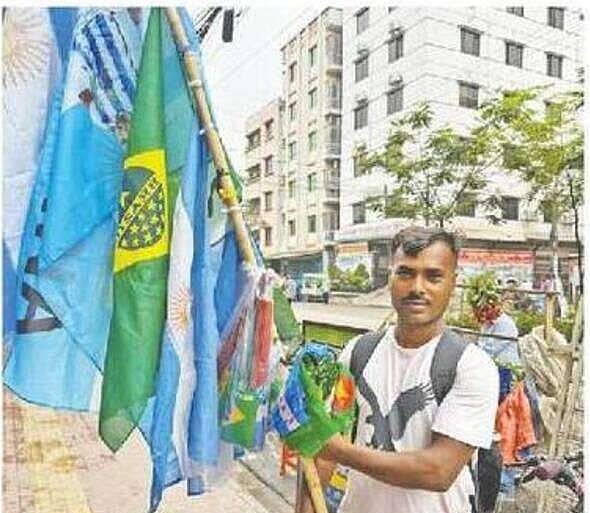
On Wednesday afternoon, Kazi Sumon, a resident of Muksudpur upazila in Gopalganj, was seen in the Lalmati area of Mirpur 11 in Dhaka.
A bamboo pole in his hand carried Brazilian and Argentine flags of various sizes, while his bag was filled with headbands and wrist badges.
During every World Cup season, he travels through neighbourhoods selling these items as a street vendor.
Speaking with him revealed that Sumon comes to Dhaka specifically to sell flags during the World Cup. At other times of the year, he sells cosmetics and decorative items outside a school in his locality.
His wife, Sheuli Begum, is a homemaker. Of their two sons, one has recently sat the Secondary School Certificate (SSC) examination, while the other studies in seven.
Sumon arrived in Dhaka on Monday and is staying at his younger brother’s shared accommodation.
Sumon said that he comes to Dhaka whenever the World Cup takes place to sell flags. He first entered the business in 2006 through his uncle. This World Cup marks his sixth tournament as a vendor.
Until now, his uncle had supplied the merchandise. However, because of his uncle’s illness, Sumon invested approximately Tk 20,000 of his own money this year.
Discussing sales, Sumon explained that he purchased flags and related items from Chawkbazar on Tuesday and began selling them from the afternoon.
On the very first day, he sold merchandise worth Tk 2,700. By Wednesday afternoon, sales had reached nearly Tk 1,000. However, rain had forced him to suspend business for part of the day.
Reflecting on the current state of this seasonal trade, Sumon expressed disappointment. He said that there were far fewer pavement shops in the past and online marketplaces were not nearly as widespread.
At that time, customers bought mainly from vendors like him. Now, increased competition has reduced sales.
Nevertheless, he continues to come to Dhaka every four years in the hope of earning some additional income during the World Cup.
Sumon also said that he struggles to manage household expenses. His income frequently falls short of his expenditure, forcing him to rely on borrowing at times.
In his own words, “Every month brings debt and financial strain. So I try to spend as little as possible on myself, but I do my best to ensure that my children do not have to suffer.”
Although this seasonal World Cup business offers no guarantee of substantial profits, Sumon said that being part of people’s festive celebrations and enjoyment remains his greatest reward.
"The World Cup is the season"
Mati Mia from Kishoreganj sells clothing from a van on the roadside in the Begunbari area of Tejgaon. He lives with his wife and daughter near Siddiq Master Mor, adjacent to Hatirjheel in Dhaka.
His wife works as an administrative assistant at a private hospital, while their only daughter is studying at BSc level at Tejgaon Polytechnic Institute.
To mark the World Cup, Mati Mia has added football jerseys of various national teams to his regular stock of clothing.
He said, “The World Cup is the season now. Alongside other clothes, people will want to buy jerseys of their favourite teams. That is why I have brought them in as well. Selling these will help me earn a bit of extra money.”
He added that customers show the greatest interest in Argentina and Brazil jerseys. Laughing, he remarked, “Most people in this country support either Argentina or Brazil. I support Argentina myself.”
Assessing the current state of his business, Mati Mia said, “Business is neither particularly good nor particularly bad. It is carrying on like this. Some days I sell a little more, while on other days sales are extremely low. At the moment, during the World Cup period, jerseys are selling the most.”
He also stated that he had purchased jerseys worth Tk 13,000 and had sold approximately Tk 7,000 worth of them by Wednesday.
Mati Mia also highlighted the growing difficulty of managing household expenses under current market conditions.
In his words, “The amount of money that used to cover a week’s groceries now barely lasts two or three days. My daughter’s education, house rent, food expenses—everything adds up to one expense after another. That is why, when a season like this arrives, I bring in jerseys in the hope of earning some extra income.”
New demand for Spain, France and Portugal jerseys
Harunur Rashid sells T-shirts, trousers, shorts and shirts on the pavement at Mohakhali Kachabazar. He has worked in this mobile trade for nearly 22 years. He sources his merchandise from Bangabazar in Gulistan.
Whenever the World Cup arrives, he supplements his regular stock with football jerseys and shorts representing various national teams.
During every World Cup season, he places special emphasis on selling these items in the hope of generating additional income.
Harunur Rashid said that, in preparation for this World Cup, he had purchased jerseys and trousers worth approximately Tk 60,000 in several batches. Of that amount, he has already sold merchandise worth Tk 40,000 to Tk 45,000.
Previously, his stall mainly stocked jerseys of Brazil, Argentina and Germany. However, in response to customer demand, he has also introduced jerseys of Spain, France and Portugal this year.
At Harunur Rashid’s stall, children’s jerseys sell for between Tk 120 and Tk 150, while adult jerseys are priced between Tk 250 and Tk 300. He explained that around 20 May, the wholesale price of these jerseys ranged from Tk 100 to Tk 200.
However, as the World Cup has drawn closer, wholesale prices have risen. Currently, each jersey costs Tk 40 to Tk 50 more than before.
Harunur Rashid said that this increase has also affected the retail market. In his words, “People do not want to buy items from pavement stalls if they cost more than Tk 200 or 300. But wholesale prices have gone up. So we also have to increase our selling prices.”
The businessman added that higher prices have somewhat reduced sales. Nevertheless, he continues to maintain his stock of jerseys in the hope that supporters’ interest in buying them will increase if the tournament’s most popular teams continue to win matches.