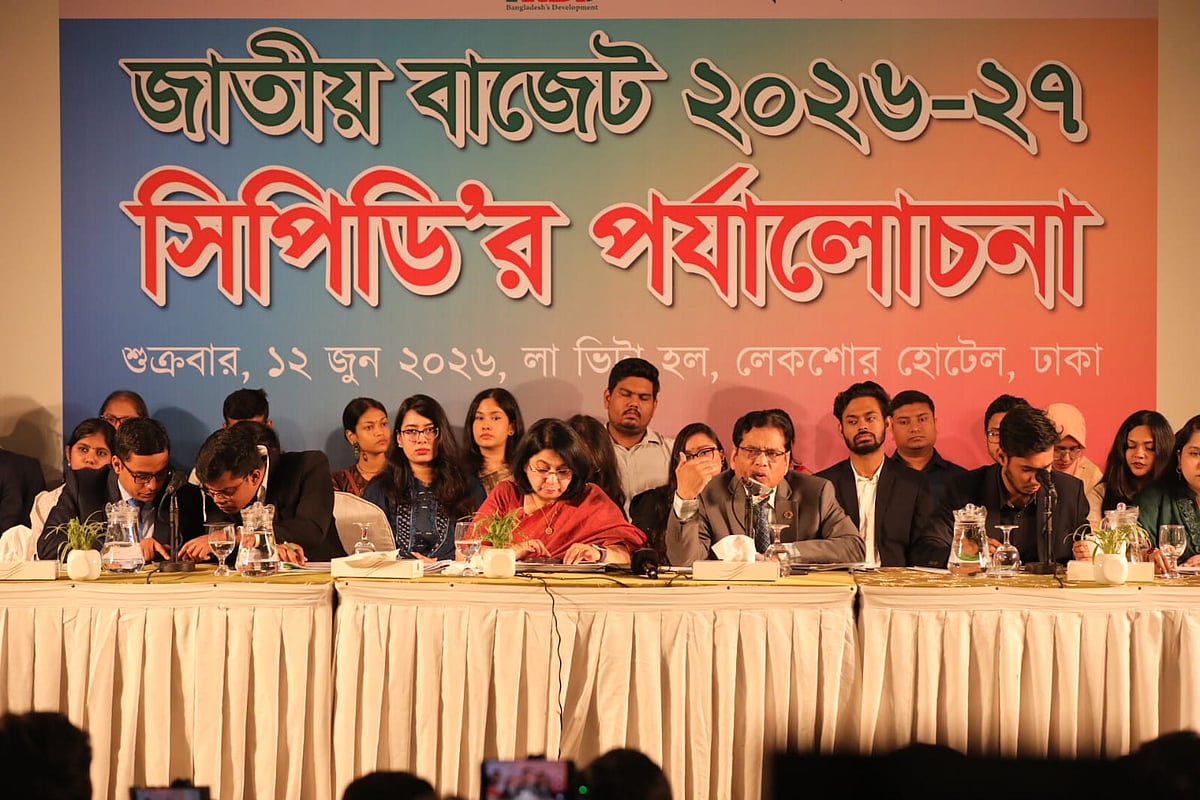
Post-budget press conference
Low-income people to bear disproportionate tax burden: CPD
The existing tax structure places a disproportionately heavy burden on low-income earners, and the tax-free income threshold proposed in the budget for fiscal year 2026–27 should have been raised further, according to the Centre for Policy Dialogue (CPD).
The independent policy research organisation said the newly proposed tax-free income threshold is insufficient to provide meaningful relief to lower-income groups amid persistently high inflation.
The observations were made at a post-budget review briefing organised by CPD at a hotel in Gulshan, Dhaka on Friday. The event was addressed by CPD Executive Director Fahmida Khatun and attended by Distinguished Fellow Mustafizur Rahman.
Predictability in tax policy welcomed
Fahmida Khatun noted that the proposed budget sets out a medium-term roadmap for the tax regime over the next five years. Under the plan, the tax-free income threshold will remain unchanged at Tk 375,000 during fiscal years 2026–27 and 2027–28. It is then projected to rise to Tk 400,000 in fiscal years 2028–29 and 2029–30, before increasing further to Tk 450,000 in 2030–31.
She described such long-term predictability in taxation as a positive development.
“Taxpayers can anticipate in advance how much tax they will be required to pay at different income levels, which helps them plan their future expenditures and financial commitments more effectively,” she said.
Threshold increase falls short amid high inflation
Despite welcoming the policy direction, Fahmida Khatun questioned whether raising the tax-free threshold from Tk 350,000 to Tk 375,000 adequately reflects the realities of sustained inflation.
“The increase is not commensurate with the sharp rise in living costs,” she said. “Given the current inflationary environment, it is reasonable to ask whether the revised threshold sufficiently takes into account the erosion of purchasing power. A larger increase would have been appropriate, particularly in consideration of lower-income households.”
She added that the budget contains several positive tax measures overall, including maintaining corporate tax rates unchanged for the next five years, thereby providing businesses with greater certainty regarding future tax obligations.
Scope for whitening undisclosed money criticised
CPD also criticised the government's decision to retain the provision allowing undisclosed or untaxed income—commonly referred to as black money—to be legalised through investments in the real estate sector, including land, buildings and apartments.
Fahmida Khatun argued that the measure undermines fairness within the tax system.
“Such opportunities erode tax justice. They create a stark disparity between those who comply honestly with their tax obligations and those who do not. Moreover, they risk encouraging moral decay in society, which is undesirable under any circumstances,” she said.
Echoing the criticism, Mustafizur Rahman said the policy was neither economically justified nor ethically defensible.
“It discourages honest taxpayers who fulfil their obligations properly,” he said. “Politically, it is also problematic because ordinary citizens perceive that individuals who have engaged in corruption or tax evasion are being rewarded, while compliant taxpayers continue to shoulder the burden.”
CPD questions basis of macroeconomic targets
CPD also raised concerns about the fundamental assumptions underpinning the government's macroeconomic projections for fiscal year 2026–27.
Mustafizur Rahman argued that the baseline used for calculating growth and revenue targets is itself flawed.
“The government has formulated its projections based on fiscal year 2025–26. Whether it is resource mobilisation, investment growth, private-sector credit, exports, imports or GDP growth, the assumptions are all built on a foundation that, in our assessment, is not entirely accurate,” he said.
According to him, the base year has been determined in a manner that either overlooks or overestimates the current realities of Bangladesh’s economy. As a result, the targets set for revenue collection, private-sector credit expansion, trade performance and overall economic growth are vulnerable to structural weaknesses from the outset.
“This could ultimately undermine fiscal discipline,” he warned.
Mustafizur Rahman further argued that achieving the budget's macroeconomic objectives would be highly challenging if they are based on unrealistic assumptions.
He said a more realistic assessment of prevailing economic conditions would have strengthened both the credibility and implementability of the budget framework.
“The government had an opportunity to acknowledge the actual state of the economy and establish a more realistic baseline,” he said. “Since many of the current economic difficulties were inherited from previous administrations, it could have adjusted its assumptions accordingly. Unfortunately, it has failed to do so.”