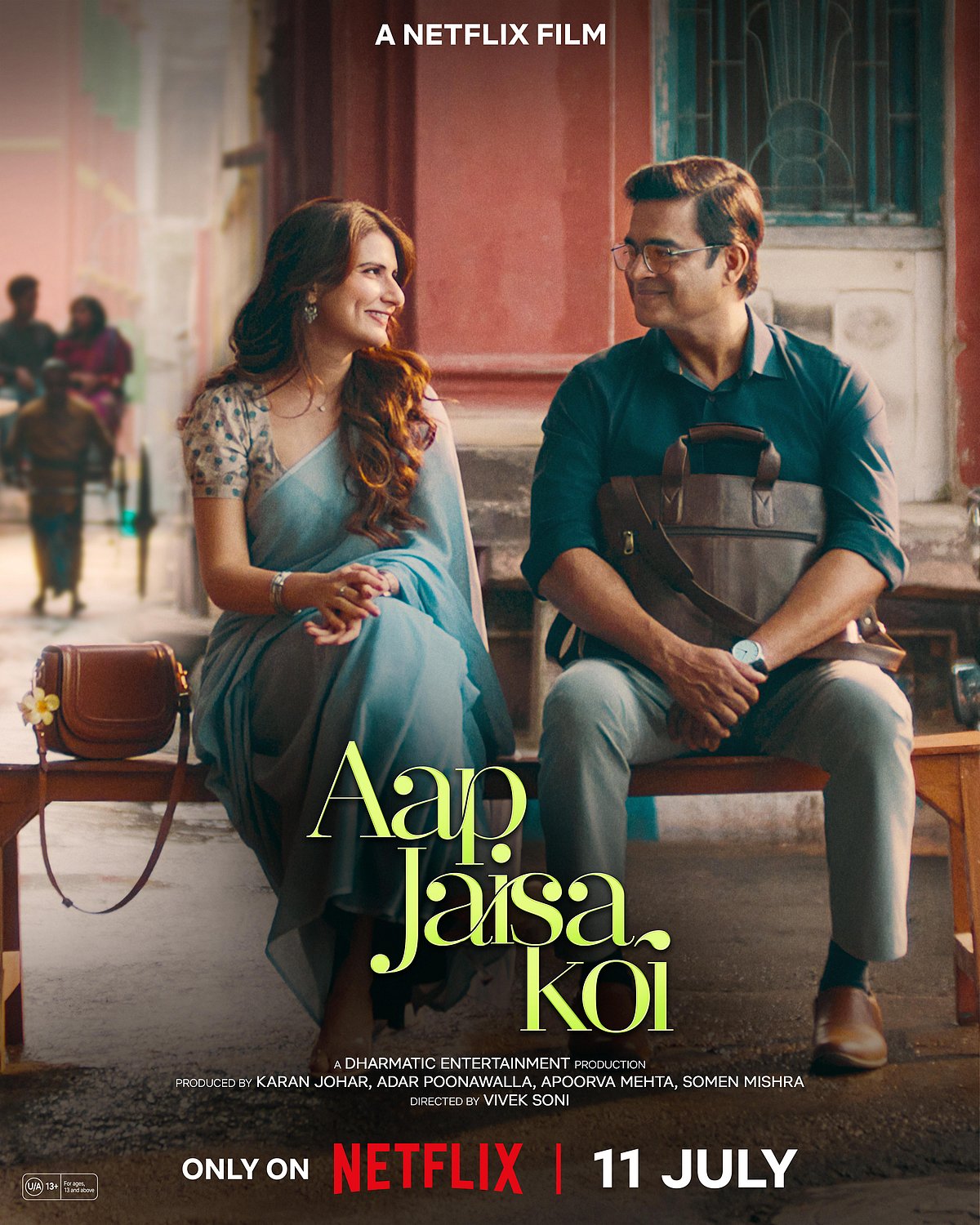
At first glance, Aap Jaisa Koi seems like just another Bollywood rom-com—full of chance encounters, and a touch of melodrama. But it quickly reveals itself as something more subversive: a film that cheerfully dismantles everyday patriarchy, even as it dresses itself in the soft fabric of romantic comedy.
The plot begins with Madhu Bose (Fatima Sana Shaikh), a French teacher from Kolkata, who meets Shrirenu Tripathi (R. Madhavan), a Sanskrit teacher from Jamshedpur. Their family set up their meeting for arrange marriage.
Their worlds are starkly different: Madhu comes from a progressive Bengali family where women have space to dream and err, while Shrirenu is rooted in a conservative North Indian household that clings tightly to gender roles—where the kitchen is a woman’s domain, and ‘fun’ is a man’s entitlement.
This contrast is not subtle—and it is not meant to be. Actor Manish Chaudhari, playing Shrirenu’s elder brother Bhanu, once again embodies the oppressive face of patriarchy. His smug authority, his obsession with female ‘role,’ and his belief that women must earn their place in a man’s world—all come across as chillingly familiar.
Namit Das as Shrirenu’s modern-but-misogynistic friend adds nuance to the theme: not all patriarchy is overt; some of it hides behind camera lenses and casual jokes.
Eventually it is discovered that Madhu actually found Shrirenu through a dating app named ‘Aap jaisa koi’ and approached through her uncle.
Soon Madhu’s mere presence on a dating app is scandalous for Shri’s household and for himself too. She’s labelled “shameless” and her character questioned, simply for daring to seek companionship. Forget sexual agency—even digital visibility becomes a transgression.
But one of the most poignant storylines belongs to Kusum (Ayesha Raza), Bhanu’s wife and Shrirenu’s bhabi. She’s a homemaker who cooks, cleans, and quietly serves—but that still doesn’t earn her basic respect. Bhanu routinely belittles her in the name of fun, his casual cruelty normalized by the household. Kusum’s journey, though quietly portrayed, is revolutionary.
She eventually falls in love with someone who treats her with dignity—coincidentally, Madhu’s uncle. When Bhanu discovers the affair, he demands an apology. But Kusum refuses to bow. His justification—that he “allowed” her to sell homemade pickles and earn money, unlike most men—only reveals the entitlement baked into such patriarchal kindness. Kusum’s calm yet firm response—“Who are you to allow?”—is one of the film’s most powerful moments.
When Bhanu finally asks, “Do you hate me?” she replies, “I don’t hate you. I just can’t love you anymore.” It’s not bitterness, but clarity. Kusum does not need to fight or scream. Her withdrawal of affection becomes a political act, a quiet revolt against years of emotional starvation. Through her, the film explores a less-discussed truth: that love cannot survive in a space devoid of equality.
While some critics have dismissed the film as just another “feminist drama” repeating old arguments, Aap Jaisa Koi forces us to ask: since when did repetition become a flaw in a country still steeped in misogyny? If patriarchy is not tired of showing up in real life, why should art stop calling it out?
The film continually circles back to the question of control. In one climactic scene, Shrirenu tells Madhu, “Everything is fine, but you need to stay within your limits.” That line distills the core of the film. Why must a man always be the one to define a woman’s boundaries? Madhu’s reply—“Why should you decide my limits?”—strikes at the heart of performative liberalism. It confronts all those ‘nice’ men who claim to support women until they step out of line.
The movie also dismantles the illusion that domesticity is inherently oppressive. What’s truly stifling is the obligation—the societal script that assigns women the household, regardless of whether they also earn outside. Today’s “woke” women aren’t rejecting chores; they’re rejecting the presumption that those chores are theirs by default.
R. Madhavan brings gravitas to the role of Shrirenu—a man torn between tradition and his growing affection for a woman who challenges him. Having lived in Jamshedpur himself, he captures the mannerisms with ease. Fatima Sana Shaikh, though sincere and expressive, falters slightly in nailing the Bengali diction expected of a Kolkata-born character. No amount of beautifully draped sarees and curated blouses can quite cover for the missing linguistic precision, especially for Bengali viewers.
While some critics have dismissed the film as just another “feminist drama” repeating old arguments, Aap Jaisa Koi forces us to ask: since when did repetition become a flaw in a country still steeped in misogyny? If patriarchy is not tired of showing up in real life, why should art stop calling it out?
Rating: 6/10 — not for lack of message, but for missing out on sharper writing in parts. Still, this is a film that earns its place—not just by telling women’s stories, but by challenging the conditions in which those stories are usually silenced.