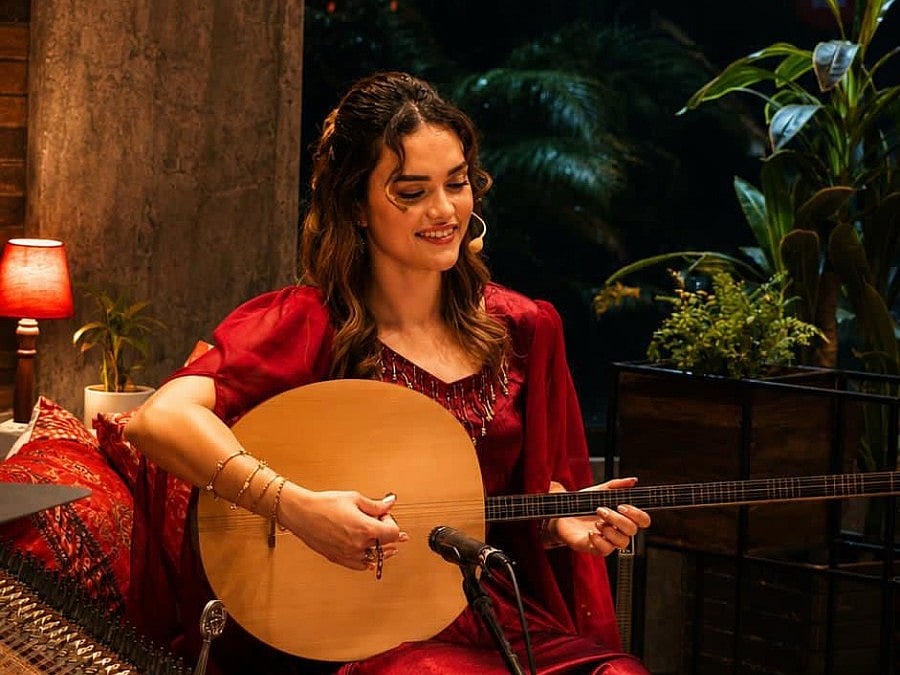
When were you offered the song “Room Jhoom” and how did you get involved with the project?
Hande Çevgel: I received the offer shortly before the shoot and accepted it without hesitation. The main reason for this was my friendship with Mustafa, my colleague on the project. I got involved in this project a few years ago thanks to a connection he made here.
How was your experience visiting Dhaka for the first time? Where did you go, and how was the food?
Hande Çevgel: Yes, this was my first time in Dhaka. Even though I live in Istanbul, I found this place very crowded and noisy, to be honest. The city is both very green and very gray. But the people I interacted with were always very friendly. I haven't tried the food, but I guess it's too spicy and heavy for me, to be honest. But since I'm a complete fruit monster and this place is a fruit paradise, I ate quite a lot of fruit. We visited Ahsan Manzil, Old Dhaka and Lalbagh. We didn't have much time during this trip, but there are many places I'd like to see.
How was your experience working with Bangladeshi artistes?
Hande Çevgel: That was the best part. I think they enjoyed their work so much, and that rubbed off on us too. They both enjoy their work and take it seriously. I feel very lucky to have met them.
There's been a collaboration between the song ‘Rum Jhum’ and the Ottoman-Turkish folk song ‘Üsküdara Gider İken’. How popular is ‘Üsküdara Gider İken’ in Turkey?
Hande Çevgel: The song is a timeless masterpiece in Türkiye. A song known and loved by everyone from young to old. Many musicians still reinterpret the song today, both instrumentally and vocally. It was a lot of fun singing along to the Bangla version. Even though I didn't know or understand the lyrics when I first heard it, the feeling made me want to sing along.
How familiar are you with Kazi Nazrul Islam, the national poet of Bangladesh, whose work inspired the lyricist and composer of “Room Jhoom”?
Hande Çevgel: Actually, I didn't know Kazi Nazrul Islam before this project. But while I was there, I saw how proudly people spoke about him, and they always portrayed him as a very valuable and important person. Afterwards, I did some research, and I must admit that not knowing him was a great oversight.
How much did you know about Bangladeshi music beforehand?
Hande Çevgel: Bangladeshi music always evokes rhythm and improvisation in me. I think it's due to both their very busy daily lives and their close connection with nature. I knew about musical instruments made from gourds and bamboo. and that instead of the musical notation system used worldwide, they used the sargam system.
Do you know that Turkish drama series are very popular in Bangladesh?
Hande Çevgel: Yes, Turkish TV series are very popular in many parts of the world. I really enjoy it when people compare me to the characters in the series, when they're familiar with Turkish words, and when they say they love and are curious about my country.
Do you have any plans in singing more Bangla songs in the future?
Hande Çevgel: As I said earlier, I find the music in Bangladesh very natural, so if I get the chance, I'd love to sing along. I really loved singing along to the Bengali part at the end of this song.
Do you have any message for your Bangladeshi listeners?
Hande Çevgel: The song quickly garnered a lot of attention, and I'd like to thank everyone for that. They were all very kind; their comments and messages made me very happy. I hope we can get together more often. I think this interview will coincide with Eid al-Adha. I'd like to wish everyone a happy holiday.