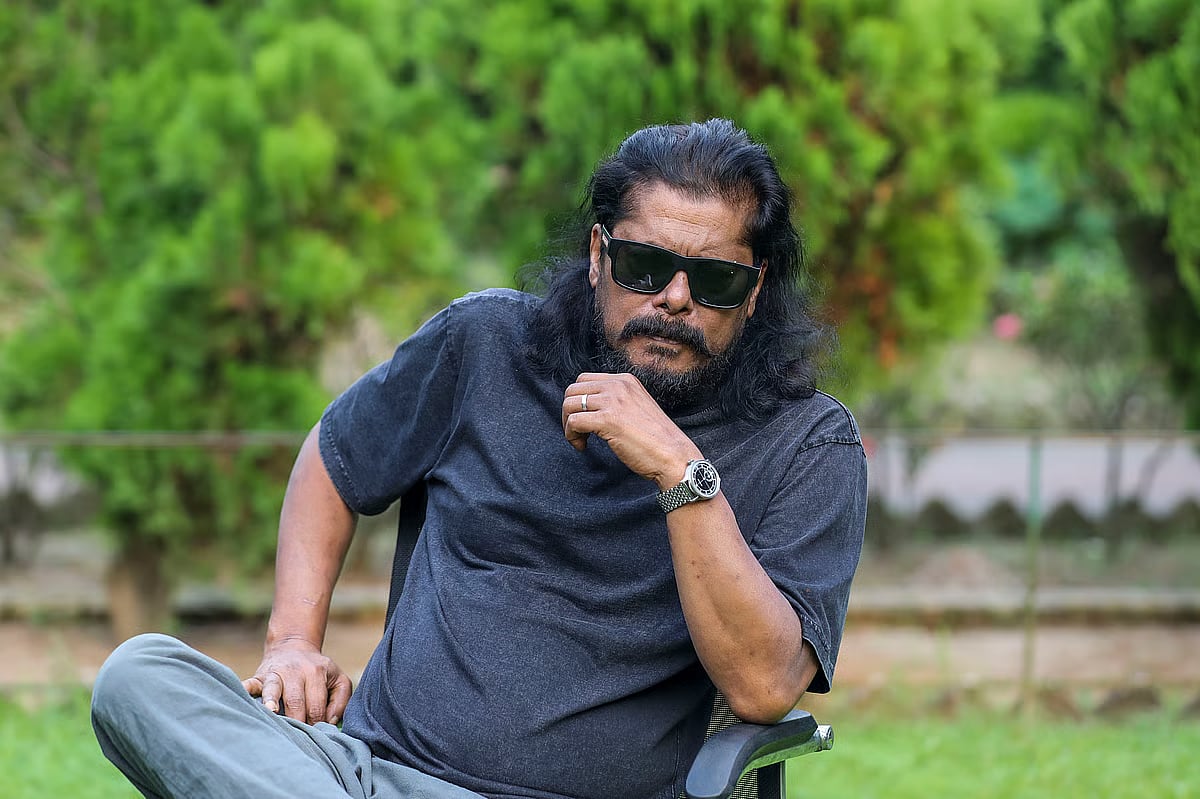
Interview: James
‘Musicians should make use of AI if they have the opportunity’
Yesterday, 2 October, marks the birthday of Mahfuz Anam James. To mark the occasion, the celebrated Bangladeshi musician met a group of journalists at Purbachal Club in the capital on Thursday afternoon. Nazmul Haque was among them.
What do you feel about your birthday at this stage of your life?
I do not have any particular plans or formalities surrounding my birthday. To be honest, I have never been someone who celebrates birthdays in a grand way. My fans, however, celebrate it, and I watch. I enjoy seeing their love and the way they organise celebrations.
Do you see any difference between the James of the 1990s and the James we see today?
As an artist, I do not really see any difference in myself. I still think about creating and performing music in much the same way as I did before. If someone wants to see a change from the outside, perhaps they will notice that I do not have as much hair as I used to—I have lost some of it (laughs). That is about the only difference! There has been no major change in my core identity or the way I think.
There was a time when band music and new albums were flourishing everywhere. How do you assess the current state of the music industry and its future?
When I try to explain the current state of the music industry, I like to use photography as an example. Back when photography depended on film, being a photographer carried a certain significance. But now, in the age of digital platforms and smartphones, everyone has a phone in their hands and considers themselves a photographer. As a result, the field has become oversaturated.
Our music industry has gone through a similar transition—from analogue formats to digital platforms and now to streaming services. People no longer have to buy music; they can access it for free on platforms such as YouTube and Spotify. And when people can get something for nothing, it no longer carries the same value or appeal for them.
Is the availability of free music on streaming platforms creating a difficult environment for today’s musicians?
I think musicians of our generation were extremely fortunate. Those making music today are far more talented and are exceptional musicians in their own right. But because of the times we live in and the rise of streaming platforms, the financial value of music has largely disappeared. How much can an artist really earn from YouTube or Spotify? As a result, making music professionally and earning a living from it has become extremely difficult. At present, those who do well in live performances are likely to benefit to some extent.
Do digital media and AI have an impact on creativity or the process of creating something new?
No, I do not see them as a hindrance to creativity at all. Those making music or practising photography today are doing so out of pure passion. Think about pottery or ceramics—nobody now expects to build a major business simply by making pottery; people have kept it alive as an art form because they love it.
Music is much the same: it is a passion. And when it comes to technology, AI is transforming not only music and photography but also coding and virtually every other field. We have to accept that many forms of art may disappear or change in the coming days. If musicians have the opportunity to use AI or modern technology, they should certainly make use of it.
Your fans are always asking to hear new music from you. Are you planning to release a new song or a full-length album at the moment?
Of course, I want to make new music, and I have plans to do so. But I become physically exhausted as there is so much work involved in concerts, tours at home and abroad, and live shows. It is becoming increasingly difficult to find enough time to record new songs in the studio while keeping up with live performances.
As for an album, I do not have any long-term plan to follow the conventional format of nine or 10 songs. If the music comes spontaneously, I will certainly make it.
Many young artists and bands now cover your songs. How do you view this practice?
I believe culture is like a river. Just as a river flows according to its own course, culture should also be allowed to flow freely. It is not at all a good thing to obstruct it or impose restrictions.
Music was created to be heard and for people to sing it in their own way—in markets, fields and wherever they happen to be. If people want to sing a song in whatever way they wish, why not let them? There is no reason to stop them.
Your name is often mentioned alongside another icon of Bangladeshi band music, Ayub Bachchu. What was your relationship and rivalry like?
My relationship with Bachchu was extraordinary. There was a healthy and wonderful rivalry between us in music. More importantly, musicians in those days would visit one another’s recording sessions. I might be recording in the studio and Bachchu would drop by; or Bachchu would be recording and I would go and sit there.
Everyone would spend hours chatting in the studio, exchanging ideas and music. But the music industry has now become centred around home studios. Everyone has retreated into their own laptops or computers, so the kind of human interaction and informal gatherings we used to have are no longer as common.
I miss Ayub Bachchu all the time. He was incredibly sociable and had a great sense of humour. Sometimes I even get angry with him for leaving us so soon! The last conversation we had was deeply personal, so it is not something I would want to share publicly. But the last time we met was at the Bangladesh-China Friendship Conference Centre. I miss those days immensely.
After such a long career in music, do you have any regrets or a sense of anything left unfulfilled?
I have never felt the need to keep an account of what I have gained in life. I do not think about what I have or have not achieved. And when it comes to happiness and sorrow, I find joy in everything.
The fact that I am sitting here chatting with you today—that itself is a great source of joy! I am not someone who believes in holding on to sorrow. You have to erase sorrow, wipe it away and move forward.