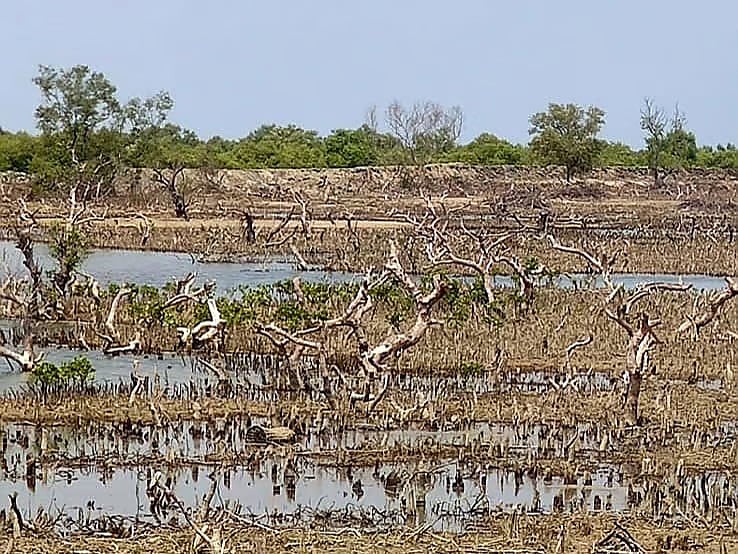
7,000 acres Sonadia mangrove forest destroyed in 4 years; occupied by political leaders-activists
At least 7,000 acres of mangrove forest have been destroyed in the ecologically critical Sonadia Island under Maheshkhali upazila of Cox’s Bazar over the past four years. Eighty-two shrimp farms have been built by occupying forest land. Shrimp are cultivated in these farms for six months of the year, while salt is produced during the rest of the period. Those involved in occupying the mangrove forests include leaders and activists of Bangladesh Nationalist Party (BNP), Jamaat-e-Islami, and Awami League (whose activities have been banned).
Officials of the Department of Environment and the Forest Department said that in multiple cases filed over forest destruction and encroachment; more than a hundred people have been accused. However, as the accused remain out of reach, they are becoming more reckless.
Located at the mouth of the Bay of Bengal, 11 kilometres north of Cox’s Bazar town, Sonadia Island is known as a habitat of red crabs, turtles, and rare bird species. Considering its ecological importance, the Department of Environment declared it an “Ecologically Critical Area” (ECA) in 2006. According to law, any alteration or commercial transformation of Sonadia’s soil, water, and natural environment is prohibited. However, with the aim of establishing an eco-tourism park, the previous Awami League government allocated 9,466.93 acres of forest land of Sonadia to the Bangladesh Economic Zones Authority (BEZA) for 1,001 taka. Of this, at least 8,000 acres were mangrove forest.
In May 2017, BEZA officially took over the land from the coastal forest department. But after that, no visible work on the eco-tourism project took place. Taking advantage of this, influential people destroyed at least 7,000 acres of forest land under BEZA’s control over the past four years and built shrimp farms there. During this time, more than 4.6 million trees of species such as Bain and Keora were cut down.
Environmental activists said that in order to encroach the forest land, trees were also set on fire at night by pouring petrol on them. As a result, biodiversity and bird habitats have been destroyed. Once, Sonadia’s mangrove forest contained 250 species of fish, 150 species of snails and shellfish, 50 species of crabs, 40 species of shrimp, 170 species of birds, 50 species of dune plants, and 15 species of mangrove plants. It was also home to dolphins, sea turtles, fishing cats, foxes, snakes, monitor lizards, and other wildlife. But due to encroachment, these are disappearing.
How business is running
On Wednesday, visiting Sonadia Island, it was seen that salt is now being cultivated in shrimp farms created after clearing mangrove forests. The produced salt is being packed and loaded onto boats.
Salt worker Saiful Islam said that the salt season is almost over. Now, saline seawater will be brought into these lands for shrimp cultivation. Again, after shrimp are sold in November–December, salt production will begin on the same land.
Local salt farmer Abdul Gani said that several partners jointly cultivated salt on 30 kany of land. For each kany (40 decimals), they had to pay 40,000 taka per season, totalling Tk 1.2 million as “lease” to the encroachers. So far, after selling salt, they have made a profit of about Tk 1.3 million after costs.
Several salt farmers, requesting anonymity, said that among the encroachers of mangrove forests are individuals linked to the political activities of BNP, Jamaat, and Awami League. Even after cases were filed, they did not leave the land; instead, they are earning large sums by leasing illegally occupied land.
A spot visit showed around 1,000 acres of land near the salt fields are still lying empty. Stumps of hundreds of Bain and Keora trees can still be seen there. Local residents claim that these trees were recently cut down. In the northern and western parts of the island, a small portion of mangrove forest still remains, but encroachment attempts are ongoing there as well.
Local salt worker Rahmat Ullah said that each shrimp farm ranges from 100 to 150 kany in size. Salt farmers Anwar Hossain and Abdul Kader said that a decade ago there was more than 10,000 acres of dense mangrove forest on the island. Hundreds of people earned their livelihood by catching fish and crabs. But in the last four years, more than 7,000 acres of forest have been destroyed and salt and shrimp farming has begun there. No effective action from the administration against encroachers is visible.
Retired teacher of Maheshkhali Degree College, Moqbul Alam, said, “Mangrove forest is a natural coastal protection system. It has protected Sonadia and Maheshkhali for a long time from cyclones, storm surges, and sea waves. Without the forest, there is a risk of severe damage in a major cyclone in the future.”
A researcher on natural resource management and climate change from a non-government, Abdul Qayyum, said that only five years ago he saw about 8,000 acres of dense mangrove forest in Sonadia. Now only shrimp farms and salt fields can be seen there.
Political party leaders and activists occupy forest
According to forest department and local sources, about four years ago in the western part of Sonadia, about 3,000 acres of mangrove forest were cleared and 37 shrimp farms were built by leaders and activists of the then ruling Awami League. In March 2004, two people were killed in clashes between two groups over mangrove occupation.
After 5 August 2024, BNP and Jamaat activists were accused of occupying about 4,000 acres of mangrove forest and building more than 45 shrimp farms. At present, there are a total of 82 shrimp farms in 7,000 acres. Although high court directives ordered the removal of these illegal farms, they have not been implemented.
According to case documents, about a year and a half ago, BNP union general secretary Alamgir Chowdhury of Kutubjom Union built shrimp farms by destroying mangrove forest in the western part of Sonadia. In the eastern part, large shrimp farms were built by local residents Abul Kalam and Mohammad Hossain. Nearby, several other farms are alleged to have been built by union parishad member Ekram Mia and residents Imtiaz Uddin, Abdul Manaf, and Azizul Haque.
However, Alamgir Chowdhury denied the allegation of mangrove destruction. He claimed, “I am not involved in making shrimp enclosures. But we have a 20-acre old shrimp enclosure Taziyakata, which was inherited from my father.” Similarly, UP member Ekram Mia also rejected the allegation of mangrove destruction.
On 23 October last year, the High Court ordered a halt to mangrove destruction and eviction of illegal shrimp farms in Sonadia and surrounding areas including Ghotibhanga, Taziyakata, and Hamidar Dia. But the order has not been implemented. Lawyer Zakia Sultana of Bangladesh Environmental Lawyers Association (BELA) said that ignoring clear court orders and continuing shrimp enclosure construction on mangrove land amounts to contempt of court.
No arrests despite cases
On 17 May, the Department of Environment filed a case against 20 people, naming BNP leader Alamgir Chowdhury as the main accused, over destruction of Sonadia mangrove forest and biodiversity loss. Most of the accused are local leaders and activists of Awami League and BNP. Notable accused include Kutubjom Union Parishad chairman Sheikh Kamal, his younger brother Sheikh Alamgir; ward Awami League (activity banned) president Abul Kalam; his nephew Abdul Manaf; volunteer league leader Imtiaz Uddin; UP member Ekram Mia of Sonadia Island; cousin of former Awami League MP Ashik Ullah Rafiq, Mohammad Shamsher Ullah; ward Awami League general secretary Azizul Haque; and Upazila Awami League labour and manpower affairs secretary Mostafa Anwar, among others.
Deputy Director of the Department of Environment Cox’s Bazar office, Khandaker Mahmud Pasha, said two cases have been filed against 53 encroachers so far over Sonadia mangrove destruction. Investigation reports will be submitted to court soon. However, no accused has been arrested yet.
On April 2, the Coastal Forest Department also filed separate cases against 30 leaders and activists of the BNP, Jamaat, and Awami League. The Forest Department claims that the accused were named based on specific evidence. Among the accused are local Jamaat leader Chhayedul Haque Sikder, Moheshkhali Upazila Jubo League General Secretary Sajedul Karim, Upazila BNP President Abu Bakkar Siddique, local Awami League leader Moqsud Miah’s younger brother Kaisar Sikder, sons of former upazila Awami League President Anwar Pasha Chowdhury—Mostafa Anwar and Mohsin Anwar—and Mohammad Shahed, younger brother of former Upazila Parishad Chairman Zainal Abedin.
One of the accused, Kutubjom UP chairman Sheikh Kamal, said he does not own any shrimp farm personally and is not involved in mangrove destruction. He claimed he has been falsely implicated for political harassment.
Gorokghata Range Officer Monowar Hossain of the Coastal Forest Department said that during the interim government period, disputed leases were cancelled and instructions were given to return the land to the forest department. Once the land is recovered, reforestation of mangroves will begin.
Tk 16 billion earned
According to local sources, shrimp farming takes place on 7,000 acres of land from June to November–December every year. Last season, shrimp worth at least Tk 3 billion were sold. On the other hand, from November–December to May, about 300,000 maunds of salt were produced on around 3,000 acres of land. At Tk 300 per maund, the market value is about Tk 900 million.
In total, the encroacher group earns about Tk 4 billion annually by illegally using government forest land. Accordingly, over the past four years, this income has reached about Tk 16 billion.
Environmental organidation Dhoritri Rokhhay Amra (DHORA) Cox’s Bazar chapter president Fazlul Kader Chowdhury alleged that the huge income from shrimp and salt sales is shared between encroachers and corrupt officials of the administration. This is why no effective eviction drive is seen against the illegal shrimp farms.