Lowest June rainfall in 7 years
June marks the beginning of the monsoon season, and the monsoon in Bangladesh is normally associated with increasing rainfall. Rivers, canals and wetlands usually begin to fill during this month, while farmers start sowing Aman paddy.
This year, however, the picture was markedly different. Bangladesh received 29 per cent less rainfall than normal during the recently concluded month of June.
Statistics show that this was the driest June in the past seven years. Long-term studies indicate that temperatures during May and June are rising rapidly in Bangladesh, the number of hot days is increasing, and people are experiencing greater heat-related discomfort than in the past.
Researchers warn that if rainfall continues to decline during June, the negative effects on agriculture and the broader economy are likely to intensify.
Lowest rainfall in 7 years
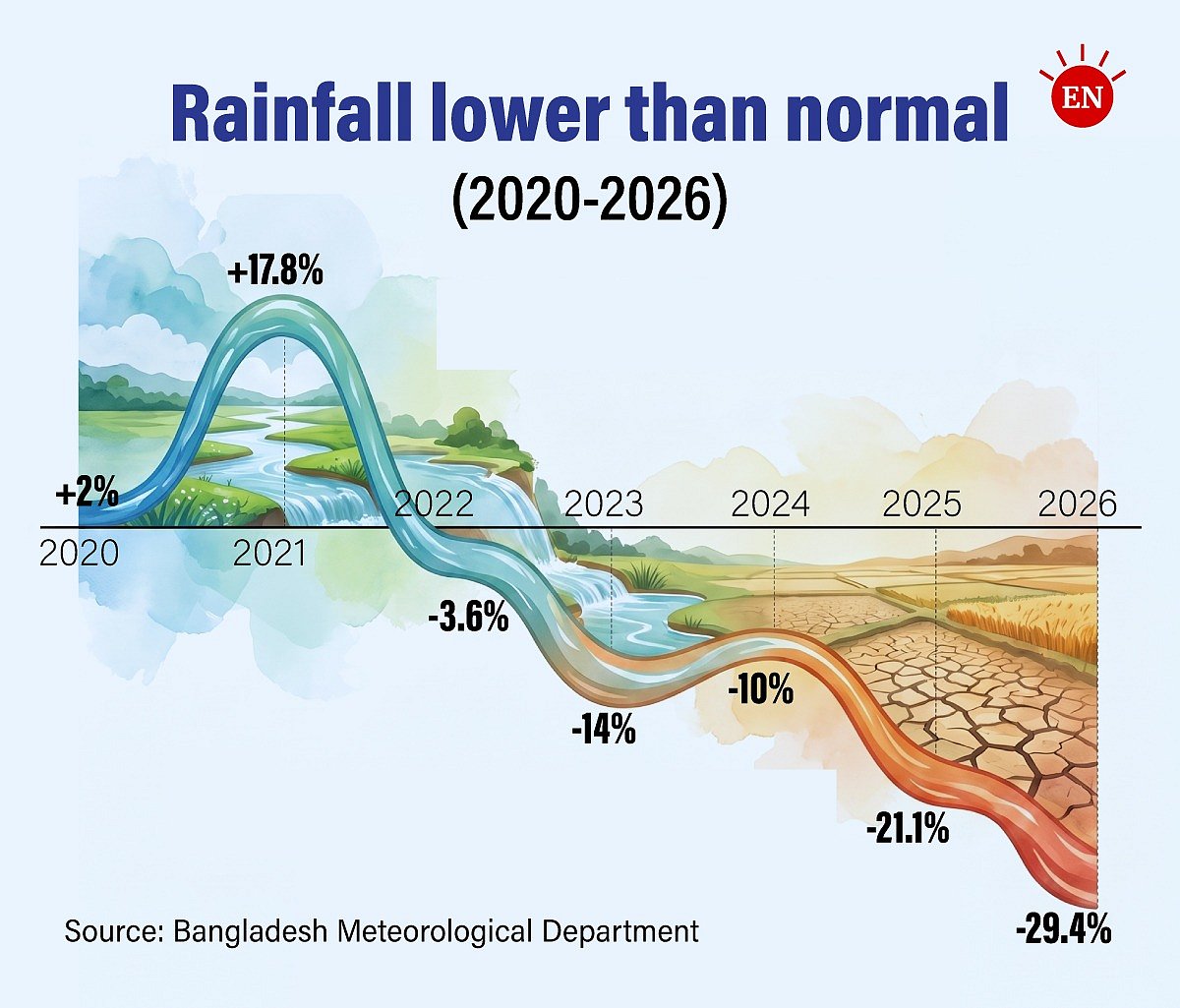
Data from the Bangladesh Meteorological Department indicate a declining trend in June rainfall over the past seven years. Meteorologist Md Bazlur Rashid presented an assessment covering June rainfall from 2020 to the current year.
According to Md Bazlur Rashid's analysis, June 2021 recorded the highest rainfall among the past seven years, with precipitation standing 18 per cent above the seasonal average.
Statistics show that this was the driest June in the past seven years. Long-term studies indicate that temperatures during May and June are rising rapidly in Bangladesh, the number of hot days is increasing, and people are experiencing greater heat-related discomfort than in the past.
In the preceding year, 2020, rainfall was also 2 per cent above normal. However, rainfall has declined steadily since 2022. Last year, rainfall was 21 per cent below normal, while this year the deficit increased to 29 per cent.
July is typically Bangladesh's wettest month, with average rainfall of 523 millimetres, while June ranks second, with an average of 459 millimetres. Even so, rainfall during this year's June fell well below the seasonal norm.
Md Bazlur Rashid said, "Lower rainfall in June has negative meteorological implications. Reduced rainfall means higher temperatures. This could adversely affect both public health and agriculture. Research indicates that below-average rainfall during this month contributes to a tendency for temperatures to rise."
Is lower rainfall, more heat part of the same story?
A single month's rainfall deficit cannot, on its own, establish the effects of climate change. However, when recent observations begin to align with long-term research, a broader trend becomes apparent.
A study entitled “Climate Change in Bangladesh: A Historical Analysis of Temperature and Rainfall Data”, published in the Journal of Environment, analysed data from 34 meteorological stations across Bangladesh between 1976 and 2008.
When rainfall is low during the preparation of Aman seedbeds, irrigation becomes necessary. That has happened this year as well. As a result, farmers' costs have increased. If this trend of below-average rainfall continues into July, it could have a significant impact on Aman production.Agronomist Mrityunjoy Roy
It found that the country's annual average maximum temperature has increased by approximately 0.019 degrees Celsius each year.
The study also found that the rate of increase in maximum temperatures was greatest between May and September. In June alone, the average maximum temperature rose by around 0.033 degrees Celsius annually.
In other words, the period that traditionally marks the onset of the monsoon has gradually become warmer over time.
Hot days rising rapidly
A separate analysis by researchers at the Bangladesh University of Engineering and Technology (BUET) reinforces this trend.
Examining data from 26 meteorological stations between 1981 and 2010, the researchers found that the country's maximum temperature increased by approximately 0.3 degrees Celsius per decade, while the minimum temperature rose by about 0.4 degrees Celsius per decade.
The most alarming finding was that the number of hot days increased by approximately 12 days every decade.
The researchers also identified a growing tendency for prolonged dry spells, indicating that dry periods are becoming longer.
This suggests that not only are average temperatures rising, but periods of sustained heat are also lasting longer.
Heat-related discomfort peaks from June
Air temperature alone does not determine how hot people feel. High humidity places additional strain on the human body.
As a result, researchers are now analysing not only temperature but also the Discomfort Index, which measures heat-related discomfort.
A study entitled “Application of Seasonal-Adjusted Hybrid Models for Forecasting Discomfort Index in a Heat-Prone Region of Bangladesh,” published in PLOS ONE in March this year, analysed 40 years of data from Rajshahi covering the period from 1985 to 2024.
The study found that people experience the greatest heat-related discomfort between June and August.
Among those months, June recorded an average Discomfort Index of approximately 28.1, placing it in the "high discomfort" category. This indicates that June is characterised not only by higher temperatures but also by humidity levels that intensify the effects of heat on the human body. The researchers warned that heat-related stress could increase further by 2027.
Pressure on agriculture, water and urban life will increase
The impact of reduced rainfall in June extends well beyond the weather itself. This is the period when farmers prepare seedbeds and begin transplanting Aman paddy.
Lower rainfall increases the need for irrigation, driving up production costs. At the same time, reservoirs, canals, wetlands and small rivers receive less water than expected.
Agronomist Mrityunjoy Roy told Prothom Alo, "When rainfall is low during the preparation of Aman seedbeds, irrigation becomes necessary. That has happened this year as well. As a result, farmers' costs have increased. If this trend of below-average rainfall continues into July, it could have a significant impact on Aman production."
Meanwhile, prolonged periods of hot and humid weather in urban areas increase electricity demand, reduce workplace productivity and heighten health risks for children, older people and manual workers.
Various studies conducted by the World Health Organization (WHO) and the International Labour Organization (ILO) have also shown that prolonged heatwaves combined with high humidity reduce labour productivity and increase the risk of heat-related illnesses.
Focus should be on long-tern trends, not a single month
Meteorologists emphasise that below-average rainfall in a single month does not, by itself, constitute direct evidence of climate change. Natural variability means that some years will inevitably experience more or less rainfall than others.
However, when June rainfall deficits continue to increase over several consecutive years, while long-term research simultaneously shows steadily rising temperatures during May and June and a growing number of hot days, the pattern can no longer be regarded as an isolated weather event. Instead, it may represent an important indicator of a changing climate.
The 29 per cent rainfall deficit recorded during the recently concluded June appears to be consistent with this longer-term trend. However, Bangladesh received 75 per cent more rainfall than normal in April this year.
The key question now is whether rainfall during the remaining months of the year can make up for June's shortfall, or whether 2026 will become another milestone in the evolving character of Bangladesh's climate.