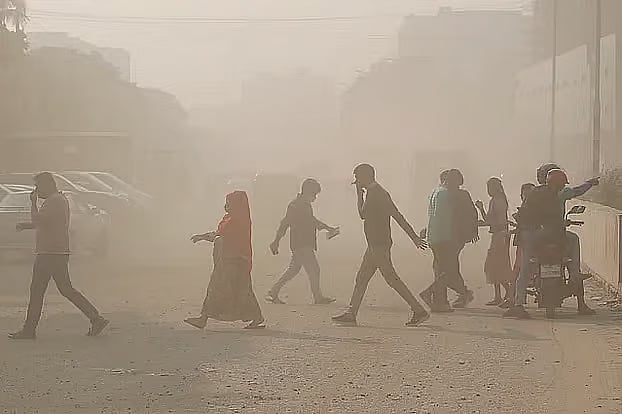
During the monsoon season, Dhaka’s air quality is generally better, largely due to rainfall. This year, air quality also remained relatively stable throughout the monsoon. However, with the reduction in rainfall, pollution levels are once again rising in Dhaka.
On Saturday, Dhaka experienced approximately 4 millimetres of rain, yet air quality did not improve. At 8:30am on Sunday, the city’s average the city’s average Air Quality Index (AQI), as measured by IQAir, stood at 168, a level considered unhealthy for human health.
Currently, Lahore in Pakistan ranks first in global air pollution with a score of 184, followed by Dhaka in second place.
The data on Dhaka’s position has been published by the Switzerland-based organisation IQAir, which regularly reports on global air pollution levels.
This live index provides real-time information on how clean or polluted the air in a specific city is, helping people stay informed and cautious.
Air pollution in Dhaka typically decreases from the end of May due to rainfall, as the monsoon season begins. Aside from this natural phenomenon, no significant measures have proven effective in combating pollution, with several government initiatives failing to yield lasting results.
Rainfall temporarily reduces pollution for a few days, but levels soon rise again. July remains the month with the lowest pollution levels.
Among the most polluted areas of Dhaka are Eastern Housing in Mirpur, with a score of 180, and Becharam Deuri in Old Dhaka, with a score of 179.
The main pollutant in Dhaka’s air is fine particulate matter (PM2.5). On Sunday, its concentration is 16 times higher than the World Health Organization’s (WHO) guideline levels.
Advice for residents
Given today’s air quality levels, IQAir has issued several recommendations for city residents. These include -
Always wearing mask when going outdoors
Keeping windows closed
Avoiding exercise outside the home
From early morning on Saturday, Dhaka’s sky appeared hazy, resembling mist, accompanied by extreme heat and suffocating conditions that persisted from around 6am until 10am. Meteorologist Md. Hafizur Rahman explained that this was caused by low cloud cover combined with air pollution.