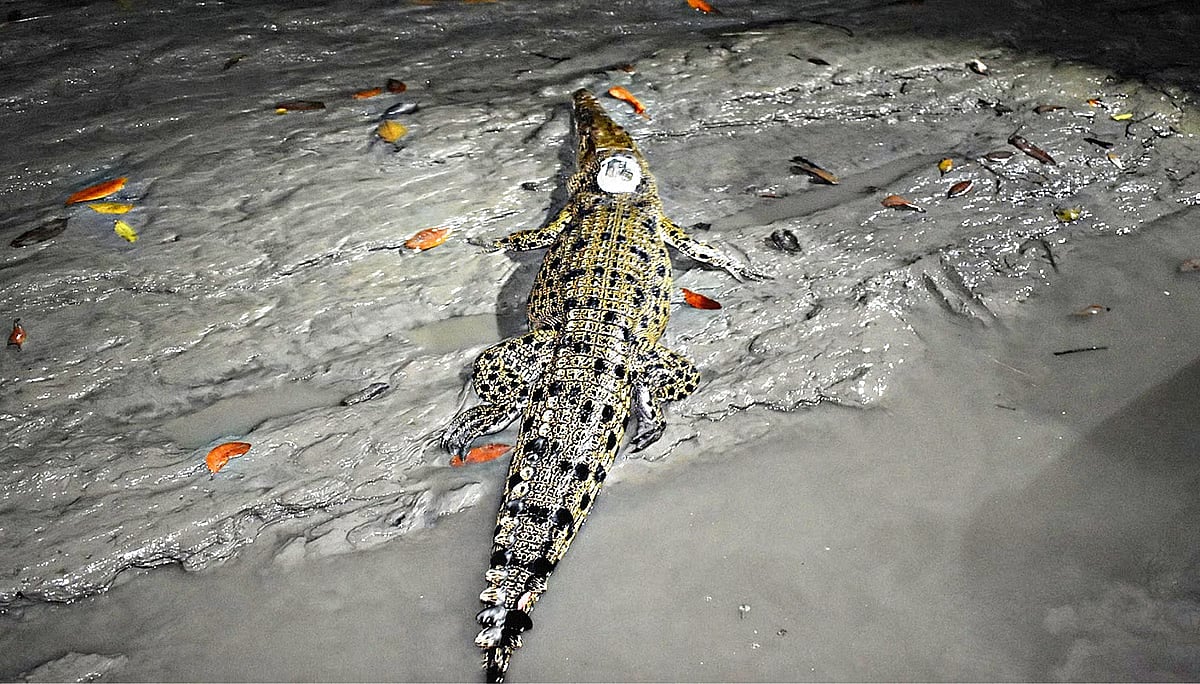
Where are 5 crocodiles released in the Sundarbans with tracking devices
Researchers selected five crocodiles---Juliet, Madhu, Putia, Jongra, and Harbaria, and attached modern satellite transmitters to their backs.
The goal was to learn how crocodiles live deep within the largely unknown Sundarbans.
This journey began in March 2024. Juliet was the first to be released from the Karamjal breeding centre. Though she had once laid many eggs, she had not reproduced in recent years. Researchers hoped that returning to the wild might spark a new beginning.
Madhu was brought from the Sagardari area of Jashore. After being rescued from captivity, she was released into a river in the Sundarbans. Putia was born at the Karamjal wildlife breeding centre, raised within enclosures, and later released into the wild.
Jongra, rescued from Shariatpur, turned out to be the most restless and adventurous. Moments after being released into the Sundarbans, it began traveling from one river to another. Harbaria, on the other hand, was a native of the Sundarbans and showed little interest in leaving its home territory.
In the early days, each signal from the satellite transmitter told a different story. Every day, researchers could track where each crocodile was, how much territory it was covering, and which canal it returned to.
Mofizur Rahman, Smart Data Coordinator at the Khulna Wildlife Management and Nature Conservation Division, said, "We used to sit in front of the map, watching each dot move, stop, then turn again. It felt like we were listening to the rhythm of the crocodiles’ lives."
While the satellite transmitters were active, Juliet traveled 145 kilometers in 71 days, Madhu 170 kilometers in 127 days, and Putia 204 kilometers in 83 days. Harbaria, calm by nature, stayed within the same canal and traveled only 51 kilometers in 52 days.
However, the most talked-about adventurer was Jongra, whose transmitter remained active for 64 days. Released at the mouth of the Jongra canal in the Sundarbans, this crocodile roamed through the rivers of Bagerhat, Pirojpur, and Gopalganj, eventually returning to its original habitat. Covering a total of 473 kilometers, Jongra astonished the researchers.
But one day, the technology stopped working. The transmitters no longer functioned, and the signals disappeared. No one knows where the crocodiles are now.
ABM Sarowar Alam Dipu, programme manager at IUCN Bangladesh and head of the research team, said: “We expected to get data for around 60 to 70 days. But fortunately, for some crocodiles, we received data for over 100 days. Even though everything suddenly went dark, the information we gathered remains an invaluable resource for us.”
The research was led by the Bangladesh team of IUCN, with support from the German Federal Ministry for Economic Cooperation and Development (GIZ). Australian crocodile researchers Samaravira and Paul Berry also participated, along with officials from the Khulna Wildlife Management and Nature Conservation Division and the Gazipur Wildlife Centre.
On 13 March 2024, two crocodiles — Juliet and Madhu — were fitted with satellite transmitters and released into the Bhadra Canal of the Sundarbans. On 14 March, another crocodile was released into the Harbaria Canal, followed by Jongra on 15 March, released into the Jongra Canal. After a long 10-month break, on 26 January of this year (2025), Putia was released into the Charputia Canal.
According to researchers, the satellite transmitters attached to the crocodiles were specially made in the United States, customised to suit the environment of the Sundarbans. These battery-powered devices have a small antenna that connects directly to satellites and updates the animal’s location every hour. The tags were attached by making a small hole in the scales on top of the crocodile's head.
Imran Ahmed, forest conservator of the Khulna region, claimed that the lightweight chip, weighing less than two grams, does not harm the animals.
Research team member Md Mofizur Rahman Chowdhury said:“The last signal we received from Putia was on 19 April. The connection with the other four crocodiles had been lost earlier. Now no one knows where Juliet is, which river Madhu is in, what condition Putia is in, or where Jongra has gone. Even whether Harbaria is still peacefully staying in its canal is unknown. Still, this mission opened an unseen window into the life of crocodiles for us. These five crocodiles have taught us that life in the Sundarbans isn’t monotonous—each crocodile has its own story. Even though they’ve vanished, their stories remain.”
According to the forest department, saltwater crocodiles in Bangladesh are found only in the Sundarbans. A 2017 survey estimated the population of this species in the Sundarbans to be between 150 and 210, though reproduction rates are declining. The IUCN has classified the saltwater crocodile as an endangered species. To support conservation and breeding efforts, the government established a crocodile breeding centre in Karamjal, Sundarbans in 2000, which currently houses 92 crocodiles.
Azad Kabir, acting officer at the Karamjal Breeding Centre, said: "We had knowledge about the crocodiles' birth, egg-laying, hatching, feeding habits, and lifespan — but not about their movement patterns. The installation of satellite transmitters has helped us uncover that information."
Nirmal Kumar Pal, Divisional Forest Officer of the Khulna Forest Division, said: "Through this research, we mainly tried to understand the behaviour of crocodiles and their habitat in the Sundarbans. While satellite tracking had previously been used on other animals, this is the first time it was applied to saltwater crocodiles. While the signals have now been lost due to salinity, the five crocodiles covered nearly 1,043 kilometers of waterways while the transmitters were active. Despite the signal disruption, we obtained more data than expected — information that will be valuable for future conservation of this endangered species."