Voice of journalism must be kept alive: Deutsche Welle Director General
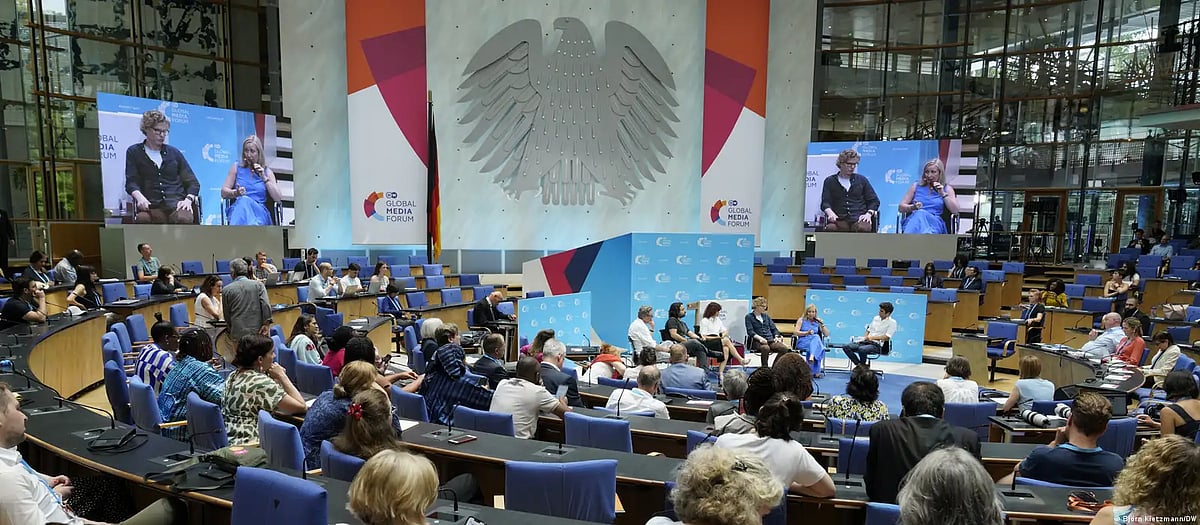
More than a thousand journalists, editors, and media professionals from over a hundred countries attended an international conference in Bonn, Germany, to discuss press freedom, the future of journalism, and the challenges facing the profession. The conference, titled DW Global Media Forum 2026, was organized by Germany's international broadcaster Deutsche Welle. At the opening session on Tuesday, Deutsche Welle Director General Barbara Massing spoke about various aspects of journalism. Her remarks are presented here for Prothom Alo readers.
Good morning. I am delighted to see all of you here and participating in the opening session of the Global Media Forum. Dear State Secretary Leminski, dear Irene Khan, ladies and gentlemen, and my dear colleagues, welcome to the Global Media Forum 2026 in Bonn, Germany.
You have come from different parts of the world to celebrate journalism and democracy in this historic building, the former seat of the German parliament. That truly makes me very happy. I find it remarkable that we have been able to bring together people from more than 110 countries under one roof. Here, we will talk about journalism—particularly its future and the challenges it faces in the current context. That is precisely the purpose of the Global Media Forum. People from different countries, with different perspectives and experiences, have been brought together so they can exchange ideas with one another.
“Fearless, Outspoken Journalism”
Our theme this year is “Journalism Out Loud.” This does not mean journalism has to be noisy. Rather, it means that in an increasingly noisy world, it is essential that journalism's voice is heard. It means restoring journalism's power to connect people. At the same time, it means reaffirming the vital role of a free press in our societies.
It means bringing people together, learning from one another, and understanding what journalism should look like today. It should serve as a powerful antidote to division, extreme nationalism, and isolation.
I believe many people in this room agree with this idea. But it is not enough to keep that belief among ourselves. We must carry it beyond these four walls and demonstrate that independent media do much more than simply deliver the news. They provide guidance, present solutions to problems, create opportunities for discussion, and encourage meaningful public participation in society. Together, all of these elements form the foundation of democracy and security.
“Journalism Out Loud” also means remaining relevant—especially in a world where journalists' voices are increasingly being pushed to the background. We are witnessing a profound transformation. We see deliberate campaigns of disinformation and misinformation. State-controlled groups are also engaged in these activities in order to influence public opinion and destabilize democratic societies. At the same time, major technology companies and their algorithms amplify information without verifying its accuracy. Emotionally charged content is often given greater prominence. This may be done to promote a particular ideology or simply to maximize profits.
“Journalism Out Loud” means staying relevant in a world that is losing its attention span and earning public trust in an age where doubt is being deliberately spread.
The good news is that people still trust people. We can see this in the influence and credibility enjoyed by influencers and so-called “news influencers.”
And that is where a major opportunity for journalism lies. Our newsrooms and media organizations are filled with outstanding journalists who have earned public trust through years of dedication, hard work, and professional expertise. Let us bring these journalists to the forefront—not because of who they are, but because of what they do while upholding journalistic standards. In this way, we can create trusted “news influencers.” However, such visibility often comes at a high price.
Around the world, the number of authoritarian rulers and governments is growing, and truth is increasingly being sacrificed for political or economic interests. As a result, journalism is becoming more dangerous by the day.
The hatred and harassment found on social media are becoming real-world threats to journalists. The number of journalists killed has increased. More than 500 journalists are currently imprisoned around the world. According to Reporters Without Borders, an increasing number of journalists are being forced into exile. Yet even in exile, many are not safe. Authoritarian governments are extending their influence far beyond their own borders. Journalists living in exile continue to face threats and pressure on a regular basis. Transnational repression has now reached alarming levels. Nevertheless, the issue is still not receiving the attention it deserves—at least not in Germany.
Many of our colleagues at DW are also victims of this kind of repression. I truly believe we need to speak about this issue much more openly.
Journalism Requires Courage
Journalism requires courage. I am proud and grateful that so many courageous people are present in this room today—people who are willing to stand up, speak out, and engage in discussions about the future of journalism with us.
One embodiment of such courage is Jimmy Lai. He has been an unwavering supporter of press freedom and democracy in Hong Kong. This evening, we will honor him with the Freedom of Speech Award. He has paid an enormous price for his commitment. He has been imprisoned since 2020. We are truly honored that his daughter, Claire Lai, is here with us today. She will accept the award on his behalf this evening. Thank you very much.
Another person paying a heavy price is our colleague Ali Oduyan in Turkey. He was imprisoned for more than three months. We had hoped that he would be able to come to Bonn, but in the end that was not possible. I am truly grateful to him. Despite his imprisonment and the fact that legal proceedings against him are still ongoing, he returned to work the very day after his release. I think that takes tremendous courage. Thank you very much.
However, people do not only trust individual journalists; they also place their trust in established news organizations.
According to the Reuters report—which we will discuss in greater detail tomorrow—2026 is shaping up to be a landmark year, the first year in which social media and AI chatbots are being used as the primary means of accessing news. Yet there is also good news. Established news organizations remain the most widely used sources of information. This gives us a strong foundation. In the end, credibility, accurate information, context, and a commitment to long-term journalism do pay off.
When people build trust in us over time, they develop a lasting relationship with our journalism regardless of the medium or platform through which they encounter it. And whenever they need reliable information, they return to the news organizations they know and trust.
This latest Reuters report reinforces our commitment to strengthening our brands. At the same time, it reminds us of the importance of distinguishing ourselves through high journalistic standards. It reminds us that trust must be earned every single day.
Let me briefly speak about DW itself. Over the next four years, our work will be guided by three principles: freedom, innovation, and dialogue.
Freedom, because independent journalism is at the core of everything we do. We do not compromise when it comes to freedom.
“Unbiased information for free minds”—that is our slogan. We want people to have access to accurate information.
Whether they live under authoritarian or liberal systems, people should be able to encounter a variety of viewpoints and form their own opinions independently.
Innovation is essential because it is crucial to the future of journalism.
Technology Companies Benefit from Journalism
Artificial intelligence is becoming a permanent feature of our lives, and the pace of innovation is accelerating even further.
As journalists, we must embrace change. We must integrate innovation into our work. We need to harness its opportunities while also addressing its risks.
Innovation is also changing the way we deliver news. We want to focus more closely on the people who are shaping social and economic change.
And finally, dialogue. Democracy depends on it. We want to bring people with different ideologies and perspectives to the same table. Through this, we hope to encourage constructive debate, find solutions, and build bridges across countries, cultures, and communities.
All of this brings us face to face with an uncomfortable truth: quality journalism requires money. It requires time, research, and expertise.
The question, then, is how we can ensure the economic foundation necessary to sustain quality journalism.
One thing is clear. Digital platforms and AI systems derive enormous benefits from journalistic content and news reporting. The content is created by others, and ownership belongs to others. Yet these platforms distribute it, aggregate it, and use it to train their own systems. That is why we need a sustainable business model that values quality journalism and ensures that news and content creators receive a fair share of the revenue generated from their work.
Without a strong economic foundation, independent journalism cannot survive. We need a reliable framework that supports its financing.
Alongside privately owned media organizations, publicly funded media institutions also play a critically important role, especially during times of political tension.
Media organizations must be able to operate independently, free from political interference. That requires a stable and clearly defined funding system that recognizes independent media as one of the pillars of a strong democracy.
In this regard, the European Media Freedom Act has established several important standards. It strengthens the independence of public-service media and makes clear that their funding must never depend on political favoritism.
Every Dollar Invested in Independent Journalism Generates One Hundred Dollars in Benefits
Independent journalism is fundamentally an investment in security, stability, and economic growth.
Just this morning, DW Akademie, the International Fund for Public Interest Media, and UNESCO published a joint research report. The report, titled The Value of Journalism, provides strong evidence for precisely this argument.
The study found that every U.S. dollar invested in independent journalism can generate more than one hundred dollars in benefits for society. These benefits come through recovering misappropriated funds, improving public services, and reducing corruption. By contrast, misinformation costs societies around the world between 350 billion and 500 billion dollars each year.
Freedom of the press and freedom of expression are not luxuries. They are essential to democracy, security, and a free society.
That is why “Journalism Out Loud” means never allowing journalism to be pushed into a defensive corner under any circumstances. Journalism must play an active role in shaping public opinion and must take responsibility for shaping its own future.
The Global Media Forum is exactly the right place to do that.
I would like to thank the German Federal Foreign Office, as well as the state of North Rhine-Westphalia, the Federal Ministry for Economic Cooperation and Development, the participating foundations, and the city of Bonn for making this wonderful event possible.
Here, people from journalism, politics, and civil society come together not only to discuss and analyze the challenges of the future, but also to search for solutions. That, too, requires courage. Because without courage, journalism falls silent.↳
And we cannot allow that to happen.
Let us raise our voices.
Let us be even more courageous.
I wish you all a wonderful conference.
Thank you very much.