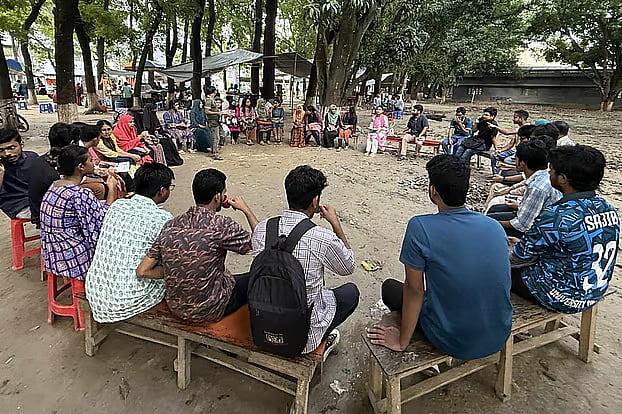
The struggles and challenges of clubs outside Dhaka
Those who are associated with various clubs or organisations at universities face various challenges, especially financial crisis to implement good ideas.
Spending days and nights on campus, organising programmes while neglecting their meals, returning home, body racked with fatigue and heart full of confidence—that's normal!
Reality can sometimes be quite complex, especially for universities outside Dhaka.
Despite all good intentions, many events may not materialise as planned. Brilliant ideas often falter simply due to a lack of sponsorship.
For clubs outside Dhaka, organising major events often equates to facing an overwhelming test. Securing sponsors or patrons is quite challenging. It becomes a norm to cut costs, reduce the scale of events, and personally fund part of the budget.
Small budget, big dreams
No matter how big the dream of organising an event on campus, it eventually has to be grounded in reality.
Zeba Anika Chowdhury, General Secretary of the Rajshahi University Education Club, shared their experience: "Often we sit with ideas, and then we start calculating. For us, financial management is the biggest challenge before implementing any idea. Many great ideas have to be downsised just due to budget constraints."
This reality is not unique to a single club. Clubs in Khulna, Barishal, Cumilla, Jashore, Dinajpur, or Rangpur all have to shape their plans within limited resources. Often, instead of organising multiple programmes together, they have to do them separately. Sometimes, the number of guests needs to be reduced, or the entire event has to be scaled down.
Yet, their dreams are not stopped by these constraints. As Zeba mentioned, "Last year, we organised an international research conference for the first time. Hosting an event of international standard is quite challenging for any club, and without a sponsor, it gets even tougher. For us, being a club outside Dhaka, this event was the most challenging. Even without sponsorship from any major corporate entities, we overcame the challenge with the help of teachers and participation fees. 1,300 people participated in our event from across the country and abroad."
Funding from their pockets
Due to a lack of funds, club members often fund events from their own pockets. This involves a sense of responsibility and passion. Iftiar Rahman, President of the Robotics Society of Jashore University of Science and Technology, said, "Since taking on the role of president, I've noticed that almost every event requires some personal spending. Other members also contribute in this way. Universities in Dhaka, where a single robotics event attracts sponsors, allows for large prize pools, and charges over Tk 2,000 as registration fees, while we have to keep the prize pool small. Sometimes, it's hard to even set a Tk 500 registration fee, and the expected number of participants isn't obtained."
Due to these limitations, club leaders employ various strategies to successfully conduct events. I spoke with Mahmudul Islam from Hajee Mohammad Danesh Science and Technology University. He is the Chairperson of the international organisation IEEE HSTU Student Branch.
He provided an example of implementing programmes by reducing the budget: "We don't view limited resources merely as constraints; rather, we see them as a creative challenge. Our student branch tries to minimise costs by maximising the use of the campus' own labs, classrooms, and existing facilities. Additionally, we reduce external expenses by incorporating skilled seniors, alumni, and team members as trainers. In many cases, we can engage more students by using online or hybrid methods. Planned management, teamwork, and optimal use of resources are our primary strategies. Recently, we organised the ''BotBuilder Bootcamp: Semi-Autonomous Soccer Bot Workshop'' successfully without any major sponsorship."
Seeking solutions
In conversations with university-based organisations across the country, it was evident that despite various limitations, they all share one common trait—they are highly initiative-driven. No one is the type to give up. They are committed to showcasing something every semester by coordinating in some way; however, merely strong will isn't enough to maintain this continuity. Structural support and equal opportunities are essential.
Shubhra Debnath, President of the IT Society of Barishal University, believes the core issue lies in the Dhaka-centricity of the country's corporate and institutional structures.
He says, "As most companies and business establishments in our country are Dhaka-centric, they mainly collaborate with Dhaka clubs. Even banks and NGOs tend to find Dhaka-centric promotions more effective."
Shubhra suggests that addressing this disparity requires more than just the clubs' efforts; a change in the perspective of sponsors and institutions is necessary.
He states, "Rather than considering Dhaka as the sole centre, communication and engagement should be increased in regional zones as well. We want opportunities for skill development to spread across the country for students; however, without corporate support, such initiatives can never have a large-scale impact. I believe, for a sustainable change, a collective effort is needed; where clubs, alumni, corporate institutions, and policymakers work together. Then, hopefully, the situation will improve."