Travelling
Nepal in three heartbeats: My memories, his first steps and her wonder
I had been to Nepal more than a decade ago, yet the country has a way of making every arrival feel like the first. This time, as our plane sliced through the morning haze, the pilot’s voice broke the quiet hum inside the cabin: “You can see Everest through your window.”
Instantly, every passenger leaned toward the glass. And there it was the Himalaya, an endless spine of white peaks, sharp and serene. The sight sent a familiar thrill rushing under my skin, that unmistakable flutter only a mountain lover knows. It felt almost symbolic, as if the mountains themselves were welcoming us back with the same tenderness of an old friend.
From the runway of Kathmandu’s Tribhuvan International Airport, the peaks looked even closer, their snow-bright silhouettes rising like guardians above the valley. The moment we stepped inside the airport, a sense of warmth replaced the mountain chill. Tribhuvan has changed: electronic visa booths line the hall, volunteers guide travellers through the process, and free Wi-Fi makes everything simpler.
Even the immigration officers greet you with genuine smiles, something rare enough worldwide to feel remarkable. Airports often feel hurried and impersonal, but here there was an ease, a slow, comforting rhythm that set the tone for the rest of our journey.
After clearing immigration, we collected our luggage and headed straight for Nagarkot in a pre-booked taxi. My last journey on this route in 2015 had been bumpy and narrow, with only a handful of lodges scattered along the way.
Nagarkot itself deserves a line of its own. Perched on the eastern rim of the Kathmandu Valley, it is one of Nepal’s most loved hill stations, known for sweeping Himalayan views, quiet pine-scented air, and skies that look close enough to touch. The stillness there feels almost sacred, as if the mountains have the power to hush every noise inside and outside you.
This time, the transformation was striking. Smooth, widened roads snaked upward, flanked by newly built hotels each prettier than the last. The drive itself felt like a gentle transition between city and sky, a gradual climb into silence and fresh air.
By the time we reached our hotel around 4:00 pm, the air had turned sharply cold. A biting wind clung to our skin, but stepping into the hotel lobby felt like entering a warm, aesthetic cocoon.
The décor was soothing, and the welcome mocktail, a tangy blend with a hint of honey, set the tone for our stay. It was such a small thing, yet after a long journey, that single glass felt like a personal gesture of warmth.
Nagarkot itself deserves a line of its own. Perched on the eastern rim of the Kathmandu Valley, it is one of Nepal’s most loved hill stations, known for sweeping Himalayan views, quiet pine-scented air, and skies that look close enough to touch. The stillness there feels almost sacred, as if the mountains have the power to hush every noise inside and outside you.
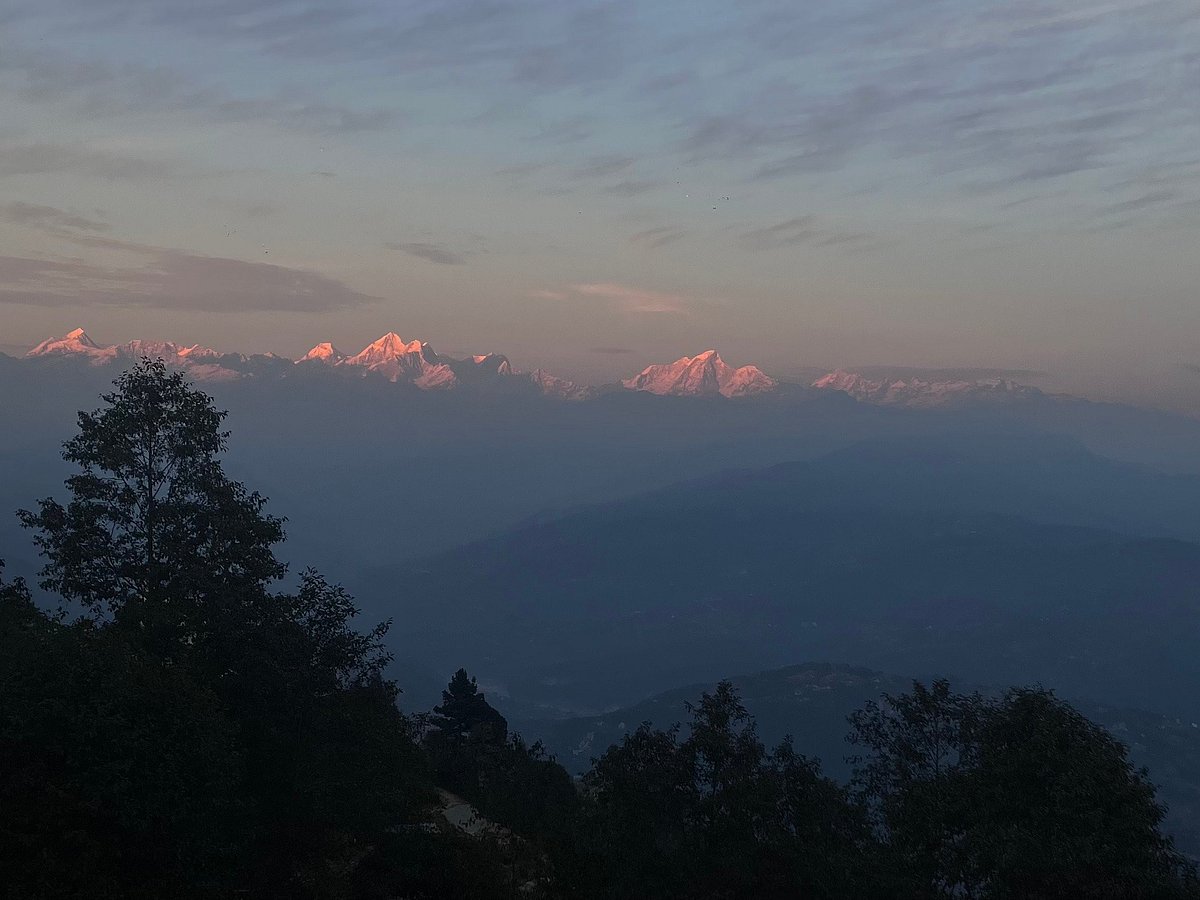
Despite the wind, we couldn’t resist climbing up to the terrace. Before us stretched an unbelievable panorama: Ganesh Himal, Langtang, Manaslu, Jugal, and several other peaks the hotel had neatly labeled on a picture they handed us. My husband, as it is his first time in Nepal, determined to identify each one, kept matching mountain outlines with the photo.
At one point, convinced he had spotted Everest, he triumphantly called the manager for confirmation, only to be gently corrected. “No sir,” the manager smiled, “Sagarmatha is not visible today.” My husband simply frowned and muttered, “He doesn’t know,” refusing to give up on his discovery. The scene became one of those small family jokes we laughed about for days.
Nagarkot is famous for its sunrise and sunset. Here, the mountains turn gold at dawn and rose-blue at dusk, shifting their colours as if breathing with the sun. No photograph can truly capture it, you must stand in the cold, watching the sky paint itself. The brief minutes of transition feel like watching nature whisper its oldest secrets.
One amusing pattern kept recurring: we frequently had to explain that Bangladesh and Kolkata are not the same place. Many Nepalis assume both are synonymous simply because we speak Bengali. These little cross-cultural confusions often make travel more amusing than frustrating.
On the third day, we headed back to Kathmandu. With each turn downhill, the temperature rose noticeably. Our taxi driver turned out to be unusually well-informed about politics, both Nepali and global. He spoke about corruption and the protests that had toppled the recent government, quoting statistics with surprising accuracy. His insights gently reminded us that no profession defines a person’s intellect; no one is truly apolitical. The drive became unexpectedly enlightening, like listening to a moving podcast against the backdrop of terraced hills and scattered villages.
During this season, Nepal’s markets overflow with fresh fruits. We bought avocados, Japanese grapes, and persimmons, priced far lower than in Bangladesh. The colours, textures and smells made the markets feel alive, reminding me how seasonal produce can instantly define the character of a place.
For our Kathmandu stay, we chose a boutique hotel in a quiet residential area, about 20 minutes from Thamel. With our daughter travelling abroad for the first time and in such cold we wanted somewhere peaceful.
The hotel’s interior resembled a traditional Newari house, full of warm brickwork and carved wooden windows. The Newar-style “jali” work, intricate latticed patterns, was mesmerising, a reminder of the Tibetan-Bhutanese cultural echoes spread across the region. Every corner told a story of craftsmanship, patience and heritage.
That evening, we visited Durbar Square. My daughter squealed with excitement at the sight of hundreds of pigeons flocking around her, their wings brushing the air like soft applause.
Children find joy in the simplest things, and watching her run among the pigeons made the ancient square feel even more alive. Later, we stopped at Himalayan Java, my old favourite from previous trips. Their coffee still carries that Starbucks-like richness I remembered.
One amusing pattern kept recurring: we frequently had to explain that Bangladesh and Kolkata are not the same place. Many Nepalis assume both are synonymous simply because we speak Bengali. These little cross-cultural confusions often make travel more amusing than frustrating.
We also observed something special about Nepali people, they are calm. Even when traffic snarls up and bikes scrape against cars, nobody shouts. No one explodes on the street. It’s a quiet patience that urban South Asians rarely witness. That gentleness becomes part of the country’s charm, an understated, effortless kindness.
Nepal is also full of electric cars now, especially Teslas and BYDs. For any car enthusiast, Kathmandu feels unexpectedly futuristic. The contrast between ancient temples and modern EVs makes the city feel like a blend of centuries.
Unfortunately, our daughter fell severely ill on the penultimate day. We cancelled our plan to visit Chandragiri and its serene cable car ride, opting instead for some light shopping at Durbar Marg. There we discovered another surprise: almost all international brands cost 20–30 per cent more in Nepal. The price tags made us laugh, but also wonder about the economic quirks that shape everyday life in a landlocked country.
Our final morning began smoothly, until we reached the airport and learned our flight was delayed by nearly three hours. When I called the hotel to request a late checkout, they insisted we return and rest. To our astonishment, they gave us their best suite, for free, and even offered food for our baby. It was hospitality at its purest. Experiences like these anchor themselves in memory far longer than any sightseeing.
But the biggest surprise awaited us back at the airport. A security officer approached me saying, “We are looking for you, we even made an announcement.” Before I could panic, he added, “You lost your wallet. It has 100 dollars and 150 rupees.” My heart froze. I checked my bag, indeed, it was missing. Moments later, they handed it back intact. We later realised our daughter must have dropped it earlier. The honesty and sincerity of the Nepali staff left us deeply moved. It felt like the perfect closing note to a trip filled with small acts of kindness.
Nepal welcomed us warmly, surprised us often, and reminded us how kindness still exists in the world. And that is perhaps the most beautiful souvenir a traveller can bring home. As our plane lifted off the ground, the mountains slowly vanished behind the clouds, but the warmth we felt from the people stayed with us, quiet, steady, unforgettable.