In retrospect, the fall of Sheikh Hasina and her Awami League government seemed inevitable. But at the time when Sheikh Hasina, as prime minister, had reached the pinnacle of autocratic power along with her clan and cronies, it had seemed like she was here to stay. So when her empire came crashing down on 5 August 2024, the country resounded with relief and jubilation. It had been a successful uprising of the youth and the masses.
A discerning political observer, of course, will be well aware that just as "Rome was not built in a day," not did the "fall of the Roman empire" happen overnight. And the same applies to Hasina''s fascist rule in Bangladesh.
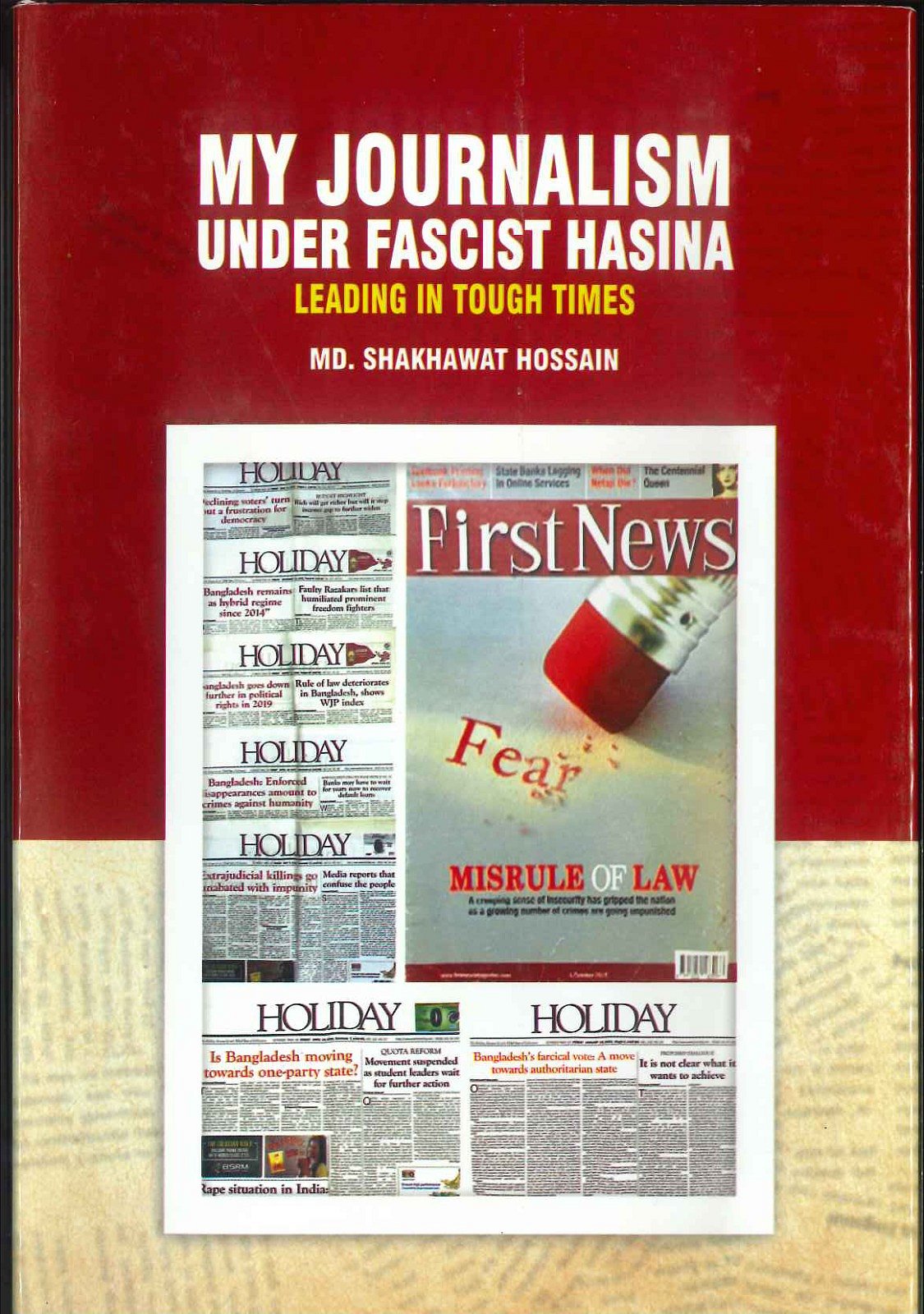
This is exactly what journalist Md Shakhawat Hossain has detailed in his book ''My Journalism Under Fascist Hasina." Having worked in both Bengali and English news media outlets of the country, including the prestigious weekly Holiday, Hossain also served for a long tenure as a senior official in a foreign diplomatic mission in Dhaka. He had the opportunity, and acumen, to observe political developments -- with all the machinations and manipulations -- at close quarters.
Nothing deterred his pen, not even dismissal from his long-standing job. He was a journalist committed to truth. And this book is a detailed narrative on unfolding events during the reign of Sheikh Hasina and her Awami League government.The book is divided into four broad sections: 1. Politics/Democracy/Polls; 2. Law and Order, Human Rights; 3. Corruption; and, 4. Foreign Affairs.
Bangladesh had officially become a one-party state of an exotic variety, where elections take place, yet votes are not properly counted; where numerous opposition parties are allowed to exist, but are effectively rendered impotent
To put things in context, in the preface of the book the author quite openly states that the election held under the military-backed caretaker government was not really all that free and fair as generally perceived. It was subtly staged to bring Awami League to power. While there is a common understanding of this among many, there is also a propensity to hush this up. Shakhawat Hossain is more outspoken. He speaks of his personal conviction that truth must be spoken. He is also ready to point out that the fall of the Awami League government and its leader Sheikh Hasina was not just a result of a 36-day movement, but a culmination of the long and extended struggle of democracy-loving political parties who were oppressed, repressed and suppressed over the years.
Opening with the questionable 11th national parliamentary election of 30 December 2018, which swept the ruling Awami League to power once again, the author chooses to quote from foreign media to back up his contention that these polls were nothing short of farcical. A foreign media outlet purportedly said that the margin of victory, 96 per cent, was a result one might expect on a place like North Korea, not a democratic nation like Bangladesh. Another outlet spoke of the opposition being sidelined to usher in an ostensibly one-party state.
He quotes from Al Jazeera: "What happened on 30 December clearly shows that Bangladesh had officially become a one-party state of an exotic variety, where elections take place, yet votes are not properly counted; where numerous opposition parties are allowed to exist, but are effectively rendered impotent and barred from every reaching power; and where the raucous media are "free" but are only able to produce a self-censored cacophony of government-approved narratives."
While pointing out the various forms of rigging which included intimidation, barring opposition polling agents from the polling centres, stuffing ballot boxes and so on, the writer also highlights the extreme criminal activities surrounding the election. He writes of a woman being gang raped for casting her vote in favour of the main opposition party.
Transparency International Bangladesh (TIB) detected malpractices, but Chief Election Commissioner KM Nurul Islam rejected TIB allegations outright. The donor community, including the UN, was not happy with the election, the media outlet CNN saw the disputed election ushering in a dangerous new era for Bangladesh politics, but the government paid no heed.
The Awami League did not bring peace of stability, just a semblance of development which analysts saw as a means to fill the personal pockets of those in power. On 4 October 2015, Shakhawat Hossain wrote in the online magazine First News, that a "sense of insecurity has gripped the nation with the worsening of law and order situation in the country." He speaks of the killings, enforced disappearances and other egregious crimes including gang rape and child murders.
Hasina and her government tried to use the facade of economic development to exonerate their authoritarian rule, subtly (perhaps not so subtly) promoting development over democracy. But in an article on 9 March 2018 in the Weekly Holiday, Shakhawat Hossain wrote about how Tk 94 billion capital was gobbled up under political influence. That was not even the tip of the iceberg. He wrote, "Sonali Bank, Janata Bank, Agrani Bank, Rupali Bank and BASIC Bank have become safe havens for rule violators as their boards illegally dictate the loan approval process and thus sources of plundering of public money could take place for lack of transparency in credit approval, credit administration and credit oversight, poor selection of borrowers, politically motivated lending and negligence in risk management."
In the chapter ''Clash of the Titans,'' the author speeaks of India''s growing interest in the power sector of Bangladesh which were also aimed at thwarting China''s business initiatives here. He writes of other interesting diplomatic developments and manoeuvres in foreign affairs. The bottom line is, even in its foreign relations, the Hasina government focussed on personal rather than national gain, subservient in some instances and arrogant in others.
Thus the book covers the gamut of Awami League''s rule of the country under Sheikh Hasina, through the eyes of the author as a journalist with an analytical bent of mind. It is interesting to read and job one's memory, so Bangladesh may never fall into that vicious cycle of crime and corruption ever again.