Opinion
Prime Minister’s China visit gives message of ‘strategic autonomy’
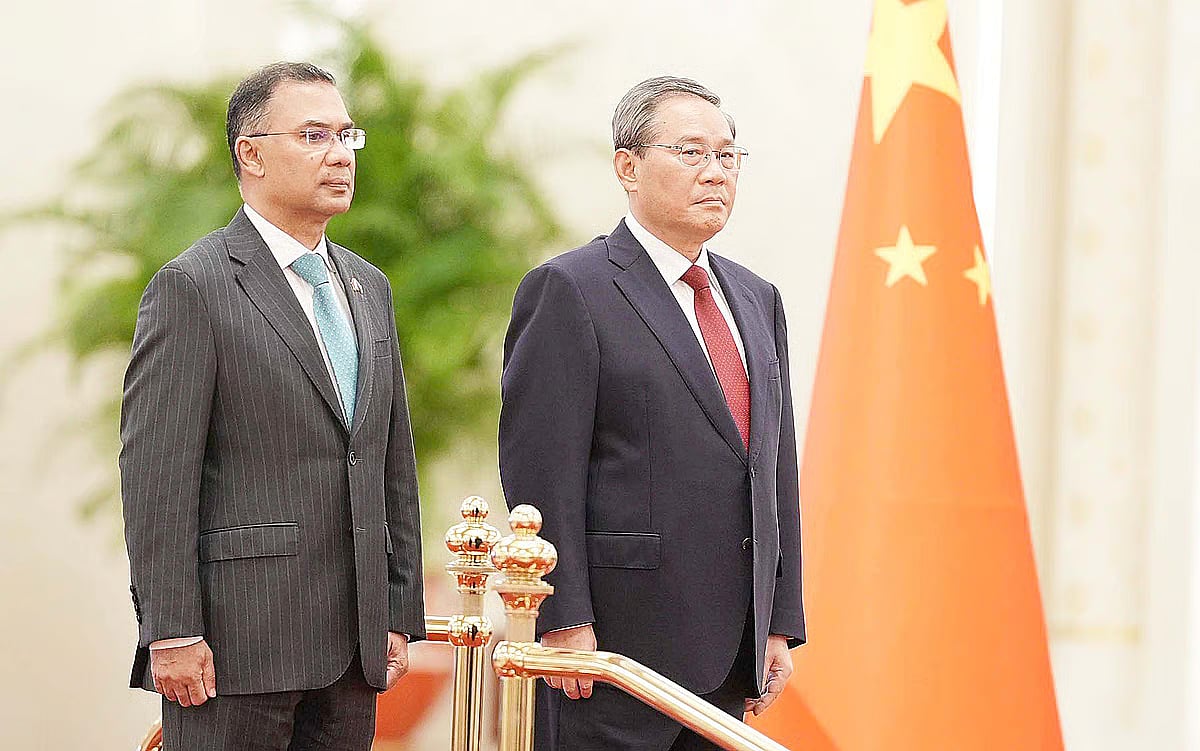
Nearly four months after assuming office, Prime Minister Tarique Rahman undertook a visit to China via Malaysia. This marked his maiden state visit. Although the itinerary spanned two nations, given the current global geopolitical landscape, public attention was overwhelmingly focused on his meeting with President Xi Jinping. In particular, Bangladesh’s large neighbour, India, kept a close watch on this visit.
Whether globally or regionally, the historical backdrop of Sino-Indian relations in the subcontinent’s geopolitics, alongside India’s perspective on China’s strategic ties with neighbouring countries, is bound to exert influence. Far from being a mere influence, it remains a critical subject of deliberation among India’s geopolitical and military analysts. This reality was clearly reflected across various discussions surrounding the prime minister’s maiden China visit.
The reason for highlighting these aspects is that the somewhat disproportionate relationship between Bangladesh and India, which developed over a long period—specifically during Sheikh Hasina’s 15-year tenure—is undergoing a noticeable shift in the current context.
My view is that for the majority of the time, we failed to maintain the necessary distinctiveness or strategic autonomy in formulating our foreign and strategic policies. This becomes glaringly evident in inter-state relations within the subcontinent revolving around China. I believe that the shifts brought to subcontinental geopolitics by the Afghan war, the Iran-US-Israel conflict, and the unprecedented rise of China are profoundly impacting the foreign and defence policies of countries like ours.
Against this backdrop, it is imperative to sustain the dialogue regarding Bangladesh’s ongoing and evolving relationship with China. China recognised an independent Bangladesh on 31 August 1975, and diplomatic ties were established in October of the same year. Following subsequent political developments in Bangladesh, President Ziaur Rahman came to power and visited China for the first time in January 1977 as the Chief Martial Law Administrator. He was accorded a significant state reception by the Chinese leadership.
He visited China for a second time in July 1980 as the President of Bangladesh. These two visits laid the foundation for a strategic relationship between Bangladesh and China in the military sphere. Subsequently, ties expanded into other sectors as well. In 2016, Bangladesh joined China’s Belt and Road Initiative (BRI), which brought with it an announcement of development projects worth approximately USD 40 billion.
However, as Bangladesh’s foreign policy over the past 15 years was predominantly India-centric, political relations with China remained somewhat lukewarm. Despite China’s substantial participation in commercial and development ventures, only about USD 4.5 billion worth of projects have been implemented out of the promised USD 40 billion development package so far.
In this context, there is ample reason to view Prime Minister Tarique Rahman’s China visit as following in the footsteps of his father, the late President Ziaur Rahman, and his mother, former Prime Minister Begum Khaleda Zia. I believe this visit has reflected the national interests and public aspirations of Bangladesh. During the tour, 13 Memorandums of Understanding (MoUs) were signed with China. Among these, three specific matters are being widely discussed within the country.
The prime minister’s visit is both timely and highly significant. Tied to it are Bangladesh’s geopolitical positioning and strategic autonomy, which constitute the natural right of an independent and sovereign state. In the recent past, this independence appeared to have been curtailed to a great extent.
Steering clear of other matters, I would like to highlight two primary areas. The first is the expansion and modernisation of the Mongla Seaport, which has also become a focal point of discussion among geopolitical analysts in our neighbouring country. This project is not new. Its core objective is to upgrade Mongla Port to handle container cargo efficiently. To this end, plans were drawn up for new terminals, necessary equipment, and yard expansion.
A project proposal worth approximately Tk 40.68 billion (4,068 crore) was formulated on a G-to-G (Government-to-Government) basis to construct two jetties and associated infrastructure with Chinese assistance. Of this amount, China’s assistance constitutes around Tk 35.93 billion, with the Bangladesh government covering the remainder.
Once implemented, the project will enable Mongla Port to handle roughly 400,000 TEUs (20-foot Equivalent Units of containers) annually. Notably, Mongla Port currently lacks dedicated container berths; all existing berths are utilised for bulk cargo. Consequently, this capacity should have been developed much earlier.
During the tenure of the interim government, the project was re-evaluated, and its cost was reduced by approximately Tk 2.14 billion. Despite receiving approval from ECNEC for a second time and the signing of the agreement, work could not commence due to delays in the release of funds from China. Later, this initiative was integrated with the proposed Chinese EPZ project in Mongla. Reports indicate that progress on this front was achieved during the prime minister’s recent visit. Meanwhile, an Indian proposal to construct and expand two additional container berths was also under consideration. However, due to escalating costs and other variables, the interim government chose not to proceed with that project.
Therefore, expansion remains the only viable alternative to transform Mongla Port into a modern and regional hub. In my assessment, China’s proposal is far more cost-effective and efficient for Bangladesh from both an economic and technical standpoint. Even in the absence of a container terminal, the port generated a revenue of approximately Tk 3.44 billion in the 2024–25 fiscal year, yielding a surplus of over Tk 620 million for the first time. At present, container handling is carried out solely by utilising bulk berths. Consequently, following the expansion, the port’s utility and regional significance will increase exponentially. Furthermore, the Chinese EPZ in Mongla will accelerate the economic development of the entire region, not just the port.
Beyond Mongla Port, the China-proposed economic corridor involving Bangladesh-Myanmar-China holds immense strategic importance. This is essentially a rebranded iteration of the earlier BCIM (Bangladesh-China-India-Myanmar) initiative. This corridor is vital for establishing connectivity and expanding future trade between Bangladesh, China, and Myanmar.
Concurrently, the regional prominence of Chittagong Port, the Bay Terminal, the APM Terminal, and the Matarbari Deep Sea Port as regional hubs will multiply manifold. In the interest of Bangladesh’s future socio-economic progression, the government must accord serious consideration to this proposal. This corridor will also integrate Bangladesh more effectively with ASEAN. It is worth noting that China has extended the invitation to join this economic corridor to India as well. This can be termed a new version of the BCIM initiative.
In conclusion, it is entirely natural and desirable for Bangladesh, as a sovereign state, to adopt an independent foreign and defence policy. However, the objective of this policy is not to cause detriment to any nation. Rather, our goal is to maintain amicable relations with all countries, particularly our neighbours. It is the expectation of the nation’s citizens that the current government will steadfastly continue to make independent strategic decisions in the national interest of Bangladesh.
* M Sakhawat Hossain is a former Adviser to the Interim Government
* The views expressed are the author’s own