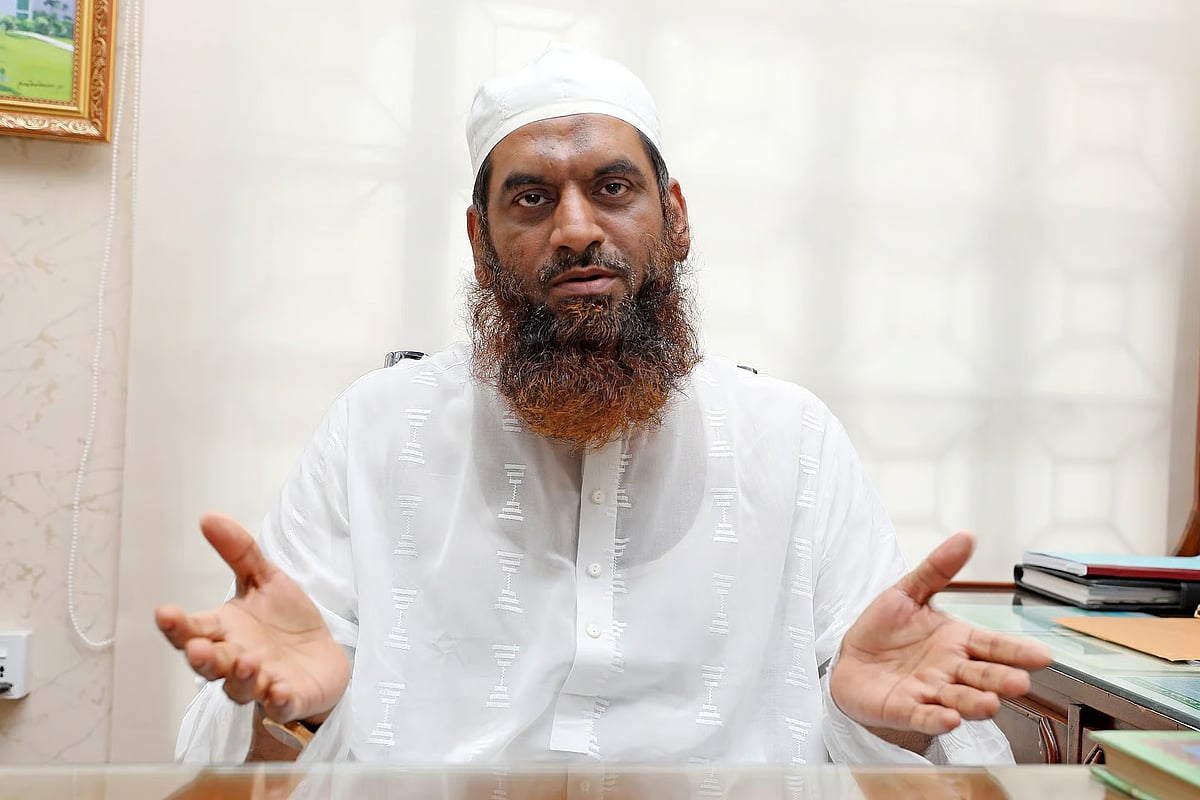
Exclusive Interview: Mamunul Haque
3 issues of Afghanistan impress, concerns for women education
Recently, seven Bangladeshi scholars visited Afghanistan. They are Maulana Abdul Hamid, Maulana Mamunul Haque, Maulana Abdul Awal, Maulana Abdul Haque, Maulana Habibullah Mahmud Qasemi, Maulana Monir Hossain Qasemi, and Maulana Mahbubur Rahman.
After an eight-day trip, they returned to Bangladesh last Thursday. Speaking to Prothom Alo, Mamunul Haque, Amir of Bangladesh Khelafat Majlis, discussed why and how they went to Afghanistan and what they witnessed during the visit. Prothom Alo’s special correspondent Selim Zahid has taken the interview.
Prothom Alo: Why did you suddenly go to Afghanistan, and who arranged it?
Mamunul Haque: There is a UK-based organisation called ‘Prosper Afghanistan.’ Most of its responsible members are of Bangladeshi origin. They work on human rights in various countries, particularly providing legal and humanitarian support to Muslims in distress. As a war-torn country, Afghanistan is of special interest to them.
Accordingly, they organise visits with different delegations. They have already brought two delegations of Islamic scholars from London. Their third project was to bring a delegation of Ulema from Bangladesh. In that context, they contacted us.
We said that if the visit was conducted properly and legally, without any issues, there would be no problem in going. Then they formed a delegate from our side and coordinated with the Afghan government. The processing was done with approval from their Ministry of Home Affairs.
Prothom Alo: How long was the visit?
Mamunul Haque: We left on 17 September and returned on the night of 25 September. About eight days.
Prothom Alo: Was it pre-planned where you would go, where you would stay, and who you would meet there?
Mamunul Haque: Our host organisation probably coordinated in advance. The details were not discussed with us beforehand. However, it was agreed that we would meet key individuals.
Prothom Alo: Who all did you meet? Can you give specific names?
Mamunul Haque: We had a long discussion at the ministry with their foreign minister, Molla Amir Khan Muttaqi. Then we met the minister of water and electricity, Molla Abdul Latif Mansur, and the minister of labour and social welfare, Molla Abdul Mannan.
They have also created a new ministry called “Amr Bil Ma’ruf, Wannahi Anil Munkar,” which is an important directive in Islam, meaning “enjoin good and forbid evil.” We had a meeting with the deputy minister there, Maulvi Ali Ahmed.
Additionally, we met Afghanistan’s chief justice, Maulvi Abdul Hakim Haqqani, a leading scholar and teacher of several senior ministers. The discussion took place at the chief justice’s office.
Outside of that, we were scheduled to meet the home minister, but due to his personal commitments, he couldn’t spare time. We met one of his deputies, who is also a well-known figure.
We also visited Khost province, a few hundred kilometres from the capital Kabul, where we met the governor—though I can’t recall his name at the moment. We visited educational institutions there, including the Afghan Darul Uloom and Abdullah Ibn Masud University.
Prothom Alo: Was the entire visit Kabul-centric?
Mamunul Haque: Yes. Apart from Khost, everything else was centred in Kabul.
Prothom Alo: What did you discuss with the Afghan foreign minister?
Mamunul Haque: We asked the foreign minister about the opportunities for Bangladesh to work with Afghanistan. In the discussions that emerged, we focused on three main points. First, as a Muslim country, we talked about establishing diplomatic relations with them. He informed us that Afghanistan already has diplomatic relations with 41 countries. In these countries, diplomats appointed by the current Afghan government are working actively. In the South Asian region, they have representatives in India and Pakistan, and in almost every other country—but not in Bangladesh. They requested us to speak with everyone on this matter, as they are interested in establishing diplomatic relations.
Prothom Alo: Has there been any communication or discussion between the Bangladesh government and them (the Afghan authorities) regarding the establishment of diplomatic relations?
Mamunul Haque: The foreign minister told us that during the OIC session, he spoke with our foreign affairs adviser. He also informed us that they (the Afghan government) have already sent a letter to our foreign ministry. They want to send a diplomat from Afghanistan to Bangladesh. However, they have yet to receive any response from the Bangladeshi side. Except for Kuwait, they have diplomats in all Arab countries. In South Asia, Bangladesh is the only one remaining.
Prothom Alo: Since they gave you this responsibility, will you be communicating with the government regarding this issue?
Mamunul Haque: No, it’s not an official responsibility. They simply made a request to us. We will convey the matter to the foreign ministry.
Prothom Alo: What stood out to you the most during your trip to Afghanistan?
Mamunul Haque: As we follow Islam in all aspects of life, what attracted us most was this: today’s world tends to believe that those educated in Islamic education are incapable of running society or the state. But what we saw there was the opposite. People with purely madrasah education are running all ministries and governing the country. They have made remarkable progress in rebuilding a war-torn nation in a very short time. That significantly boosted our confidence.
Prothom Alo: If you were to name three key takeaways from this trip, what would they be?
Mamunul Haque: Three things stood out:
Security – That’s number one. At least 5 million people there possess heavy weapons. Almost everyone owns a weapon, yet in the last four years, there hasn’t been a single incident of fighting, clashes, or bloodshed. You don’t hear of robbery or mugging. They’ve created an incredible environment of security in a short time.
Development – Economically, the entire world is boycotting them. Yet, they are running the country with just two main sources: customs revenue and mineral resources. Despite these limitations, they are progressing rapidly. They told us they provide monthly allowances to 800,000 families, including orphans and widows of those who died in the previous war. Interestingly, they don’t just support the families of their own supporters—if someone who fought against them died and left behind orphans or widows, those families also receive support. When they first came to power four years ago, one US dollar was equivalent to 130 Afghanis. Now, it’s 68 Afghanis.
Justice System – We learned how their judiciary functions. It has three tiers: lower court, appellate court, and the high court. Lower courts must resolve cases within 15 days. If an extension is needed, they must seek permission from a higher court. There’s no requirement for lawyers, barristers, or mediators. If someone wants, they can hire a lawyer, but in most cases, both the plaintiff and the defendant present the case themselves. Over 50 per cent of cases are resolved without any legal representation. This aspect impressed us the most.
Prothom Alo: What did you find objectionable or concerning?
Mamunul Haque: There is one issue we found objectionable, and that’s related to women’s education. We expressed our concerns about it. However, there are a lot of rumours about women’s situation there—we didn’t find those to be entirely true. We saw that women are moving around freely.
Prothom Alo: Without the burqa?
Mamunul Haque: Wearing the burqa is not mandatory. Covering the face is also not mandatory. However, there are public announcements or signs in some places encouraging it—like, “Please observe Islamic hijab.” Not all women follow it. Some fully adhere to it, while others partially deviate. Women are going shopping. In the hotels and restaurants where we dined, women were also there—eating in separate sections. We saw groups of women out on the streets, shopping, some even driving cars.
Prothom Alo: What did you say to them about women’s education, and
Mamunul Haque: We spoke to them about education. They told us that during the previous occupation, the education system was heavily altered and made un-Islamic. So now, they are completely reforming the curriculum. As part of that, they are eliminating co-education and creating a separate education system for girls. Currently, girls are allowed to study up to Class 6. Girls are attending school up to that level. Beyond Class 6, only religious education is available for girls. For boys, both religious and general education are available. Girls’ higher education is currently suspended, but they are in the process of developing a new curriculum for it.
Prothom Alo: You mentioned your objection to the restriction on girls’ education. Did you raise this with them? Who did you speak to?
Mamunul Haque: Yes, we raised the issue with several ministries. We mentioned it to the foreign minister, and also to the chief justice. They assured us that girls will be allowed to pursue higher education. They said they are working on it quickly and that we’ll hear good news soon.
Prothom Alo: Do you think there is any room for suspicion or doubt about your trip and your meetings with ministers and other important figures there?
Mamunul Haque: We think this is just an unnecessary fear. There’s no reason to panic, and nothing illegal has taken place. The US is having official meetings with this government, NATO is meeting with them, and countries from the Western world are engaging with them. If the major powers can hold meetings and sign agreements with them, then why should it be questionable if people from a poor country like ours simply meet and speak with them? That kind of reaction reflects an inferiority complex.
Prothom Alo: There has long been talk of a connection between Bangladesh’s Qawmi madrasahs and the Taliban in Afghanistan. Perhaps some people are concerned because of that.
Mamunul Haque: We have no need for a Taliban-style state in Bangladesh. Ninety per cent of Bangladesh's population is Muslim. As you know, surveys conducted by the National Consensus Commission have shown that 70 to 80 per cent of people in the country want Shariah-based governance. If the people of the country want Shariah law, why should that public desire be silenced by labeling it as Taliban-style rule? We see that as deeply unfair. Any Muslim naturally has an aspiration to live under Shariah law. That’s because no other system can fully guarantee people's complete rights the way Shariah can.
Prothom Alo: Were they aware of recent events in Bangladesh, especially the "July uprising"?
Mamunul Haque: Yes. The interior minister said, "You’re doing well after the July revolution." Almost everyone there seemed to be aware of the uprising. They view the movement positively. They believe that the injustice and oppression under the previous Awami League government have come to an end. Islamists played a significant role in that uprising. They had suffered the most under the previous regime and have now been freed from that oppression.
Prothom Alo: Was it the first time your entire team visited Afghanistan?
Mamunul Haque: Yes, I believe it was the first time for everyone.
Prothom Alo: Final question, before going to Afghanistan, did you seek any permission from the government? And on your return, were you questioned at the airport?
Mamunul Haque: There is no legal barrier to visiting Afghanistan. As you may know, not long ago, a state-sanctioned Bangladeshi team went there with humanitarian aid. Several Bangladeshi NGOs have also been providing services there for years. So we didn’t feel the need to seek permission from the government.
After performing Umrah in Saudi Arabia, we traveled to Kabul via Dubai. On the return journey, we came back to Bangladesh from Kabul through Dubai. The Afghan government arranged special visas for us to enter from Dubai, so no entry stamps were placed on our passports. Because of that, the immigration authorities had no reason to question us.