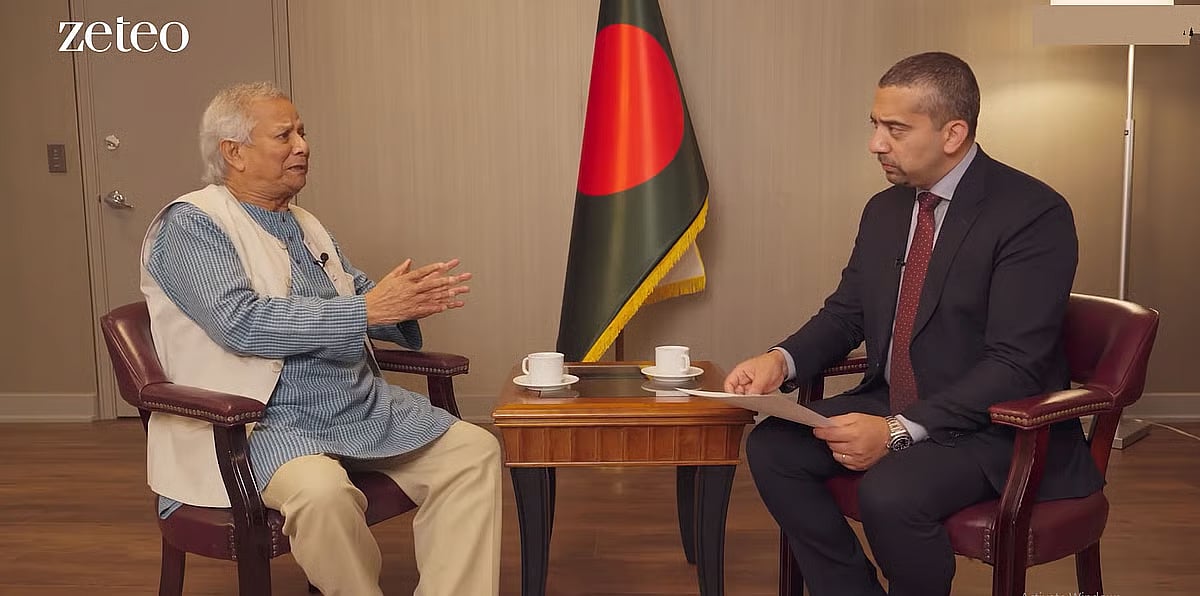
Interview to Zeteo’s Mehdi Hassan
What Prof. Yunus says about Awami League and Sheikh Hasina
Chief Adviser Professor Muhammad Yunus is currently on an official visit to New York to attend the 80th session of the United Nations General Assembly. On the sidelines of the session, he gave an interview to Mehdi Hassan of the digital media outlet Zeteo. In the interview, he spoke on a wide range of issues including the July Uprising, the fall of the Awami League government, his assumption of office as Chief Adviser to the interim administration, Sheikh Hasina’s refuge in India, the banning of Awami League’s activities, and the upcoming elections. A substantial part of the conversation centred on the prohibition of Awami League activities and his reflections on Sheikh Hasina. Presented below, in a question-and-answer format, is that section of the interview, reproduced verbatim for readers of Prothom Alo. Subsequent portions of the interview will follow in due course.
Muhammad Yunus, Chief Adviser to Bangladesh, thank you so much for joining me on Zeteo.
Muhammad Yunus: Thank you for having me.
A lot has happened since you and I last spoke. I think we last spoke in 2017. You were a private citizen back then. Just your regular Nobel Peace Prize winning economist, but you weren’t running a country. A little over a year ago, student protesters in Bangladesh toppled the Awami league government, with Prime Minister Sheikh Hasina fleeing the country. For two decades, she was a de-facto dictator in your country; carried out multiple human rights abuses. A lot of people were pleased to see the back of her. What was your initial reaction to the toppling of her government? What was your memory of that day that night? What did you feel that night? Fear, hope, shock?
Muhammad Yunus: Excitement, excitement. Excitement. Yes, indeed. Finally, it happened. That’s fantastic news.
Did you think it would happen?
Muhammad Yunus: No, it was out of the blue. There was a demonstration going on that’s what you see in Bangladesh. But not something like that. That’s you fleeing the country; situation was so bad. At that time I didn’t know the details of what happened before she left but the final news that she left, that was exciting.
And what is the reaction being from the Bangladeshi people over the last year? You just marked one year since. The revolution just had the first anniversary. What is the mood in the country right now? Is it still optimism, excitement, hope or is it frustration of the slow pace of change.
Muhammad Yunus: All of it, all mixed frustrations as well as excitement of something happening. Frustrations, because people like to complain as usual, which is a common thing. They want more. The expectation level is so high, they want everything to be done right now, not tomorrow. So if it is not happening today you are not good. Those kinds of things but this is a good direction. It’s not a negative direction. It’s just a high level of expectation.
And after Hasina fled, the student protest has chosen you to lead Bangladesh’s interim government. Were you surprised by that decision? And why do you think they wanted you, a non-politician, an economist, respectfully a man in his 80s? Why did they pick you to be the head of this caretaker government, the chief advisor?
Muhammad Yunus: I was surprised because I don’t know them. I never met them. I never had any conversation with them. So this is a message first comes through my colleagues in my organisation that the students are trying to contact you. They want you to take over the responsibility. I said ignore them; don’t get involved with this discussion. So trying to convince them that this is not happening. So, the next day they themselves try to get to me directly because it’s not working with my colleagues. So they called me and explained to me. I said no, find somebody else, I don’t want to get involved.
So it’s three days of this negotiation; discussion, not negotiation, I’m trying to stay away from it and they keep repeating …
What made you do it then?
Muhammad Yunus: Finally they narrated the situation – look, students gave blood, sacrificed them, kids were shut down and, so much happened and, they want you to come; ignore all this what happens to the country.
So they were very passionate, they were trying to argue this case. Finally I said, okay, if you have sacrificed so much, I will change my mind and see what I can do for you.
You mentioned the sacrifice in the bloodshed. In February the UN reported that an estimated 1400 people were killed during Hasina’s crackdown on the student protest last summer. Bangladesh has now formally charged her with crimes against humanity. And of course, as you know better than me, she is in hiding in India where she fled to, under the protection of Prime Minister Narendra Modi. You’ve made repeated requests for her to be returned to Bangladesh. What is your response to Modi ignoring your calls to return her to Bangladesh for accountability? Do you believe that Hasina will ever be handed over by India to Bangladesh?
Muhammad Yunus: Given to themselves if they are free to make a choice, probably they will keep her. If some legal obligation is there that they cannot avoid, then the situation will be different.
What’s India’s interest in keeping her?
Muhammad Yunus: They have been supporting her all along. They are still hoping probably those who are behind her hoping that she will come back in Bangladesh and with full glory of returning as a victorious leader.
The New York Times has reported that she is having virtual meetings with the Awami League. Does it worry you that India is going to bring her back and try and reinstall her?
Muhammad Yunus: I wouldn’t say exactly in that words but with the possibility that some external forces support her to come back to Bangladesh. And we are all always worried about that because …
Have you spoken to Modi?
Muhammad Yunus: I have spoken to Modi
What did he say when you said, send her back to face justice?
Muhammad Yunus: Two things: first, I said you want to keep her, I can’t tell you what to do with her but make sure she doesn’t talk about us. She doesn’t talk about the Bangladeshi people.
So, Modi said that to you. You said that to him?
Muhammad Yunus: I told Modi
Okay.
Muhammad Yunus: about that you know that please make sure that.
And what did he say?
Muhammad Yunus: He said I cannot control social media.
Since Hasina’s ousting, your government has banned her former party, the Awami League, suspended their registration, effectively banned them from participating in the next elections. This was despite your fellow Nobel prize winner Amartya Sen, you know very well. He warned against banning the League saying it would simply be a repeat of the previous government’s mistake which came to office and banned their opposition. You’re just repeating the cycle. What is your response to that line of criticism from Sen and others?
Muhammad Yunus: It’s the wrong criticism because we have not banned Awami League.
I mean you suspended the registration?
Muhammad Yunus: No, not the registration. Simply activities has been suspended.
What does that mean?
Muhammad Yunus: Meaning that they cannot do any political activity. I mean they can’t run for office. The party is still there.
Can they run for office?
Muhammad Yunus: Not now, but the activities are banned. They remain valid as a party. Activities for the time being are suspended. Anytime it could be open.
You mean you could un-suspend.
Muhammad Yunus: That’s a possibility.
So, you haven’t banned the party. Just for now it can’t participate in elections.
Muhammad Yunus: That’s right.
But how is that democratic to ban a group of people from participating in elections?
Muhammad Yunus: Well, that’s on the election commission, it has decided, seeing the possibilities and the characteristics of the party that will disturb the whole election. So, they thought it’s better not to.
But you wouldn’t deny that they have millions of supporters in Bangladesh.
Muhammad Yunus: I wouldn’t say millions. They have supporters, but I don’t know how many are left because supporter is something, you are so powerful - I’m always bowing to you because you are powerful. I am not your supporter.
But you are not denying this, they do have constituencies in Bangladesh.
Muhammad Yunus: Definitely, it’s a long time.
But now those people have no voice. You banned their party. I mean, you prevented their party from taking part in politics.
Muhammad Yunus: They can vote as voters, they are valid voters. There are a lot of contestants. They will choose their own. Only Awami League label will not be there.
But is that helpful to Bangladesh to have this situation where people are saying, “Well, the new government is cracking down on the old government, the cycle continues.”
Muhammad Yunus: Otherwise, we cannot hold the election. This party, “if it is a party at all”, as a political party, is not behaving as a political party. They have not expressed their remorse that they have killed people. They have not taken responsibility of anything that they have done during this period. Not a word. Always accusing that somebody else is responsible for that.