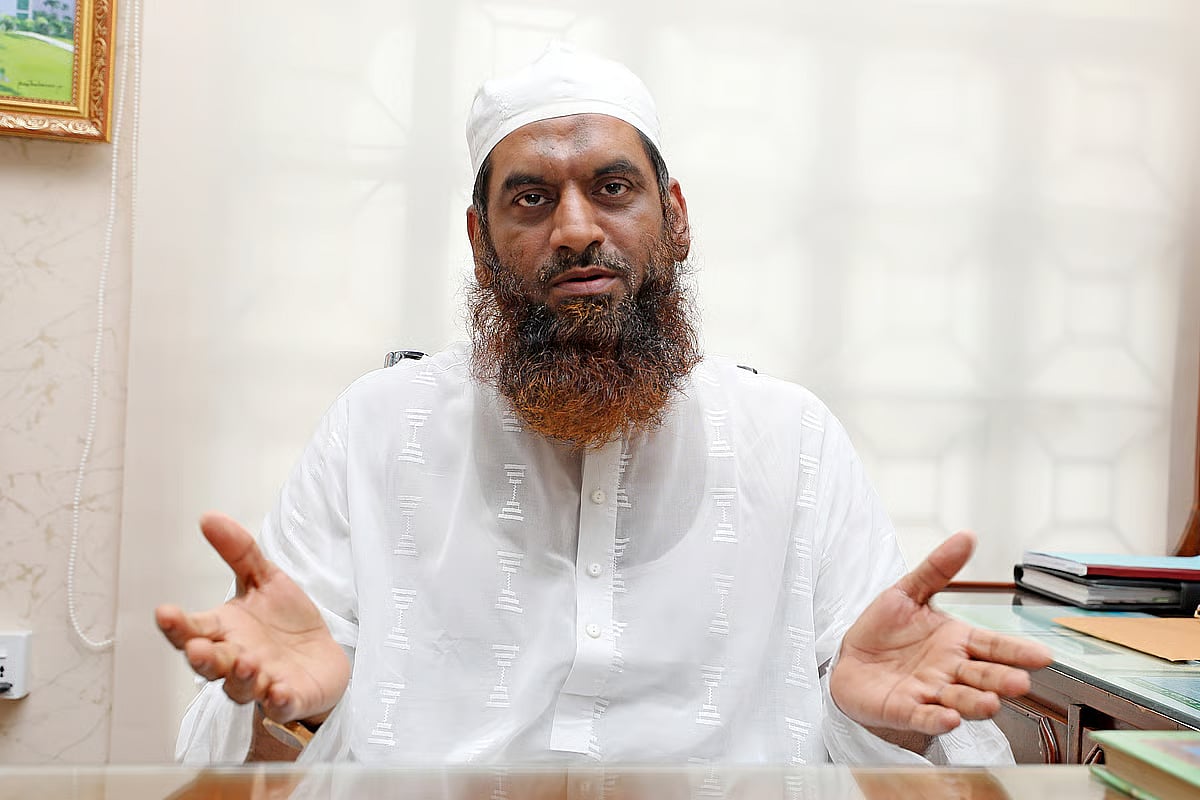
Exclusive Interview: Mamunul Haque
BNP must align with Islamists and rely on their support
Maulana Mamunul Haque is the Ameer of Bangladesh Khelafat Majlis and the Central Joint Secretary General of Hefazat-e-Islam. He is also an Islamic preacher. In an interview with Prothom Alo, he spoke on various issues including the upcoming election, alliance politics, relations and differences with Jamaat, the Shapla Chattar incident, marriage, the Sonargaon episode, and the lessons BNP should draw from the fall of the Awami League. The interview was conducted by Selim Zahid.
Will you contest the election?
Mamunul Haque: Personally, I am not interested in contesting the election. But if it becomes necessary from the party’s perspective and for the greater national interest, then I will contest.
Which constituency are you considering?
Mamunul Haque: There are three possible constituencies. One is Mohammadpur in Dhaka (Dhaka-13), where I reside. Another is Lalbagh (Dhaka-7), my birthplace. And one constituency outside Dhaka is Bagerhat-1 (Chitalmari, Mollahat, and Fakirhat), which is my maternal grandfather’s home. I have close family ties and strong connections there.
In Mohammadpur, you have homes and educational institutions. But to win an election, popularity and organisational strength are essential. Do you think your party has that in Mohammadpur, Lalbagh, or Bagerhat?
Mamunul Haque: I may not have a strong party-based workforce of my own, but in Mohammadpur we have an environment suitable for contesting elections. In both Lalbagh and Mohammadpur, due to our long-standing activities and the active presence of the ulama, we have a significant reserve force that can work effectively during elections. Moreover, we have been engaged in various activities concerning religious and social issues in these areas, which has helped us build a strong base of public connection and strength.
In that case, would you need to form an alliance with someone?
Mamunul Haque: The election may be contested through an alliance. But even if we contest independently, we expect a good result.
It is being heard that BNP might leave the Mohammadpur constituency for you. There are also rumours that if they come to power, you might be given a position. Have you received any such proposal?
Mamunul Haque: No, we haven’t had any formal discussions with BNP in this regard. I have heard such things informally and can sense BNP’s interest in leaving a seat for an individual candidate. But so far, no official discussion has taken place.
Do you have conversations with BNP’s top leader, meaning Tarique Rahman?
Mamunul Haque: Yes, I have spoken to him occasionally whenever necessary.
When was the last time you spoke with him?
Mamunul Haque: Quite a few days ago.
Let’s talk about the national election. You know that there are discussions among Islamic parties about forming an electoral alliance. Your party’s name has also been mentioned. Is there such a possibility?
Mamunul Haque: Yes, there is such a possibility, and it is quite realistic. Islamic parties are in discussions with each other about this. However, it seems that not all Islamic parties will unite. Some are leaning toward an alliance with BNP, while others are trying more to unite Islamic-oriented parties, including Jamaat-e-Islami.
Who is leaning in which direction—can you mention names?
Mamunul Haque: I don’t want to mention the names at the moment. Another important factor is the PR (proportional representation) system in the upper house, which has been recommended by the consensus commission. If that system remains, the calculations may change. Smaller parties may think that instead of relying on big parties for seats, they could contest on their own and still secure some seats with their 1–2 per cent nationwide vote share.
So, will the PR system create an obstacle to forming alliances?
Mamunul Haque: It may create some complications in electoral calculations.
It is quite apparent that Jamaat-e-Islami and Islami Andolan are making serious efforts to build an electoral alliance of Islamists. Do you see these two parties as potential political partners?
Mamunul Haque: We haven’t made any final decision yet. We have had several meetings and discussions with Islami Andolan about a possible electoral alliance. But we haven’t yet held any official discussions with Jamaat-e-Islami on this matter.
What is the reason? Is there any fundamental ideological difference between Jamaat and your party?
Mamunul Haque: Yes, the fundamental difference lies in the ideology of Maulana Maududi. Traditionally, our ideology has differed from his, and that’s the main point of difference. Apart from that, we also differ with Jamaat in our vision of the broader Islamic Ummah.
You mentioned differences with Maulana Maududi’s thoughts and beliefs. Historically, Qawmi scholars also had major differences with him. But that’s no longer the case, is it?
Mamunul Haque: The differences that Qawmi scholars had with Maududi’s ideology still exist. However, due to the global Muslim Ummah’s common interests and the struggle against the influence of foreign hegemonic powers in Bangladesh, Deobandi groups fighting against these powers and Jamaat-e-Islami fighting against the same forces have created a ground for political unity.
Do you think Jamaat-e-Islami’s role has caused harm to the broader Islamic movement?
Mamunul Haque: Yes, absolutely. If Maulana Maududi had not been associated with the ideological flaws identified by our predecessors, then Jamaat’s activities could have maintained their original unity. Initially, Jamaat started from a united platform without disputes, but later controversies arose, causing mainstream scholars not to support Jamaat.
You pointed out Maududi’s controversial religious ideas, but how do you view Jamaat-e-Islami’s controversial role during the Liberation War of 1971?
Mamunul Haque: Yes, their role in 1971 was certainly controversial. However, I think not only Jamaat but also other Islamists, out of ideological concerns and fears of Indian dominance, were wary of India during the war. So, from my perspective, the ideological concerns were more significant than Jamaat’s role itself.
Islam is one, but there are many political parties. Why?
Mamunul Haque: Islam is one, but groups are many—the question itself is not consistent. Islam is one, but institutions are many. There can be different approaches and schools of thought for establishing Islam. Those who feel comfortable working together with shared views form parties and work accordingly. So, just because Islam is one, it does not mean all parties must be united.
You often talk about establishing a Sharia-based state. How is that possible under a multi-party democratic system?
Mamunul Haque: If the majority of people want it, then it is not impossible. With a simple or absolute majority, it is possible to Islamise everything including the country’s laws and constitution.
Suppose you became elected as a Member of Parliament. What would be your top three legislative priorities?
Mamunul Haque: The first will be that the laws and policies which are against the Quran and Sunnah, we will abolish them through fundamental policies. That is to say, no law, policy, or decision that conflicts with the Quran and Sunnah will remain in force. The second will be that we will ensure the rights of minorities based on the Quran and Sunnah. Thirdly, in the judicial system, there are several penal codes that are in conflict with the Quran; those penal codes will be changed, and the penal codes of the Quran will be enforced.
You are a Shaykh al-Hadith, a teacher of Hadith. You have a respected scholarly status. Why enter politics?
Mamunul Haque: I have been involved in organisations and politics since my student life. I didn’t just come into politics suddenly; from childhood, I was introduced to political activities. The knowledge we gain from the Quran and Sunnah obliges me to work toward its implementation. And to establish Islam in the state system, politics is necessary. Without political engagement, Islam cannot be fully implemented in society.
Are you aware that BNP Secretary General Mirza Fakhrul Islam said he sees a rise of right-wing politics in the country and is concerned about it? What do you think?
Mamunul Haque: Here, by ‘right-wing’ it does not mean what in the international political arena is understood as right-wing — that is, full Islamic. Rather, right-wing politics has a definition. However, if by right-wing politics he meant religion-based politics, then from our perspective this is an extremely objectionable statement. We cannot in any way support this statement nor can we show any flexibility towards it.”
How do you view BNP—as a right-wing party?
Mamunul Haque: I don’t see BNP as fully right-wing, but I believe its politics was founded on right-leaning values. Islamic principles are one of its core foundations. So, while not completely right-wing, BNP’s politics is built upon right-wing values.
Recently, you said in a speech that from an Islamic political perspective, BNP plays the role of Abu Talib, while Awami League plays the role of Abu Jahel. Why did you say that?
Mamunul Haque: Many people say that BNP and Awami League are the same, like two sides of a coin, or they think of the two parties in parallel. From the past history of BNP and Awami League, we come to the conclusion that their behaviour toward Islam, Islamists, and the religious scholar community is not the same. I have referenced this in that statement. BNP leader Begum Khaleda Zia has made a clear statement; she told us that we (BNP) do not engage in Islamic politics. However, if you (others) can create an environment in the country through Islamic politics to establish Islam, then you will not find us as your opponents. From that perspective, we always see that one of the key philosophies of Awami League’s politics is that they never tolerate the rise of religion-based or Islamic politics. Sometimes they may practice religion personally or show respect and devotion to religious personalities—but as political leaders, in the sphere of political leadership, they do not tolerate anyone who follows Islamist or Islamic ideals. It is from this context that my comment arises, and this comment of mine is very well-considered.
But during the long rule of the Awami League, the people of the country saw prominent Qawmi scholars, including Allama Shah Ahmad Shafi, meeting with the then Prime Minister Sheikh Hasina. They praised the government and also met the then Home Minister many times.
Mamunul Haque:
There is a term in Islam called Muallafat al-Qulub. It means winning someone’s heart. It is also called Talif al-Qalb, meaning the effort to please someone’s heart. In Islam, this has been mentioned in a significant way. Islam talks about winning the hearts of two types of people, and this has been encouraged for two reasons.
One is those who are soft or inclined toward Islam; it is said their hearts should be won over so that they may completely turn toward Islam.
The second category is also given the option of winning their hearts, and this too has been encouraged. These are those who are strongly anti-Islam, who are fiercely hostile toward Islam and Muslims. Islam says their hearts should also be won over, in order to protect oneself from their aggression.
Historically, we have seen that the Awami League has always been hostile toward the ulemas. So when we tried to build rapport with the Awami League, the main reason behind this effort was self-defense against their aggression. And if by winning their hearts, we could bring them down from a harsh stance to a softer one, then this is part of the traditional and religious responsibility of the scholarly community.
So, it was a strategy?
Mamunul Haque:
Of course, it was a strategy.
Now let’s talk about two turning points in your personal and political life. One was on 5 May 2013 at Shapla Chattar in Motijheel, and the other was on 3 April 2021 in Sonargaon, Narayanganj. How do you view these two events?
Mamunul Haque:
Shapla Chattar is one of the milestones in the history of Bangladesh. We believe it was the new Balakot of Bangladesh (referring to the Battle of Balakot). Just as Balakot played a decisive role during colonial times in safeguarding independence and the traditions of this land, so too will Shapla Chattar play a crucial role in shaping the future course of Bangladesh.
At Shapla Chattar, I had a role; I was visibly present. Allah granted me the ability to play that role. For me, Shapla Chattar is one of the most memorable events of my life, a foundation for refining myself and building my future.
The Sonargaon incident, however, was undoubtedly a tragic event in my life—something I had never imagined. There were both good and bad sides to it. The bad side was that I had to face a very embarrassing situation of being targeted personally and having my character assassinated.
But the important positive aspect was that I and the people of the country realised that Sheikh Hasina and Islamophobic foreign forces considered us important. They feared me, they feared my leadership. I felt that from that attack, I discovered both my personal self and my leadership identity.
Many people are curious whether the woman involved in that incident—whom you had introduced as your wife—is still with you.
Mamunul Haque:
Yes, she is still with me. In that incident, regarding her role, there were some weaknesses. Meaning, while I was able to withstand the pressure, she could not face it with the same strength. That has created some tensions.
After the Sonargaon incident, the issue of multiple marriages without a first wife’s consent surfaced against many scholars—yourself, Junayed Al Habib, and others. Although Islam permits up to four marriages, how do you see this in the social context of Bangladesh?
Mamunul Haque:
Multiple marriages are viewed positively in the social context of Bangladesh. From the perspective of Islamic Sharia, we find this social viewpoint very objectionable. Because what is lawful in Islam and what has no grounds for being viewed negatively—something that is sacred and necessary—should not be socially stigmatised. I consider seeing it negatively a superstition.
It is indeed a major responsibility of religious leaders and scholars to eradicate this superstition. To prevent this, the scholarly community must take a bold stand. And those who accept Islam unconditionally, all of them must play their role, wherever they are, in eradicating this superstition.
Can a husband ensure equal rights and dignity in every aspect for two, three, or four wives at the same time?
Mamunul Haque:
This question itself is very objectionable. Allah would never have given this decree if it were not possible. In the Qur’an, Allah has said repeatedly that He does not give any ruling to humans that they are incapable of fulfilling.
After the change of power on 5 August, some events have led members of civil society to think that a radical class of people has emerged. What do you think?
Mamunul Haque:
I do not think that after 5 August, a new radical class has emerged. Rather, I think that through the events of 5 August, new stakeholders have been created among the young generation on important national and state issues.
Earlier, it was thought that only those who were political musclemen, involved in politics and violence, would concern themselves with the state and politics. That was the political culture before 5 August in Bangladesh. One of the positive changes brought by 5 August is that now good people, students—those who think creatively, positively, and for the welfare of the people—have begun to think that they too can think about the state, and their ideas can be effective in the state.
Then how would you describe the mob incidents?
Mamunul Haque:
The mob incidents were partly sabotage and partly the tendency of some people to take the law into their own hands. A major reason behind this is also the people’s lack of trust in the existing state structure and law-and-order system.
You are a major leader of Hefazat-e-Islam. What will be Hefazat’s role in the upcoming elections?
Mamunul Haque:
Since Hefazat-e-Islam is a non-political organisation, it will not play any direct role. That is its declared final policy. However, since Hefazat comprises many groups and includes both political and non-political leaders, I think if the Islamic parties are divided, then Hefazat too will not be able to stay united on a single position.
You must have noticed that two top BNP leaders have met Hefazat’s Ameer Shah Muhibbullah Babunagari and the director of Hathazari Madrasa. What does this indicate?
Mamunul Haque:
This indicates that the BNP wants rapport and support from Hefazat, and wants to demonstrate that. But I believe the doors of Hathazari and Hefazat are open to everyone.
You always say Hefazat is a non-political organisation. But its important leaders do politics; some compete to become members of parliament; some even try to make electoral deals with big parties. How do you explain this?
Mamunul Haque:
A person can have multiple identities. A person may be a member of a political party, at the same time a member of a social organisation, or other types of organisations. So individuals can have multiple identities. In that sense, I think that those of us who do politics, we have our separate platforms for politics, and we conduct our politics from there.
Then doesn’t the Hefazat platform give you an advantage? When it is about religion, you are religious leaders; when it is about elections, you are politicians.
Mamunul Haque:
If someone considers it a benefit, then it is a benefit. But we consider it from a standpoint of responsibility. We want to address religious issues rising above partisan politics.
The Consensus Commission has suggested that 5 to 7 per cent of candidates in the 300 parliamentary seats should be women. What is your position on this? Does your party have that many women candidates?
Mamunul Haque:
We consider such thinking—fixing quotas for women—as discriminatory. In Bangladesh’s current political system, all avenues are already open to women. For 35 years, Bangladesh has been led by a female prime minister; for a long time, the leader of the opposition was also a woman; the speaker of parliament has also been a woman.
So, by the logic that women are lagging behind and need a speed boost, if after 35 years of female leadership someone still claims that women haven’t gained that speed, I think this is insulting to women. Therefore, I believe there is no need for any reservation for women. Rather, they can and do qualify, compete, and rise to the highest positions. We consider seat reservations for women to be unjustified and discriminatory.
Will the upcoming elections resolve the country’s political problems, or will they intensify the crisis?
Mamunul Haque:
I am not so optimistic that the upcoming elections will solve all the political crises of Bangladesh. But I believe it will deliver a major blow to the political culture of the past 54 years. Because it will lay the foundation for change, and the election will serve as an important milestone in building a new Bangladesh.
The Awami League (whose political activities are banned) cannot participate in the elections. This means the big party BNP has the greater chance of coming to power. How much change do you think BNP can bring to politics?
Mamunul Haque:
We believe BNP will in no way behave in a fascist manner like the Awami League. Ideologically, we believe BNP does not have such a mindset of repression, traditionally. In fact, BNP does not have that capacity for repression either.
And I think BNP will learn from the 2024 mass uprising. Even someone like Sheikh Hasina, the “Iron Lady,” collapsed like a house of cards in the face of popular resistance. Therefore, we do not fear that such fascism will reemerge in Bangladesh in the near future. On the contrary, we expect good things from BNP.
I believe that for BNP’s political stability in Bangladesh, it must stand with the Islamists and take their support. Otherwise, that will be risky for BNP.
Thank you.
Mamunul Haque:
Thank you as well.