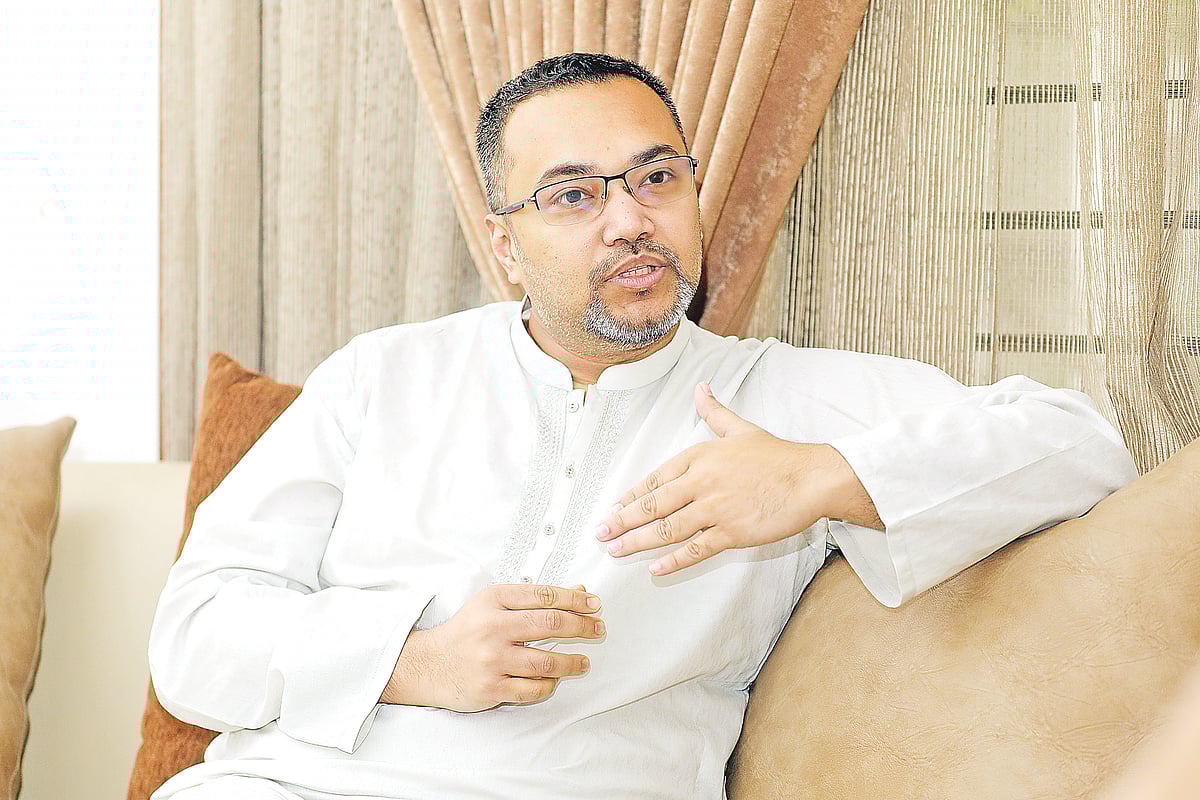
After nearly two decades, Tarique Rahman has given direct interviews to the media, where he discussed the upcoming election, reforms, trials of the Awami League, and Bangladesh-India relations. How much has his interview energised the BNP?
Mahdi Amin: Tarique Rahman, the BNP’s acting chairman, recently gave interviews to BBC Bangla and the Financial Times. In both, he outlined a clear political vision and direction for the party. We believe that not only BNP supporters but people from all walks of life in Bangladesh have warmly received his message.
The aspiration of the mass uprising of 2024 is to build a Bangladesh founded on harmony, mutual respect, and above all, national interest and sovereignty. That is precisely what Tarique Rahman said. Even when referring to political opponents, he did not use a single discourteous word. He emphasised justice and the rule of law. His interview reflects our collective desire to establish a politics of development and productivity in Bangladesh.
One of the most common questions among BNP supporters and citizens since the uprising is when Tarique Rahman will return home. He told BBC Bangla that he would return “very soon” and contest the election. But with just four months to go, how soon is “soon”? Is there still any uncertainty about his return?
Mahdi Amin: Tarique Rahman has made it clear that he will return before the election. He said that this people’s uprising — which freed Bangladesh from fascism — was led by the people themselves. It was the combined effort of people from all walks of life that made this freedom possible. His struggle and sacrifice have always been for the people.
He, his family, his party, and ordinary citizens all fought side by side for a free Bangladesh. Naturally, he will return to be among the people. We believe he will return soon — before the election — and lead the campaign.
There is a discussion that while BNP is vocal about the election, it lags behind its rivals, particularly Jamaat-e-Islami, in preparation. How would you respond to that?
Mahdi Amin: Every political party has its own strategy. The party you mentioned has already announced candidates for all constituencies, while BNP has not. BNP has advanced through sacrifice and struggle over the past 16–17 years of democratic resistance.
As part of our internal democratic practice, the selection of candidates — from grassroots to top levels — will be based on broad consultation and public connection. Once nominations are finalised, we will become even more focused on election. Meanwhile, our potential candidates are already working to build public engagement.
Since 5 August, BNP has held many rallies. At both divisional and central levels, these rallies have drawn hundreds of thousands of people. There have been youth rallies and seminars targeting young people. In these programmes too, there has been significant participation of young people from both inside and outside the party.
So, although we may not have started constituency-based election campaigning, from the central level to the grassroots, our election-related activities are continuing through public-oriented programmes.
In most constituencies, it is not yet clear who BNP’s candidate will be. In most seats, there are three, four, or even more individuals who want to be candidates, and everyone is campaigning in their own way. This is confusing BNP supporters and also confusing the public. Will BNP be able to move beyond its past practice in the matter of nominations this time?
Mahdi Amin: Tarique Rahman has said that candidates will be selected based on their acceptability within the party and their connection with the people. As part of that, those who have sacrificed and struggled in the democratic journey will be given importance.
In a democratic process, it is natural that a political party will have multiple aspirants. BNP does not want to impose nominations from the top. BNP is conducting internal surveys to assess who has how much acceptability and public involvement within the party. It may take some time to complete all the processes and announce the candidates. We hope that candidates will be announced in all constituencies at the right time, in line with the election schedule.
The fact that there are many aspirants in many constituencies also reflects BNP’s organisational strength. Many in leadership positions think that getting a nomination from the party is a form of recognition. For many, it is an expression of their organisational capability.
Therefore, many leaders feel that they might receive that recognition from the party. However, once the party’s nominations are announced, we believe all divisions and differences will break down, competition will be set aside, and they will work for the party.
BNP’s politics stands on the statement of martyred president Ziaur Rahman: “The party is bigger than the individual, and the country is bigger than the party.”
During the Awami League’s rule, despite greed, fear, attacks, and lawsuits, BNP remained united. We believe that after the announcement of nominations, everyone will work together following the party’s instructions in the greater national interest while holding on to that unity.
You are saying that even though there are multiple aspirants in many constituencies, everyone will unite after nominations are announced. But that is very difficult in Bangladesh’s politics.
Already we are seeing BNP’s potential candidates in some areas clashing with one another, even causing deaths. Rebel candidates mean vote-splitting. How much can BNP control this rebellion? How concerned is the party about rebel candidates?
Mahdi Amin: As far as I understand, BNP has no concerns about rebels, but there is a realisation. The reality is that despite many conspiracies and smear campaigns, BNP as a political party has remained united. There has been no division within the party. So there is already a big ground of unity within BNP.
That unity in the anti-fascist movement was for establishing democracy. Now we may see that for the election, different aspirants are seeking nominations from their own positions. But BNP believes that when the party announces its candidates, in most cases almost all leaders, activists, and supporters will work with those candidates. If there is any deviation anywhere, then instructions will come from the party leadership. We are hopeful that through organisational discussion and communication, a resolution can be reached.
Will new faces or young candidates be given priority this time in terms of nomination?
Mahdi Amin: As far as I have learned, along with senior and experienced leaders, young people who are skilled, qualified, and popular will also be valued. Those who have been in BNP for a long time, who have led the Chhatra Dal, Jubo Dal, or Swechchhasebak Dal at various times—they will certainly emerge as candidates based on their sacrifice, struggle, and popularity.
Dynastic politics is a major problem in our politics. According to media reports, in some constituencies, senior BNP leaders themselves are seeking nominations and also seeking seats for their sons and daughters. But in politics, a leader is made through a long process. Should someone get priority just because they are a leader’s child?
Mahdi Amin: Tarique Rahman recently presented an analysis on this issue. He said not all leaders’ children enter politics, and not all who do become successful. Success in politics depends on how long someone has been with the people and whether the people and the party’s leaders and activists spontaneously accept their leadership. There will be a balance between these two factors in selecting candidates.
If we think of our acting chairman, he has been involved in BNP politics organisationally since 1988. After doing politics for 37 years, he has reached this position and achieved universal acceptability.
We believe that leadership develops through a process of political practice. What is important here is whether someone has been able to build acceptability and earn organisational support through the process of leadership development.
In the DUCSU and JUCSU elections, Chhatra Dal suffered major defeats. A recent survey also shows that among those under 30, support for BNP is comparatively low. What do you think is the reason for Chhatra Dal’s big defeat in the student union elections? Is BNP failing to connect with the political aspirations of the young generation?
Mahdi Amin: BNP has several plans centered on the youth. Tarique Rahman has said that work is underway on what policies will be adopted to build the future Bangladesh, how employment will be created, how the education system will be restructured, and in which sectors true equality and dignity can be ensured for young people.
In our election vision, the economic and political empowerment of youth is being given special importance. Work is ongoing in every sector.
You mentioned university-based elections; but historically, the direct link between national politics and student union elections has been relatively low.
In universities, over the past 16 years, Chhatra Dal leaders and activists have not been able to stay in dormitories even for a single night under their own name. They couldn’t even enter the canteen once. In many cases, apart from taking exams, they couldn’t go to the campus. As a result, they couldn’t build relationships with general students as part of the same ecosystem.
On the other hand, some political organisations maintained continuous relationships with students using different strategies and identities, and this influence was seen in the elections.
However, we believe these elections should be conducted in a way that leaves no controversy. Allegations of “election engineering” have arisen here, which is undesirable. We want that elected student leaders from DUCSU, JUCSU, and all universities win through fair elections. Because we want to congratulate them. We also urge university administrations to ensure such elections are entirely free of controversy. Because this too is an important step in the democratic journey.
BNP seems to be stuck in old types of programmes such as rallies and showdowns. Even in social media campaigns, BNP appears visibly weaker compared to other parties. But in the upcoming election, young voters will play a decisive role, and they are influenced by online campaigns. How much do you think this communication weakness will hurt BNP?
Mahdi Amin: It’s true that BNP is somewhat behind in social media. Perhaps the reason is that in the last 16 years, BNP’s main focus has been on the streets. However, BNP is now working on its social media campaign strategy. We hope that very soon, BNP’s positive presence on social media will increase visibly.
But it must be admitted that since 5 August, BNP has taken countless people-oriented initiatives at both central and local levels, yet news of these did not reach the people effectively; instead, we were victims of massive misinformation campaigns. BNP believes that misinformation, false information, and character assassination cannot be political strategies. Our main strategy is to highlight what is true and just, what is correct and real, on social media.
Since 5 August, there have been allegations of extortion and land-grabbing against BNP leaders and activists. It is being said that only the faces have changed, the system has not. It is true that BNP’s central leadership has taken action against nearly seven thousand leaders and activists, but the reality on the ground has not changed much. Sheikh Hasina’s 15 and a half years are not comparable; but in Bangladesh’s political landscape, the names of Awami League and BNP are often mentioned together. BNP’s opponents are taking advantage of this, saying, “You’ve seen Awami League, you’ve seen BNP—now give us a chance.”
Mahdi Amin: It is embarrassing to compare a democratic political party like BNP with a fascist party. History shows that the Awami League brought BAKSAL and created fascism, while BNP introduced multiparty democracy and the parliamentary system. During the 16 years of fascism, BNP was the biggest victim of enforced disappearances, killings, and human rights violations. Comparing BNP with the Awami League is an opportunistic attempt at political gain.
A culture of impunity had developed in the country. Coming out of that, BNP has taken organisational action against about seven thousand leaders and activists to create a culture of accountability.
BNP’s six million leaders and activists have been victims of false cases—it cannot be expected that this vast number will all be entirely free of fault. However, as a party, BNP has taken a zero-tolerance policy against such crimes. When there are allegations, investigations are done; when evidence is found, organisational action is taken. But the problem is that the volume of propaganda is far greater than the actual incidents or allegations. Many times, allegations such as extortion are falsely imposed in BNP’s name, whereas investigations reveal BNP had no involvement at all.
Thank you for your time.
Mahdi Amin: Thank you too.