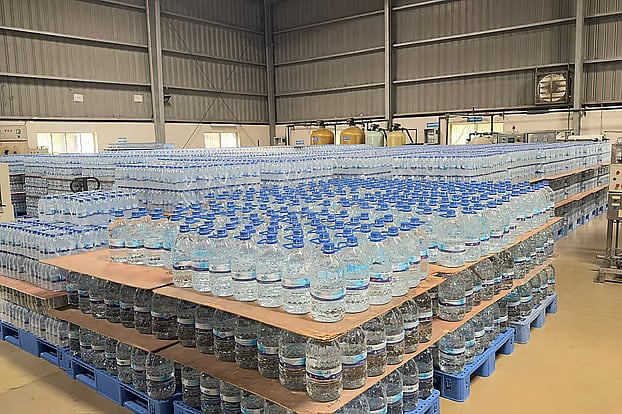
Safe drinking water is one of the most basic necessities of everyday life. Ensuring that it remains accessible and affordable is therefore among the state's most important public responsibilities.
In a densely populated city like Dhaka, where millions rely on bottled water every day, making safe drinking water affordable is not simply a commercial concern but an important public responsibility.
It was with that objective in mind that Dhaka WASA launched Shanti in 2006. The idea was straightforward: use public infrastructure to produce high-quality bottled water at an affordable price while providing a credible public alternative in a market dominated by private companies.
Yet, nearly two decades later, Shanti has become a brand that most consumers rarely see. As a recent Prothom Alo report , “Dhaka WASA's 'Shanti' water sold below cost, losses mount” published on 29 June found, the Mirpur bottling plant now operates for less than four and a half hours a day, while cumulative losses have reached an estimated Tk 150 million.
The report highlights a troubling reality. The infrastructure exists—the purification plant is operational and bottled water continues to be produced every month. What has failed is the system that connects production to consumers.
More strikingly, despite producing hundreds of thousands of litres of water every month, Shanti is largely absent from grocery stores, tea stalls, restaurants and supermarkets across the capital.
The report highlights a troubling reality. The infrastructure exists—the purification plant is operational and bottled water continues to be produced every month. What has failed is the system that connects production to consumers.
That distinction matters because Shanti was never intended to be just another bottled water business. According to WASA itself, the project was launched to prevent private companies from arbitrarily increasing prices and to ensure that safe drinking water remained affordable for ordinary people. Those objectives remain as relevant today as they were in 2006. Unfortunately, neither has been realised.
One reason is that Shanti has struggled to compete in a retail market without adopting many of the systems that successful consumer products depend on.
The economics explain part of the problem. Dhaka WASA currently produces a half-litre bottle at a cost of nearly Tk 11 but sells it to dealers for Tk 9, while the maximum retail price remains Tk 15. The lower price benefits consumers, but it also leaves retailers with significantly smaller profit margins than competing brands.
According to the investigation, shopkeepers can earn up to Tk 9 by selling a private company’s bottle of the same size, compared with only Tk 4 from selling Shanti. For small retailers operating on narrow margins, the decision is hardly surprising.
Distribution has proved to be an even greater weakness.
A modest campaign through Bangladesh Television, Bangladesh Betar and government digital platforms could introduce Shanti to consumers as a safe, state-tested and affordable bottled water brand
Private bottled water companies have established extensive supply networks that replenish shops regularly and maintain close relationships with retailers. If a shop runs out of stock, a sales representative simply delivers more.
Dhaka WASA has never developed a comparable distribution system. In many cases, dealers or customers must collect products directly from the Mirpur plant or a limited number of WASA sales centres. Unsurprisingly, a product that is difficult to obtain rarely finds a place on shop shelves.
Public awareness deserves equal attention. A modest campaign through Bangladesh Television, Bangladesh Betar and government digital platforms could introduce Shanti to consumers as a safe, state-tested and affordable bottled water brand. Greater public recognition would naturally increase consumer demand, encouraging retailers to keep the product in stock
The report also points to another overlooked issue: visibility. Despite being available for almost twenty years, many consumers are unaware that Dhaka WASA even produces bottled drinking water.
While private companies invest heavily in advertising, branded refrigerators, shop signs and promotional materials, Shanti has received almost no sustained marketing. Consumers cannot choose a product they do not know exists, and retailers have little reason to stock a product that customers rarely request.
These shortcomings should not be viewed simply as commercial mistakes. They reflect a broader lesson about public welfare projects. Building infrastructure is only the beginning. Without professional management, accountability, effective distribution and public engagement, even the best-intentioned initiative will struggle to achieve its purpose.
The government should begin by ensuring that Shanti reaches the people it was created to serve. That requires a modern distribution network capable of supplying neighbourhood grocery stores, tea stalls, restaurants and supermarkets on a regular basis.
Retailers also need sufficient incentives to stock the product. If Shanti is expected to compete for shelf space, its pricing and dealer margins must reflect the realities of the retail market while preserving its public service objective.
Shanti was never meant to compete with private brands on commercial terms alone. It was created to ensure that safe drinking water remained within everyone's reach
Public awareness deserves equal attention. A modest campaign through Bangladesh Television, Bangladesh Betar and government digital platforms could introduce Shanti to consumers as a safe, state-tested and affordable bottled water brand. Greater public recognition would naturally increase consumer demand, encouraging retailers to keep the product in stock.
The government can also strengthen the project’s financial sustainability by making greater use of its own institutions. Bottled water is routinely purchased for ministries, public universities, hospitals, railway stations, bus terminals and official events. Prioritising Shanti across these institutions would create a stable base of demand, increase production volumes and reduce per-unit costs without compromising the project’s original social purpose.
Globally, state-backed consumer products can succeed when governments remain committed beyond the production stage.
Look no further than the iconic Amul model in neighboring India. What began as a state-backed cooperative initiative was built on a foundation of intensive public trust, massive marketing campaigns, and a robust logistical network. Amul did not wait for consumers to find it; it used high-visibility advertising to become a household name, proving that a state-supported essential commodity can establish public purchasing capacity while keeping quality high and prices fair.
More recently, India's Bharat Brand initiative has shown how governments can directly market essential commodities under a trusted public label to protect consumers from rising prices.
We see similar success in Malaysia through FELDA and state-backed distribution channels, which were established by the government to ensure that essential cooking oils and agricultural goods are explicitly branded, heavily promoted, and routed directly to local communities to prevent supply gaps.
Ultimately, Shanti was never meant to compete with private brands on commercial terms alone. It was created to ensure that safe drinking water remained within everyone's reach.
The real test of a public welfare project is not whether it can produce, but whether it can deliver. Shanti has already proved it can bottle water. What remains is ensuring that it reaches the people it was created to serve.