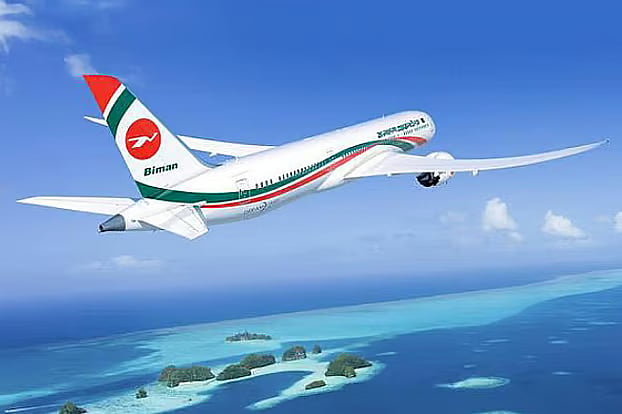
I'm afraid to question about buying airplanes! It's not an easy task to determine which questions are acceptable and which ones are not. Our current government came to power just eight months ago. In that short time, it has either completed or is in the process of completing agreements to purchase 35 aircraft. The first question that came to my mind after reading the news is, where are we going to keep so many airplanes?
There are more questions tumbling around in my head—do we have the infrastructure to operate such a large fleet? What are the terms under which these planes are being purchased? Where will the financing for the purchase come from? If, for some reason, we need to back out of the agreement, is there an option to do so in the contract? If there is, will there be a penalty?
The aviation minister has said that it will cost $6. 4 billion (approximately Tk 787 billion) to purchase 25 Boeing aircraft as per the agreement. Of course, these planes will be delivered in phases, and payments will be made at the time of delivery; the first is expected in 2031, and the final one in 2035. This means that the financing and delivery timeline extends beyond the current government's term and could become a burden for the next government.
There are more questions. The government is only eight months old; when did it find the time for planning and negotiating these aircraft purchases? Has there been any due diligence to ensure the precise implementation skills necessary for buying and operating so many planes?
Many might say, "Why does an 'outsider' need to know so much about airplanes?” However, these days, the general public seems to have a heightened interest in everything—students are making governments, 'cockroaches' are doing politics, and 'outsiders' are getting updates on airplanes instead of ships!
People haven't overlooked one aspect of buying airplanes. The Ministry of Foreign Affairs has talked about purchasing aircraft from the US's Boeing! Two days later, information about buying planes from Europe's Airbus came from the Ministry of Civil Aviation and Tourism.
A question frequently heard from everyone about buying airplanes is—has the US forced 25 Boeing planes upon us? But the biggest question is, given Bangladesh Airlines' track record, will it be possible for the airline to operate so many airplanes efficiently and run a profitable business? What does Biman Bangladesh's track record look like?
Skytrax is an international agency that reviews the operations of various airlines worldwide and prepares a report each year. According to the Skytrax report, Biman Bangladesh Airlines has a rating of three out of five.
In other words, Biman is a three-star airline. This rating is determined based on the standards of the domestic airports, the quality of the materials used by the airline (such as seating quality), other facilities, and cleanliness. One of the major factors in the rating is the quality and efficiency of the cabin crew and other staff.
Work on the third terminal of Dhaka Airport began seven years ago and is still ongoing. Dhaka Airport has only one runway, meaning no more than one aircraft can land simultaneously. The plan to add another runway remains confined to paper.
In the Skytrax report on Biman’s operations, it mentions, "The airline has a lot of inconsistencies that impact its ratings. More focus is needed on cleanliness and cabin maintenance. The service from the cabin crew ranges from good to quite poor, and there’s a need for improvement in consistency here. The service quality at Dhaka airport is still very weak. ”
However, Biman has received a five-star rating concerning safety, as there have been no major accidents in the past 40 years. This is a major positive aspect for Biman. Yet it can be said with certainty that if Biman does not make significant changes in its operations, then merely expanding its fleet with large planes will not increase its profitability, service, or reputation.
The former Chairman of the Bangladesh Civil Aviation Authority (CAAB), Air Vice Marshal (retd.) Mahmud Hossain, recently said at a discussion, “The biggest crisis in Bangladesh's aviation sector is not aircraft but the deficiency of skilled manpower. Despite increasing demand, there is a shortage of pilots and licenced aircraft maintenance engineers in the country.”
On paper, Biman Bangladesh appears to be a highly profitable organisation. It has reported an annual profit of Tk 9.37 billion for the fiscal year 2024-25, which is a record in Biman’s history. However, beneath this apparent glow lies a significant shadow.
Major questions have been raised on social media and in the news about these earnings, suggesting that Biman is actually a loss-making entity; because it has over Tk 81 billion in unpaid debts owed to various government agencies.
What is the future plan after buying so many planes? Although not very clear, some signs of government thought processes can be gleaned from ministers’ statements. Some envision building a 'travel hub' in Dhaka, while others aspire to build a large fleet like Ethiopian Airlines and make a significant contribution to the country’s GDP.
Many questions will arise from these issues. Our country’s tourism facilities are woefully inadequate, the condition of airports is shamefully poor, and there is a lack of skilled manpower for airline operations. Without significant changes in these areas, building a ‘hub’ will remain a far-fetched dream. Moreover, due to the war in the Middle East, there are concerns about maintaining job markets for our workers there. Amidst this, a significant number of workers have returned home. The question arises, will this impact constrict air travel in Bangladesh?
Comparing with Ethiopian Airlines also doesn’t bring much confidence. It’s a four-star airline. According to Skytrax, Ethiopian Airlines is a highly disciplined organisation that has increased its profits annually and gradually procured new airplanes. In comparison, here everything other than the airplane purchase agreements is progressing at a snail's pace.
Work on the third terminal of Dhaka Airport began seven years ago and is still ongoing. Dhaka Airport has only one runway, meaning no more than one aircraft can land simultaneously. The plan to add another runway remains confined to paper.
Considering all of this, it seems that hastily signing contracts to purchase new airplanes is a huge risk. Many will question whether such an extensive buying plan was made with careful planning and profit-loss considerations.
However, it is also true that since the agreements to purchase the planes have been or need to be made, optimism is the best course. No matter what arguments or questions anyone may have, we all hope that Biman Bangladesh can elevate our travel industry to a higher, more disciplined level!
#Saleh Uddin Ahmed is educationist, writer, and political analyst
salehpublic711@gmail. com
*Opinions expressed here are the author's own.
#This article, originally published in Prothom Alo print and online editions, has been rewritten in English by Rabiul Islam.