Opinion
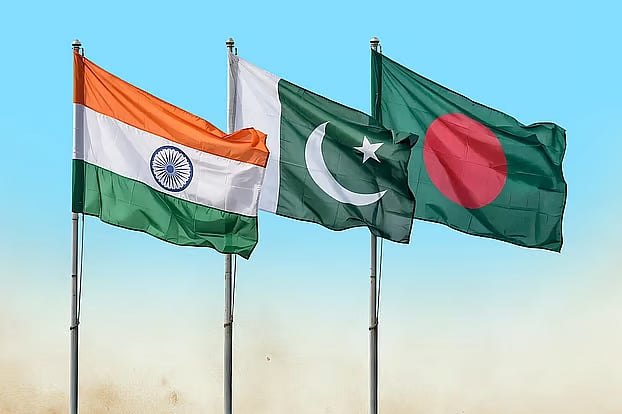
Who is ahead in the India–Pakistan ‘cold war’ over Bangladesh?
A small but significant piece of news published recently revealed that Pakistan has provided training to several senior Bangladeshi bureaucrats at Pakistan’s Civil Services Academy. Pakistan is bearing the full cost of the program. Although it has been described as training aimed at improving the “leadership and skills” of Bangladeshi officials, Pakistan’s objectives and potential benefits from it are much broader.
Bangladeshi bureaucrats play a major role in shaping the country’s trade and foreign policy, so training them is a significant opportunity for Pakistan. After Bangladesh’s independence, the opportunity, or privilege, of training Bangladeshi civil servants had effectively been monopolised by India.
India provided Bangladesh with wholehearted support and assistance during the Liberation War. Many people, however, have interpreted that support in different ways. Right-wing Bangladeshi politicians who opposed the independence struggle believe that India’s sole objective was to weaken Pakistan. Although independence was achieved through the Liberation War of 1971, a large pro-Pakistan political force continued to remain in Bangladesh.
On the other hand, after the Liberation War, a politics of friendship toward India naturally developed in Bangladesh under the leadership of Awami League. During the Pakistan era, India’s doors had been completely closed to the people of Bangladesh, but overnight, new horizons opened up in trade, diplomacy, tourism, and governmental cooperation with India.
At different times, after changes of government in Bangladesh, Pakistan tried to find new opportunities to rebuild ties with the country, while India tried to preserve the advantages it had already gained. Broadly speaking, however, relations with India remained relatively stable until the July movement. July brought a major transformation.
After the July mass uprising, many of the institutional frameworks underpinning India–Bangladesh relations, including agreements related to the training of civil servants, collapsed. It can be said that during the Yunus government, relations with India deteriorated in almost every sector except import trade. Problems emerged regarding visas, tourism, diplomacy, land corridors, and even cricket ties.
Following the July mass uprising, Bangladesh’s Gen-Z generation became sharply anti-India. In this context, Pakistan has, from the very beginning of the Yunus government, tried to build a new framework for relations with Bangladesh.
Professor Yunus was also seen as a willing partner of Pakistan, having met the Pakistani prime minister several times. Pakistan also found supportive attitudes among Bangladesh’s political parties. Jamaat-e-Islami and the NCP are strongly pro-Pakistan, and even BNP cannot really be described as anti-Pakistan. In fact, in Bangladesh’s 55-year history, the period of the interim government has been the most favorable environment for Pakistan to improve relations with Bangladesh.
Pakistan’s Foreign Minister Ishaq Dar visited Bangladesh during the Yunus government. He personally met leaders of BNP, Jamaat, and NCP at their homes. Pakistan’s commerce minister also accompanied him. Trade agreements were signed, along with various friendship agreements. However, it cannot be denied that while the ministers’ visit was warm and cordial, the agreements themselves were not equally productive. The reason is that Pakistan’s economic structure is not well suited to sustaining large-scale import-export trade.
At the time, India could do very little. It was waiting for Bangladesh’s election and the formation of a new government. After the death of Begum Khaleda Zia, India’s Foreign Minister S. Jaishankar came to Bangladesh to offer condolences and signaled that India would be willing to normalise relations if BNP came to power.
On one hand, Bangladesh now has a new government; on the other, the geopolitics of the region are changing rapidly. Against this backdrop, both India and Pakistan have shown certain advantages and limitations in improving relations with Bangladesh.
India’s disadvantages
India shares a very long border with Bangladesh. Although there is no territorial dispute over the border itself, issues such as smuggling, illegal crossings, push-ins, and the killing of Bangladeshis at the border periodically create severe bitterness on both sides. The sharing of water from the Ganges and Teesta rivers has also been a long-standing problem between the two countries. There is no easy solution to this issue, and hostility continues to grow.
BJP’s anti-Muslim politics, along with isolated incidents involving the suffering of Hindus in Bangladesh, also periodically generate intense tension and dissatisfaction among the people of both countries. The strong rise of right-wing politics in Bangladesh has become somewhat uncomfortable for India. In the absence of the Awami League, there is currently no major pro-India political party in Bangladesh. BNP can be described as pragmatic, it may lean in whichever direction circumstances require.
India’s advantages
India’s biggest advantage is its strong economic infrastructure. As a result, India has long maintained a dominant position in supplying consumer goods and electricity to Bangladesh. The shared border also offers major advantages. Transportation costs for imports and exports are lower, and both countries are able to use each other’s land corridors for their own needs. Various destinations in India are also quite popular among Bangladeshis for affordable medical treatment and tourism facilities.
Pakistan’s advantages
The political forces in Bangladesh that are sympathetic to Pakistan and were suppressed during the Awami League era are now closer to the centers of power. In the absence of Awami League, they have emerged as alternative political forces in the country. This has created a major opportunity for Pakistan.
Pakistan has also gained new international recognition as a mediator in the Iran war. This has worked positively for Pakistan’s interests in various bilateral understandings. In addition, Bangladesh has an interest in building up its own defence system, which could create a major opportunity for Pakistan in the future.
Pakistan’s disadvantages
Pakistan has never formally apologised for the genocide of 1971. In addition, there remains the issue of the large amount of assets owed by Pakistan to Bangladesh. These issues have repeatedly become major obstacles to improving relations between the two countries. Pakistan also lacks the production capacity and commercial infrastructure needed to meet Bangladesh’s import demands. This is Pakistan’s biggest limitation.
Although Bangladesh has many points of bitterness with India, India’s geographical position and strong commercial infrastructure help support improved relations with Bangladesh. On the other hand, Pakistan’s biggest obstacle is the weakness of its commercial infrastructure.
Ensuring an uninterrupted supply of essential goods for Bangladesh’s 170 million people is the highest priority for any government. Shortages of rice, lentils, onions, and other staples often destabilize the country’s internal balance. Even during the Yunus government’s intense anti-India stance, imports of goods from India still increased by 7.8 per cent.
Prominent Indian journalist Gautam Lahiri said that Indian government circles believe Bangladesh’s growing closeness with Pakistan and China could affect bilateral relations
However, Pakistan does have one advantage: the possibility of cooperation in Bangladesh’s defence sector. Even that, however, is not certain to be realistic. Given the extent to which the Pakistani military interferes in its own country’s politics, it is also worth considering whether its involvement could increase instability in Bangladeshi politics.
After the election, the BNP government moved quickly to improve relations with India.
As long as Bangladesh does not achieve self-sufficiency in electricity and the production of various essential goods, dependence on India will remain unavoidable. Based on the experience of the Yunus government period, it can be said that repairing the collapsed frameworks with India is far easier than building entirely new frameworks with Pakistan. That said, Pakistan is not giving up, and the rivalry continues.
In a recent interview, prominent Indian journalist Gautam Lahiri said that Indian government circles believe Bangladesh’s growing closeness with Pakistan and China could affect bilateral relations.
A few days ago, a report in the Pakistani newspaper Pakistan Observer claimed that Prime Minister Shehbaz Sharif and Army Chief Asim Munir may visit Bangladesh on a three-day trip. The main purpose of their visit would reportedly be discussions focused on trade and defence cooperation. However, the Pakistani embassy in Dhaka denied the report. It is believed that no final details regarding the visit will be settled until Prime Minister Tarique Rahman completes his visit to China.
Meanwhile, in the context of the Iran war, Pakistan’s Defence Minister Khawaja Asif has spoken about the idea of an “Islamic NATO” led by nuclear-armed Pakistan. He said discussions on the matter are taking place among Saudi Arabia, Turkey, and Qatar. Bangladesh will certainly watch such an arrangement carefully. If such an alliance succeeds, Pakistan’s position would become significantly stronger.
As mentioned earlier, Pakistan faces several major obstacles in building deep relations with Bangladesh. In other words, in the tug-of-war over relations with Bangladesh, India currently appears to hold the advantage.
At the same time, given the realities of current geopolitics and domestic politics, it is also true that India probably no longer has the ability to maintain an exclusive relationship with Bangladesh. In some sectors, Pakistan or other countries may receive priority. Moreover, the two major geopolitical powers, the United States and China, are also actively trying to secure influence across various sectors.
* Saleh Uddin Ahmed is teacher, writer, and political analyst.
* The views expressed here are the author's own.
* This article appeared in Bengali in Prothom Alo print and online and has been translated into English by Ayesha Kabir