After a new government comes to power, changes in various positions and the appointment of new individuals are not unusual. A political government has specific goals, programs, and a manifesto. To implement that manifesto, the government appoints people it considers ‘suitable.’ There may be differing opinions about whether a person is suitable or not, but no one questions the fact of change itself.
The BNP came to power in the 13th parliamentary election with an overwhelming public mandate (209 seats). The party’s written document of commitment to the people is its election manifesto.
For the purpose of this analysis, one pledge from the BNP’s election manifesto may be highlighted. That is the commitment to “establish the rule of law at all levels.” The manifesto states: “The BNP is firmly committed to establishing the rule of law. At the same time, the BNP believes in humane values and human dignity.”
That is the party’s written commitment in its manifesto. Now let us recall what the party’s chairman and Prime Minister Tarique Rahman said in his first address to the nation on 19 February. He said, “Not party or political influence, nor coercion; the rule of law will be the final word in governing the state.”
On 18 February, on his first working day at the Secretariat, Home Minister and one of the BNP’s policymakers Salahuddin Ahmed said, “Mob culture is over.”
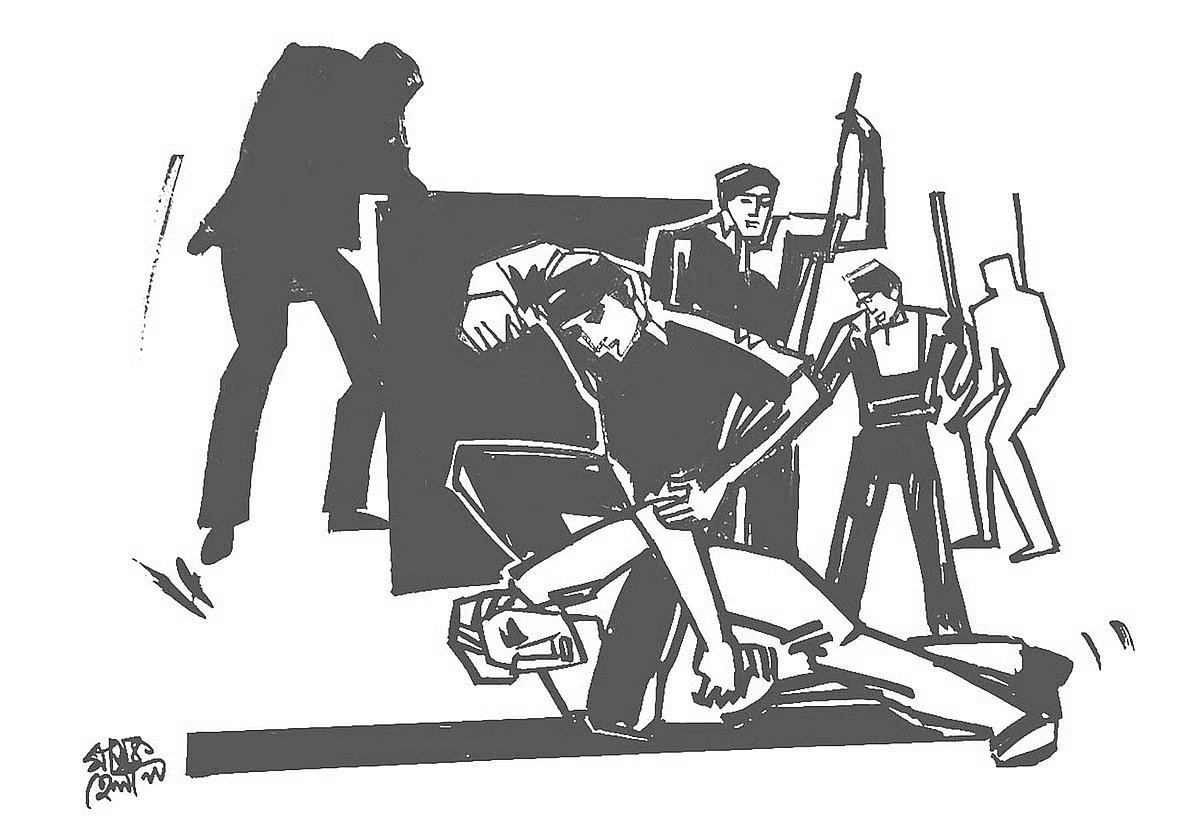
The BNP’s election manifesto and the statements of its leaders had given people hope. Many were excited that the ‘era of disorder’ would come to an end. But it was seen that just nine days after the new government assumed responsibility, an incident of mob action (disorder created by an unruly group of people) occurred—at Bangladesh Bank, one of the most important institutions of the state, which must be kept away from political controversy and disorder.
There is saying “a burnt child dreads the fire” is perhaps most appropriate for this time. Over the past 18 months, the people of Bangladesh have witnessed many such incidents—mob action.
After the fall of the Awami League government in the student–public uprising on 5 August 2024, the country had no government for three days. There was no police activity. On 8 August, an interim government led by Professor Muhammad Yunus took office. After that, changes began in the top positions of various institutions. Some individuals fled. Some were forced to step down.
Among the notable incidents after the interim government took responsibility were: forcing the resignation of Appellate Division judges of the Supreme Court (10 August 2024); HSC examinees entering the Secretariat and compelling the authorities to grant “auto pass” (20 August 2024); Ansar members besieging the Secretariat (26 August 2024); arson and demolition of Bangabandhu Sheikh Mujibur Rahman’s house at Dhanmondi 32 in the capital (5 February 2025); and arson at the central office of the Jatiya Party at Kakrail (30 August 2025). Beyond these, in many institutions and educational establishments, mobs were formed to force resignations.
The number of people beaten to death has been documented by Ain o Salish Kendra (ASK). According to their records, 293 people were killed in “mob violence” during the 18 months of the interim government.
On 18 December, the offices of Prothom Alo and The Daily Star were subjected to a planned and organised terrorist attack. The country’s two leading newspapers faced attacks, vandalism, looting, and arson. Chhayanaut was also attacked. The following day, the office of Udichi Shilpigosthi was set on fire.
According to some political analysts, although Professor Yunus’s government saved the economy from collapse, it failed to eliminate disorder in the country. Rather, supportive statements from some within the government encouraged mob actors. After one incident after another, people realised that the government would not be able to fully manage such situations. At that point, the necessity of an elected, strong government came to the fore, and demands for elections intensified not only from political parties but also from various quarters.
Some had warned the interim government about the matter earlier. One of them was economist Debapriya Bhattacharya. On 28 November 2024, he said that if economic relief and security could not be ensured, the interim government’s reforms would not succeed.
The interim government departed after holding an acceptable national parliamentary election. Alongside, it presented an extensive list of reforms. However, major questions remain as to how successful those reforms were.
The new government and the mob
After the BNP government took office, an incident of mob action was seen at Bangladesh Bank. Although the new government made changes in various positions, there had been no indication that it would replace the Governor of Bangladesh Bank. Governor Ahsan H Mansur had been performing his duties as usual.
On 23 February, Ahsan H Mansur went to the Secretariat and met Finance and Planning Minister Amir Khasru Mahmud Chowdhury. After the meeting, he told journalists that he had received assurances that the BNP government would continue reform work in the banking sector. It can be assumed that if he had been given an indication in the meeting that he (Ahsan H Mansur) would need to step down, he would not have hesitated to resign.
On Wednesday morning, Ahsan H Mansur also held a press conference. In response to journalists’ questions, he said, “It would take me just two seconds to resign.”
Ahsan H Mansur’s departure did not go well. This economist, who had worked at the International Monetary Fund (IMF), is well known in his own right. After the fall of the Awami League government on 5 August 2024 during the July mass uprising, he was appointed Governor of Bangladesh Bank on 14 August of that year. He had most recently been the Executive Director of the well-known research organization Policy Research Institute (PRI).
During his 18-month tenure at Bangladesh Bank, Ahsan H Mansur achieved several successes. These include—
First: Due to the rise in the dollar’s price, people and businesses in Bangladesh had suffered. He overcame the dollar crisis and stabilised the currency’s price.
Two: He brought foreign exchange reserves to a comfortable position. Before the fall of the Awami League government on 5 August 2024, reserves stood at 25.92 billion (2,592 crore) dollars. As of the end of Tuesday, reserves stood at 35.04 billion (3,504 crore) dollars. Generally, reserves equal to three months of imports are considered comfortable. Bangladesh now has reserves equivalent to 5 to 6 months of imports.
Third: The real true picture of hidden non-performing loans emerged during Ahsan H Mansur’s tenure. He upgraded the definition of non-performing loans to international standards. According to central bank data, 36 per cent of bank sector loans, or Tk 6.5 trillion 650,000 crore, are non-performing.
Four: Five Shariah-based banks that were unable to repay funds due to irregularities and corruption were merged to form a Combined Islamic Bank. In addition, a decision was made to close six financial institutions.
Five: A large amount of non-performing loan funds had been laundered abroad. Banks signed agreements with foreign institutions to recover those funds.
Six: During his tenure, investigations were initiated against various institutions including the family of former Prime Minister Sheikh Hasina, as well as S Alam Group, Beximco Group, Gemcon Group, Nassa Group, Bashundhara Group, and Sikder Group. Bangladesh Bank is working to recover looted funds in the country and abroad in the names of these institutions.
Seven: He undertook extensive initiatives to enhance the authority and efficiency of Bangladesh Bank and to reform the banking sector.
Eight: Inflation declined from 12 per cent to below 9 per cent during his tenure, although that is still not sufficient.
Nine: Inflows of foreign currency through banking channels increased. According to Bangladesh Bank data, a total of 32.82 billion dollars in remittances came into the country in 2025, which is 22 per cent higher than the previous year.
Ten: Anonymous bank loans were stopped. Irregularities and corruption became more difficult.
Due to taking strong measures, many inside and outside Bangladesh Bank were angry with Ahsan H Mansur. A group that had lost control of banks was also against him. After he was removed, expressions of joy from controversial individuals appeared on Facebook statuses.
The government could have given Ahsan H Mansur a dignified farewell. He could have been given the opportunity to resign. After indicating his willingness to resign, if he had clung to his position, he himself would have become controversial. That did not happen. Instead, the government added elements of controversy to what could have been a normal change process, creating opportunities for criticism.
The most significant incident is that on Wednesday, the Governor’s adviser Ahsan Ullah was harassed by a mob. Ahsan Ullah is a former Bangladesh Bank official. He had been appointed on contract by Ahsan H Mansur to begin reform work at the central bank. He had planned various initiatives, including introducing an examination system for officials’ promotions. For this, many officials were angry with him.
People are waiting
Abraham Lincoln (1809–1865), former President of the United States who played a key role in abolishing slavery, delivered a speech to young people in Illinois in 1838 at the age of 28. At that time, one mob incident after another was occurring in the United States. Lincoln said there is no grievance that justifies redress through mob action. That is, 188 years ago he spoke of the rule of law and resolving any grievance through the state’s legal process.
This is 2026. The BNP government has spoken in its manifesto and through its leaders about the rule of law and ending mob culture. After the party came to power, a mob was formed at an important state institution like Bangladesh Bank. Now people are waiting to see when the government will take legal action. Let “mob culture is over” not be mere words.