Bangles and sarees aren’t insults, stop shaming womanhood to prove a point
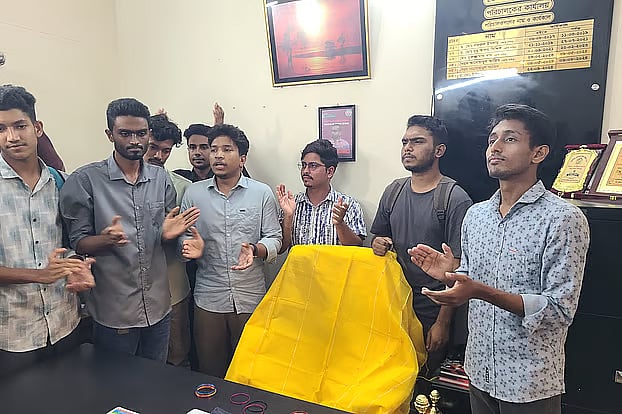
Recently, two separate but striking protests unfolded in Bangladesh, both using sarees and bangles as symbols to shame institutions accused of inaction.
In the first incident on 13 July, students gathered at the Ansar camp near Mitford Hospital to protest the Ansar force’s inaction during the brutal, broad-daylight killing of Sohag Chand.
The second protest, on 20 July at Begum Rokeya University in Rangpur, saw students placing sarees and bangles in administrative offices, condemning the administration’s failure regarding a ban on factional student politics.
On the surface, these protests represent deep frustration with institutional failures. But beneath the surface lies a troubling, often overlooked dimension: the use of feminine symbols as instruments of shame, equating womanhood with weakness, passivity, and disgrace.
Sociologist Raewyn Connell’s theory of hegemonic masculinity explains how such gender norms take root. It refers to the dominant form of masculinity that justifies male supremacy and marginalises not only women but also men who do not conform — the “soft,” the emotional, the gentle.
This gesture is not merely symbolic; it reflects a deeply rooted misogyny that shapes our cultural imagination, political dissent, and ideas of masculinity.
To understand how bangles and sarees which are celebrated long as symbols of identity and resilience become tools of insult, we must examine the history and cultural meanings attached to these items.
Bangles, or churi, have existed since the Indus Valley Civilization, dating back to 2600 BCE. A famous Mohenjo-Daro statue — often dubbed the “Dancing Girl” — wears nothing but a stack of bangles on one arm. These were not merely decorative; they signified stages of life, fertility, power, and continuity.
Similarly, the saree has long been a symbol of womanhood and adaptability — worn by everyone from farmers to freedom fighters, teachers to tribal women. Its folds have hidden resistance leaflets and weapons during the Liberation War, carried infants and rice in famine, and held space for both tradition and modernity.
Yet in patriarchal societies, where masculinity is defined in opposition to femininity, these cultural symbols are turned against women themselves. When bangles and sarees are used to mock or shame institutions or men, the message is clear: “You acted like women, and that is disgraceful.”
This is not harmless satire. It weaponises femininity. It upholds a binary that exalts aggression, stoicism, and dominance as masculine virtues while degrading softness, compassion, and vulnerability as signs of inferiority.
In South Asia, this hegemonic ideal equates masculinity with power, physical force, and sexual control, often reinforced through peer mockery, bullying, and even violence.
Where does this mindset come from?
In most Bangladeshi households, children internalise gender roles early. Boys are told not to “act like girls,” and the term meyeli (girlish) is used as a slur. The implication is that anything associated with femininity is lesser — weak, sentimental, irrational.
Fathers, teachers, and peers highlight this idea. Masculinity is validated through toughness and emotional detachment, while femininity is treated as ornamental or dependent.
Sociologist Raewyn Connell’s theory of hegemonic masculinity explains how such gender norms take root. It refers to the dominant form of masculinity that justifies male supremacy and marginalises not only women but also men who do not conform — the “soft,” the emotional, the gentle.
In South Asia, this hegemonic ideal equates masculinity with power, physical force, and sexual control, often reinforced through peer mockery, bullying, and even violence.
When institutions like universities or law enforcement agencies are criticised using “feminine” symbols, it is not just the institutions being ridiculed — it is also the entire idea of femininity. It reinforces the belief that failure to be aggressive, commanding, or violent is feminine, and therefore shameful.
Feminist theorists have long argued against this false binary. Simone de Beauvoir’s famous line — “One is not born, but rather becomes, a woman” — argues that gender roles are constructed, not natural. And Nivedita Menon, in Seeing Like a Feminist, critiques how even women’s bravery is often only recognised when described in masculine terms. She points to the iconic line praising the Rani of Jhansi: “Khoob ladi mardani” — “She fought like a man.” As Menon asks, what does it mean if even female heroism must be understood as masculine?
The reality is that womanhood is not weak. In fact, women bear immense physical and emotional burdens, often without recognition.
Pregnancy, for example, involves physiological transformation, emotional upheaval, and often life-threatening labour pain. Labour can last for hours or even days, causing pain considered equivalent to breaking multiple bones simultaneously. Yet women go through it repeatedly, quietly.
Add to this the unpaid care work that women perform daily — cooking, cleaning, nursing children and the elderly — often without complaint or compensation. These acts require emotional strength, resilience, and an ability to endure monotony, fatigue, and invisibility. Why is that not valorised as real strength?
Consider the case of rural Bangladeshi women who work in fields under the hot sun, their sarees shielding them from the heat and dust. Or the garment workers who stand for hours on production lines.
Or the teachers who wear sarees every day while nurturing entire generations. Sarees and bangles, in these contexts, are not signs of frailty — they are part of a lived strength that is physical, moral, and cultural.
Even in moments of national crisis, women have resisted while wearing these symbols. During the 1971 war, female fighters and informants used their sarees to smuggle documents and weapons, crossing checkpoints unnoticed. Femininity was not a barrier to revolution — it was a vessel of it.
That history is erased when sarees and bangles are used as insults. These protests, while justifiably angry, reproduce the very misogyny they seek to critique. They draw upon a toxic hierarchy where masculinity is valorised and femininity denigrated.
So how do we combat this?
First, by teaching boys that emotional expression and empathy are not weaknesses. By celebrating male tenderness, not ridiculing it. By allowing men to cry, to lose, to nurture — without shame.
Second, by reclaiming our symbols. Women must speak out when cultural attire and adornment are turned into symbols of disgrace. They must remind the world that wearing a saree or a bangle is not a sign of silence or surrender — it is a mark of identity, continuity, and strength.
Third, our protests must evolve. In our fight against corruption, impunity, or political failure, we must not reinforce the very hierarchies we seek to topple. Justice cannot be built upon the humiliation of half of society.
The Mitford and Begum Rokeya incidents reveal not only our anger, but also our blind spots. If womanhood is to be mocked, then perhaps, as Menon warns, patriarchy had better watch out — for it is built on the false assumption that womanhood is fragile.
And history has shown, again and again, that it is anything but.