Opinion
The city runs late today: Dhaka waterlogging, our everyday curse
You know it has rained in Dhaka when the city suddenly forgets how to move. Just a few millimetres of rain — barely enough to water a stubborn houseplant — and voilà, the capital of Bangladesh is transformed into Venice. Except here, the gondolas are replaced by rickshaws demanding triple fare, and the canals are filled with a cocktail of mud, waste, and whatever sinister organisms thrive in knee-deep water.
This is the story of Dhaka for over a decade now. Year after year, season after season, our city drowns faithfully at the first sign of rain. And yet nobody — not the city corporations, not the mayors (past or present), and certainly not us, the perennially patient citizens — seems to know when, or if, it will ever end.
Before every monsoon, we heard the same rehearsed promises: “This time, we will solve waterlogging.” It was almost like the opening act of a play we’d all seen too many times — speeches, blueprints, grand assurances. Curtain fell, and nothing changed.
Now? Even that ritual has ended. Since the fall of the government last year, Dhaka has no mayors left to make those promises. The city corporations are run by faceless administrators, and the blame game has evaporated along with accountability. What we’re left with is the same old water, only deeper, and a silence that somehow feels worse than empty words.
But let me tell you about my morning.
My office starts at 8:00 am, so like a good soldier preparing for battle, I left home at 7:40. It was still raining at the time, nothing biblical, just a steady drizzle. My journey was supposed to be simple: Rajarbagh to Karwan Bazar. A daily, boring route. Except today, the city decided otherwise.
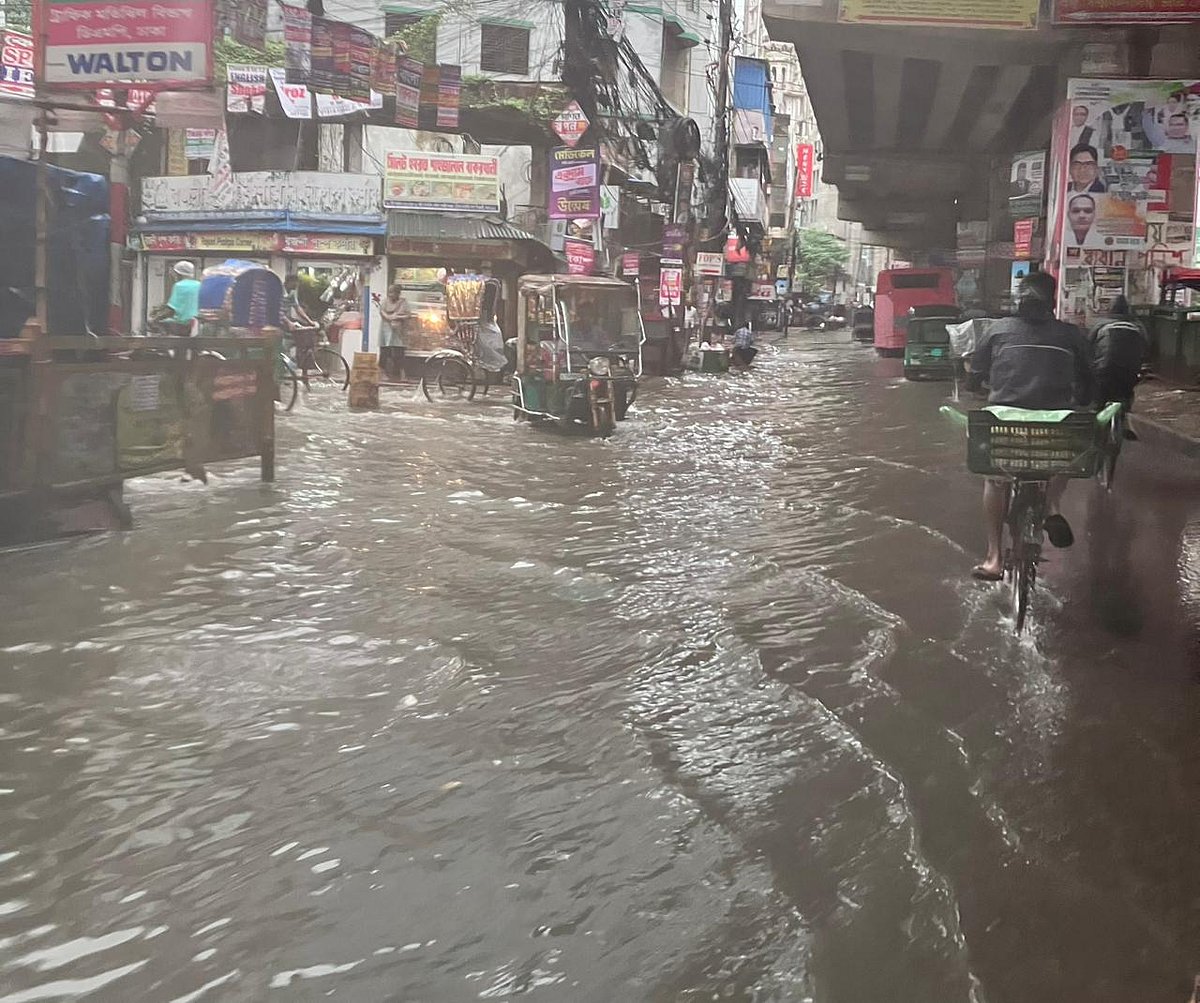
From the moment I stepped outside, the landscape looked like an unfinished disaster movie. Water, water everywhere. And not the clean, sparkly kind you would dip your toes in. No, this was Dhaka water, brown, smelly, frothy in places you do not want to imagine. The sort of water you would not step into unless you had a secret desire to land in the hospital with an exotic infection doctors might struggle to name.
From 5:45 to 7:00 am, it poured, enough to turn half the city into a water park no one asked for. By 7:30, the list of flooded areas read like a tour guide’s brochure: Dhanmondi, Mohammadpur, Kalabagan, Karwan Bazar, Green Road, Manipuri Para, New Market, Asad Gate, Jigatola.
So the waiting began. And the begging.
I tried every option: rickshaw, auto-rickshaw, CNG-run autorickshaw. Some drivers did not even bother with excuses. Just a flat “No.” Others quoted fares that would make you wonder if they thought they were offering air-conditioned helicopter rides. Double fare, sometimes triple. And mind you, I was ready to pay extra!
Finally, I got lucky. A rickshaw puller agreed to take me. Off we went, pedaling through knee-high water as if we were in a surreal water-sports competition. I half-expected someone to hand me a life jacket. On both sides of the road, hundreds of people marched along, shoes in hand, their clothes soaked, their tempers thinner than the drizzle.
Students in uniforms splashed by, running late for school. Office-goers glanced at their watches every thirty seconds, calculating just how late they would be. Everyone was on the same sinking boat, only without an actual boat.
From 5:45 to 7:00 am, it poured, enough to turn half the city into a water park no one asked for. By 7:30, the list of flooded areas read like a tour guide’s brochure: Dhanmondi, Mohammadpur, Kalabagan, Karwan Bazar, Green Road, Manipuri Para, New Market, Asad Gate, Jigatola. In some places, the water reached your knees; in others, your waist. Dhaka does not discriminate — everyone gets a taste.
The cruel irony is that none of this is new. We have adapted so well to waterlogging that it has practically become part of our urban identity. We know which shortcuts to take, which roads to avoid, how to hold our bags high to keep them dry, and how to haggle over fares with rickshaw pullers who suddenly feel like they are piloting yachts. We know the drill. But knowing does not make the suffering any lighter.
Because every year, it chips away at our time, our patience, and our dignity. The simple act of going to work, to school, to anywhere really, becomes a gamble against the weather. And let’s not even talk about what happens when the rain lasts longer than a few hours. One drizzle is enough to drown us. What hope do we have against a full monsoon downpour?
So here we are again, living the same soggy, frustrating, ironic story. The city runs late today, but really, it always does. Dhaka, after all, is a place where time flows slower than water drains.
And the saddest part? Nobody even pretends to be surprised anymore.