Opinion
7 issues to be considered in river and canal dredging
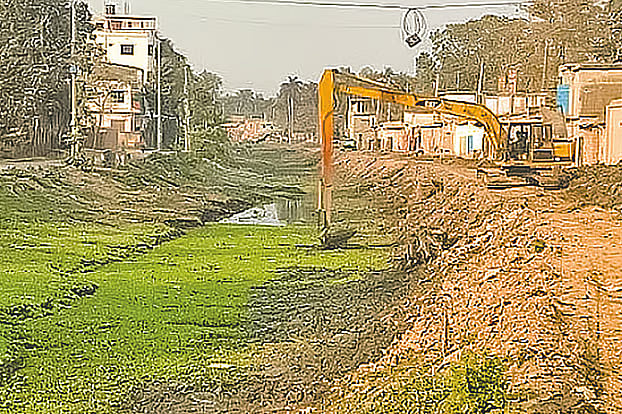
In line with its electoral commitment, the BNP-led government has launched a canal dredging program. The programme was inaugurated by Prime Minister Tarique Rahman on Monday. Tuhin Wadud writes about the key issues that need to be taken into account regarding river and canal dredging.
In our country, the government institutions responsible for river dredging are: BIWTA (Bangladesh Inland Water Transport Authority), BWDB (Water Development Board), BADC (Bangladesh Agricultural Development Corporation), BMDA (Barind Multipurpose Development Authority), LGED (Local Government Engineering Department), and the Department of Fisheries.
BIWTA does not have field-level offices. As a result, when it carries out river dredging, proper supervision is lacking. In many cases, BIWTA takes assistance from the Water Development Board. BIWTA is mainly supposed to dredge rivers that have or will have navigational routes. However, by exerting influence, it also dredges rivers that have no connection to navigation. In Dinajpur, BIWTA dredged the Punarbhaba River. In this dredging project, embankments were built inside the river itself.
In Rangpur, the Ghaghat River was dredged by the Water Development Board four to five years ago, and now there is hardly any need for further dredging. Navigation will not be possible on this river. Yet, BIWTA has taken up a new project worth nearly 10 billion taka to dredge it again.
This is an example of how poorly planned a river dredging project can be. There were allegations that the project had been adopted during the Awami League government for the special benefit of a few top officials of the shipping ministry. Although reports were published on the matter during the tenure of the interim government, the project was not canceled.
A few years ago, the Dudhkumar River in Kurigram was dredged under BIWTA. Despite spending several hundred crore taka, the dredging caused more harm than benefit. The small amount of material that was dredged was dumped back into the river. With rainfall, that sand returned to the river again.
Because the dredging was done in a haphazard manner, riverbank erosion increased in the same year. BIWTA spent about 27.65 billion taka on a project that included dredging the Brahmaputra-Jamuna River and other works. Many media reports have shown that this dredging did not serve any real purpose. Even after this work, the old Brahmaputra in Mymensingh continues to face water shortages. The initiative to establish river navigation from Balasi Ghat in Gaibandha to Bahadurabad Ghat failed to be practical, and that money was effectively wasted.
BWDB has effectively destroyed countless rivers in the country. By blocking the water flow of the Baral River in Pabna-Natore, this institution has caused extreme devastation. BWDB is also responsible for the tragic condition of the Karatoya River, which flows through Bogura. A 10–12-foot sluice gate was installed across the nearly 300-foot-wide Karatoya River, effectively killing it.
In the name of riverbank protection, BWDB has destroyed at least 10 tributaries and branch rivers of the Teesta River by building embankments. Rivers dredged by BWDB in recent years have not followed river-friendly methods. The Chikli River, flowing through Badarganj-Taragonj in Rangpur, was not dredged according to its actual width.
In Nilphamari, the soil from almost all dredged rivers, including the Dewnai River, was dumped on the riverbanks. Rainwater washes this soil back into the river. BWDB is also responsible for the water crisis in Bhobdah, Jashore. BWDB is one of the country’s largest institutions, with many skilled and experienced engineers. It is unacceptable for river or canal destruction, or any river damage, to occur under their supervision.
BADC is an institution under the agriculture ministry. This institution is eager to dredge rivers under the label of ‘canal.’ In Nilphamari district, there is a river called Bagdokra. After dredging it, they put up a signboard calling it “Bagdokra Canal.” A river flowing through Pirgachha in Rangpur is called Alaikmari. This river was also dredged and labeled a canal on the signboard.
The people living along these two rivers objected to calling the rivers ‘canals.’ There are countless examples of rivers being turned into canals. Another institution under the Ministry of Agriculture is BMDA, which is also skilled in works similar to those of BADC.
LGED has caused damage to numerous rivers by building bridges smaller than the actual width of the rivers. The institution has also constructed roads across many rivers without building proper bridges. Even when there is little water in small rivers, LGED takes projects for irrigation purposes, often spending money unnecessarily.
The Chekadara River in Nilphamari district is a clear example. LGED has turned the river into a pond. Another example is the Baishadara River in Pirgachha upazila, Rangpur district. The Department of Fisheries also dredges rivers into small ponds. In Kurigram, the Sat Bon River and the Payradanga River have been converted into ponds by the Fisheries Department.
These institutions often cause similar types of damage to rivers. Sometimes, a single river is split into two, sometimes into three. This may not be obvious at first, but examples make it clear. For instance, in Mithapukur upazila, Rangpur district, there is a river called Burail. This river was formed by the confluence of the Shalmara River and the Kafrikhal. The river is about 200 feet wide. If 30-40 feet is dredged in the middle and the dredged soil is dumped on both sides, the river effectively becomes three separate channels.
BWDB has divided the Manas River in Haragach, Rangpur, and the Burail River in Mithapukur into three separate channels. BADC has split the Alaikmari River into three channels. In Kaunia, the Barind Development Authority has created two separate flows in the Manas River by dumping soil across the middle at several points.
Rivers and natural canals never maintain a uniform width. They narrow in some areas and widen in others. When a dredging project is undertaken, the cross-section, slope, and current condition of the river are often ignored, and boundaries are not properly marked. Dredging is generally done according to almost the same measurements everywhere.
In some areas, rivers or canals are dredged narrower than their actual width, without considering the natural width. As a result, the river becomes much narrower than its original size. At the same time, river encroachers benefit. This has been observed in nearly all rivers.
Previously, river and canal dredging showed widespread lack of coordination. An example illustrates this clearly. In Badarganj upazila, Rangpur, there is a river called Chikli, which flows from the confluence of the Sonamati and Karatoya rivers. Both BMDA and BWDB had taken separate dredging projects on this same river.
Tensions arise between two institutions over the project. Each institution dredges a different section of the river. Even more concerning than having two projects is that the designs of the two institutions are different. Dredging the same river according to two different designs in the same location is extremely harmful to the river.
Currently, the government is preparing a list of rivers and canals that actually require dredging, and in the meantime, the canal dredging program has already been inaugurated. Previously, the institutions that dredged rivers and canals, either made them much narrower than their actual width or split a single river into multiple channels. Those dredged rivers and canals should not be included in the new list. For this reason, it is necessary to verify whether previously dredged rivers and canals were dredged according to their actual width; if not, they must be re-dredged to restore the correct width.
Prime Minister Tarique Rahman is highly committed to the dredging of rivers and canals in the country as well as to environmental protection. The river and canal dredging program was inaugurated yesterday, 16 March. In this situation, I am presenting several proposals for river and canal dredging:
1. Before dredging a river or canal, boundaries must be marked according to the CS (Cadastral Survey) records. Even if someone has recorded the river or canal land under a personal name, that ownership is invalid. There is no legal basis for changing the classification of rivers, canals, wetlands, or water bodies. Since these properties belong to the public, they cannot be donated or assigned to any individual. Even if a waterway is unrecorded, no one can claim it as private property. In such cases, the Deputy Commissioners should declare these flows as rivers through proper survey.
2. Dredged soil must not be dumped on the riverbanks. Dumping dredged material on river or canal banks destroys their natural form. Rainwater cannot flow away quickly, and floodwater may be obstructed from entering the land. When adopting a dredging project, proper management of the dredged soil must be ensured.
3. Rivers must never be referred to as canals. The National River Protection Commission has defined what constitutes a river. Flows that qualify as rivers according to this definition must be referred to as rivers. Previously renamed rivers labeled as canals should have their original names restored.
4. In most dredging projects, excavators remove soil and deposit it on one side first, then on the other side. This single-shifting method is common, but dredging should prioritise the width of the river rather than shifting soil.
5. River and canal dredging requires coordination committees at upazila, district, and divisional levels. The District Executive Engineer of the Water Development Board and the zonal Chief Engineer at the divisional level can serve as chairpersons of these committees.
6. All rivers and canals whose mouths have been blocked must be reopened.
7. The National River Protection Commission should be involved in river and canal dredging so that it can play an active role in monitoring and guidance.
It is assumed that river and canal dredging is being carried out as a special priority project under Prime Minister Tarique Rahman. The dredging must be conducted realistically, taking the type and condition of each river into account. The goal is not just to see how many thousands of kilometers of rivers and canals are dredged; it is equally important to ensure protection of agriculture and biodiversity and that the dredging achieves its intended purpose.
For a long time, we have been calling for the correction of defects in river dredging, but no action has been taken. Under the direction of Prime Minister Tarique Rahman, dredging is expected to be carried out as correctly and defect-free as possible. This is our expectation.
* Tuhin Wadud, Professor, Department of Bangla, Begum Rokeya University, and Director, Riverine People. Email: wadudtuhin@gmail.com
* The views expressed here are the author’s own.