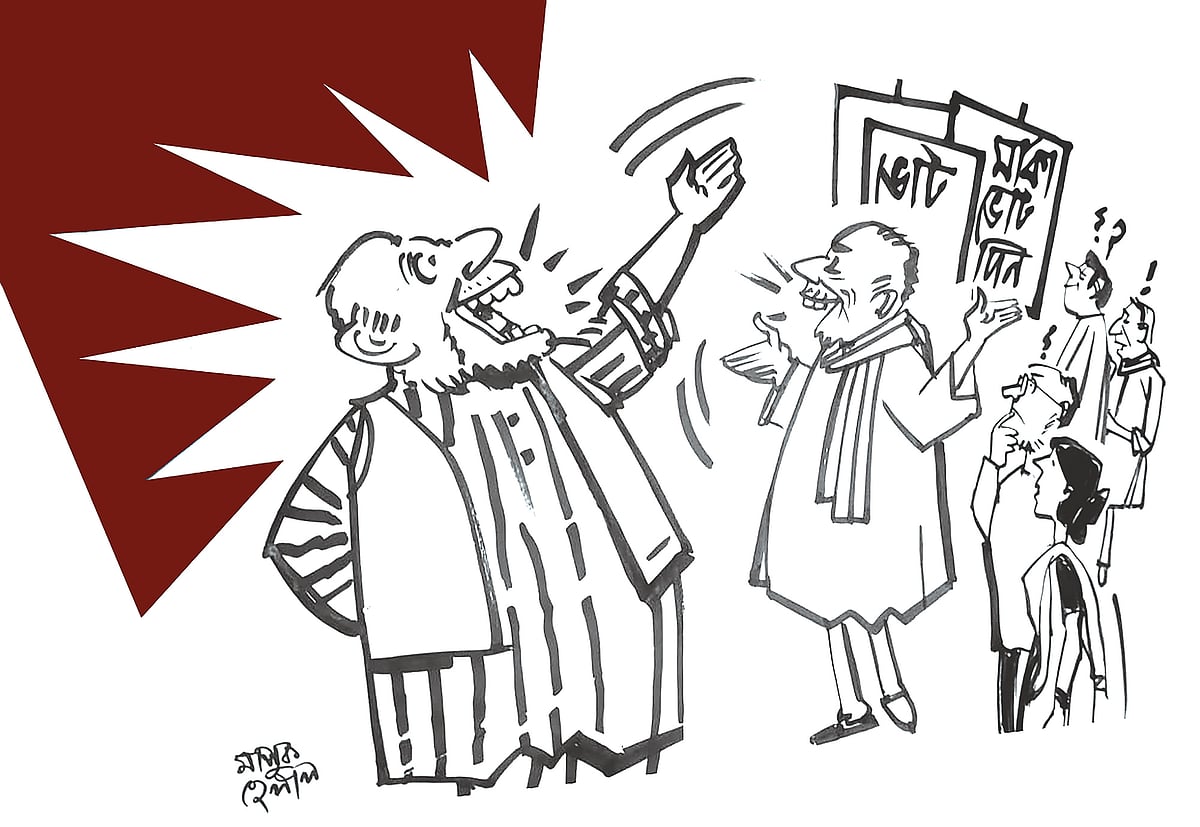
The countdown to the election has begun. Only 12 days are left. The head of the government is saying that this election will be the best election ever. We will be proud of it. The election will be held in a festive atmosphere. Yet, people are not at ease.
Whenever elections come around, people become anxious. Rallies, processions on the roads, long parades with motorbikes and cars, and loudspeakers blaring. Threats like "I will gouge your eyes out, I will kill you" can be heard. This doesn't seem to echo the spirit of a positive political change for which there was a mass uprising in 2024. It seems this uprising was only for changing the government, not for changing society.
Otherwise, how could politicians' language remain the same and unchanged, like before?
There are disturbances happening in various places. Arguments among rival party supporters are leading to fights. No one is sparing any effort to incite trouble.
The most disappointing aspect is that some people are beginning to think, "Things were better before." The number of such people is growing day by day. This trend cannot be stopped even by cursing the fallen government. Just as the previous government looked for conspiracies in everything, even during the interim government's rule, some are sniffing out conspiracies.
Our country's politics is focused on the past. "We did this fifty years ago, we did that twenty-five years ago, we've been the ''vanguard'' for fifteen years"—these words keep reminiscing history, along with verbal battles. Someone uses a sharp word, immediately countered by even harsher words, spewing venom.
There is something called an electoral code of conduct. The Election Commission officials occasionally say a few words about it. Their words do not sweeten anyone's ears. It feels like uttering words of conscience during a theatrical performance, which doesn’t bring about any change. Every day, we hear complaints about violations of the code of conduct. In some cases, we see the commission warning candidates. Some are even fined, but it does not seem to make much of a difference.
Leaders and candidates of various opinions have entered the race with full zeal. Their words reflect their personal and party perspectives, education, and taste. Fearing ''election engineering'' might occur this time too, just like in the past, they are giving counter-statements. In their speeches, they attempt to convey that some parties might ''manipulate'' this election. It reminds us of the 2018 overnight voting incident.
On 22 January, at a gathering at the Shayestaganj Upazila Parishad ground in Habiganj, BNP Chairman Tarique Rahman said, "This time, be prepared to go to the polling station after offering Tahajjud prayers. Pray Fajr in congregation in front of the polling station and then stand in line at seven to cast your vote. Remember, this vote is extremely important."
At another rally, clearly indicating Jamaat-e-Islami, he said, "Those who are misleading innocent mothers and sisters and taking NID numbers and saying various things, they had one role when we liberated the country in 1971 with the blood of millions of martyrs. Millions of mothers and sisters were disgraced back then. The people of Bangladesh have recognised what they are."
Jamaat is not holding back either. In a street rally in Magura on 26 January, the party’s Amir Shafiqur Rahman said, "Keep an eye all around you. On 12 February, no eagle will swoop down and take away the vote." In a gathering in Jhalakathi, he said, "If anyone tries vote engineering or occupying polling centres like in the past, a befitting reply will be given." On 27 January, in a public meeting at Jashore Eidgah ground, targeting the BNP he stated, "We will bring new politics to Bangladesh, where there will be no family-centric politics."
On 26 January, in a rally in Laxmipur, NCP's convener Nahid Islam, referring to Tarique Rahman's statement, said, "It is being said to be present at the voting centre after the Tahajjud prayer. Right after Tahajjud, they are planning to seal the votes. They're planning to occupy polling centres. The leaders and workers of a united Bangladesh will thwart these conspiracies."
In some people's words, there is a noticeable lack of basic courtesy. In attacking the opposition, they often lose their sense of proportion, using words and sentences that cross the boundaries of decency. The level to which this kind of street brawl through words to strike down rivals has reached, I witnessed in a report published in the media.
On the night of 24 January, at an election rally for Jamaat-e-Islami candidate Sultan Ahmed in the Barguna-2 constituency at Katakhali area of Patharghata, Barguna, while criticising the past stance of the Dhaka University Central Students' Union (DUCSU), Barguna District Jamaat-e-Islami Assistant Secretary General Md Shamim Ahsan at one point said, "We watched; after the DUCSU election, the DUCSU, which was a den of drugs, which was a brothel, was capable of being changed by Islamic Chhatra Shibir. Jamaat-e-Islami is capable of eradicating all types of injustice, all kinds of extortion, and corruption from Bangladesh."
We know that Jamaat's affiliate organisation, the Islamic Chhatra Shibir, won in the recent DUCSU elections. There are various reasons for their victory. However, such comments about previously victorious organisations in DUCSU are unexpected, verbose, and tasteless. Yet Jamaat claims it does politics for the satisfaction of Allah. Here is a sample!
NCP's chief coordinator Nasiruddin Patwary is the candidate for Dhaka-8 constituency. On 27 January, when he went to attend a pitha festival as an invited guest at Habibullah Bahar College in Dhaka, he was attacked. Eggs were thrown at him. Nahid Islam, the party’s convener, alleged, "The identified miscreants of Habibullah Bahar College intentionally carried out this attack. This incident took place under the instruction of Mirza Abbas and with the consent of Tarique Rahman. On stage, they will give good speeches, while on the other hand, they will suppress opponents through terrorist means. They want to rehabilitate Awami League politics; we will not let that happen."
Notably, this is the second time eggs have been thrown at him. Earlier, on the evening of 23 January, during an election campaign street rally at Golden Plaza Alley, Siddheswari, dirty water and eggs were thrown. At that time, he blamed extortionists for the incident. NCP leaders have been saying for a long time that BNP people engage in extortion.
In all of this, we see exceptions. Independent candidate Tasnim Jara from Dhaka-9 constituency believes that people vote out of trust. People's trust is the strength; not a rented crowd for a rally or ear-piercing announcements using microphones or loudspeakers. On the night of 26 January, in a post on her verified Facebook page, she said, she believes that if it can be shown in this election that an independent candidate can win without ear-piercing announcements using microphones, without littering the city with posters, or spending millions on showdowns, then in the future many such people will come into politics who do not have money or muscle power, but have the aspiration and capability to change the country. And then political parties will be forced to abandon their old practices.
# Mohiuddin Ahmad is a writer and researcher.
*The opinions expressed are the author's own
#The article, originally published in Prothom Alo print and online editions, has been rewritten in English by Rabiul Islam