Opinion
Viewing Padma Barrage in light of the Teesta Barrage experience
The government has approved the Padma Barrage Project at a cost of Tk 344.97 billion. The project will be implemented with the country’s own funding. Completing the entire project will require nearly Tk 500 billion taka. The current government adopted this mega project soon after taking office. There are discussions and debate regarding the project. Questions have arisen in the interest of the project itself, and these need to be taken into consideration.
To reap the benefits of the Padma Barrage Project, several issues must certainly be considered. If those matters are already included in the project, then there is no issue. To make the Padma Barrage Project effective, the river must have sufficient water even during the dry season.
The full benefits of the project cannot be achieved solely with water retained during the monsoon season. If water is not received on the basis of a fair share, alternative measures will have to be determined. If the project is undertaken, the extent of environmental damage and the impacts upstream and downstream of the barrage must also be identified. There are many issues involved, including whether water will come from India, river erosion, silt removal, and increasing salinity in the coastal areas.
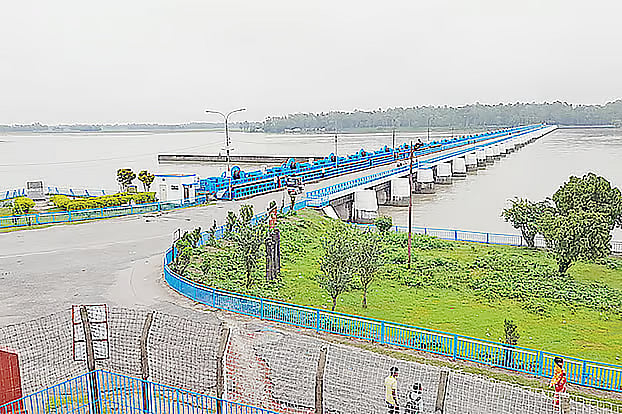
For the past 16 years, I have closely observed the country’s largest irrigation project, the Teesta Irrigation Project. I have seen how cruelly India treats Bangladesh regarding river issues. I also have extensive knowledge of how the Bangladesh Water Development Board (BWDB) has virtually destroyed around 20 distributaries and tributaries of the Teesta River. Because of the grim reality surrounding the Teesta River and the Teesta Irrigation Project, several questions keep popping up in my mind regarding the Padma Barrage Project.
According to a report published in Prothom Alo, the Padma Barrage Project was originally supposed to be undertaken in 1961. Later, in 2002–2003, the BNP-led government began work on the barrage. Its feasibility was also assessed during the subsequent Awami League government. In line with its election pledge, the current government is now taking up the Padma Barrage Project. It is being said that, once implemented, the project will make it possible to irrigate 2.9 million hectares of land. Navigability will be restored in five important rivers, and a small hydropower project will also be established.
How justified is the naming?
The approved project on the Ganges River has been named the Padma Barrage. In the six-volume 'Rivers of Bangladesh' published by the Bangladesh Water Development Board, the Ganges and the Padma are assigned separate identification numbers. The Ganges River’s identification number is NW 27, while the Padma River’s identification number is NC 32. In fact, the river is called the Padma only after the Ganges meets the Jamuna River. Therefore, if a barrage is built on the Ganges River, its name should logically be the Ganges Barrage.
Calling it the Padma Barrage could strategically benefit India in subtle ways. Sheikh Rokon, Secretary General of Riverine People, said, “Naming the project Padma Barrage instead of Ganges Barrage is geopolitically incorrect. Because doing so would voluntarily surrender the downstream country’s rights over the Ganges River, which is exactly what India wants.”
The Teesta Barrage project experience
Just as India has a barrage upstream on the Teesta, it also has a barrage upstream on the Ganges. After next December, there will no longer be any agreement on the Ganges either, much like the Teesta. India may cast the same dark shadow over the waters of the Ganges as it did over the Teesta. Surely everyone remembers what India did with Teesta’s water.
In 2011, the Teesta water-sharing agreement had been finalised. However, opposition from then West Bengal Chief Minister Mamata Banerjee prevented the agreement from being signed. Moreover, since 2014, India has begun unilaterally withdrawing Teesta water. In 2014, around 65,000 hectares of land in Bangladesh were under irrigation through the Teesta project. Suddenly that year, India withdrew virtually all of the Teesta’s water. The farmland under the irrigation project cracked open from lack of water. If the same thing happens on the Ganges, where will Bangladesh get water?
It has been stated that, once the Padma Barrage Project is implemented, irrigation will be possible on 2.9 million hectares of land. But will we actually receive enough water to irrigate that amount of land? Mamata may no longer be in power, but how much certainty is there that Bangladesh will receive adequate water from the Padma during Suvendu Adhikari’s era?
After India withdrew the Teesta’s water, Bangladesh managed to hold back the limited subsurface flow upstream of the barrage and divert it through adjacent canals to irrigate barely one-fourth of the originally targeted land area during the initial phase.
Many fish species have disappeared from the Teesta. When egg-bearing fish cannot move upstream because of the barrage, their spawning is obstructed. As a result, fish populations decline
During this time, the Teesta downstream of the barrage dried up completely. People were able to walk across the riverbed. Despite movements, struggles, seminars, meetings, and extensive writing, it has still not been possible to ensure Bangladesh’s rightful share of Teesta water. India opposed the 1997 UN Convention on the Law of the Non-Navigational Uses of International Watercourses. Therefore, if India unilaterally withdraws Ganges water just as it did with the Teesta, Bangladesh must establish a clear framework for how the project would still be implemented.
After the Teesta Barrage was established, the river downstream behaved in very unusual ways. River erosion downstream accelerated significantly. At times, India suddenly opens all the sluice gates at Gazoldoba. Then water rushes into Bangladesh at tremendous speed. The resulting erosion and flooding cause immense downstream damage. At the end of October 2021, although there was no rainfall in Bangladesh, all the gates at Gazoldoba were opened. That year, the Teesta’s water level rose to its highest point above sea level. Bangladesh must remain vigilant so that India cannot inflict similar damage on the Padma.
How will the benefits be achieved?
If water is not received, if less water is received, or even if the current amount is maintained, the downstream flow below the barrage will not remain as it is today. The current between the barrage and the confluence of the Jamuna and the Ganges, about 37 kilometers away, will decrease significantly. A certain velocity of river flow keeps sediment moving. If that velocity decreases, sediment will inevitably accumulate on the riverbed. Therefore, if sediment builds up in the river due to the barrage, arrangements must also be made to remove it. There is also a risk that the distributaries of the Ganges, Padma, and Meghna downstream of the barrage may die out because of reduced water flow.
Will salinity increase along the coast?
The waters of the Padma, formed by the confluence of the Ganges and Jamuna, eventually flow into the sea through the Meghna. If the current of the Padma-Meghna system weakens, saline seawater will intrude farther upstream. Holding back the waters of the Ganges for project operations will inevitably reduce the river’s flow power significantly. In that case, will the damage caused by saline water along the coast increase? If so, measures must be adopted to minimize the damage.
Will fish production increase?
It has been claimed that the establishment of the Padma Barrage will increase fish production by 234,000 tons. Provisions will supposedly be made for fish migration. Similar claims were made when the Teesta Irrigation Project was undertaken. In reality, however, the canals were unsuitable for fish farming, so aquaculture did not develop there. On the contrary, fish production in the Teesta has declined significantly because of the barrage.
Many fish species have disappeared from the Teesta. When egg-bearing fish cannot move upstream because of the barrage, their spawning is obstructed. As a result, fish populations decline. If water flow decreases, deep-water fish species may disappear altogether. There is also a serious risk that aquatic plants and biodiversity will be severely damaged. The failure of fish farming in the Teesta should not be repeated here.
Long-term concerns
Then there is a long-term concern. India is making various arrangements to divert water from the Brahmaputra. If India or China withdraws Brahmaputra water, the Jamuna River will no longer carry water at its current levels. If the Jamuna loses water and irrigation is carried out using Ganges water, there is a risk that the Padma River could dry up like the Teesta. In that case, the Brahmaputra-Ganges-Meghna basin could face a severe crisis. India’s interlinking river project has already progressed as far as the Dharla River. India aims to divert as much Brahmaputra water as possible through canals. Therefore, long-term risks and crises must also be taken into consideration.
Will opinions be taken into cognizance?
There are criticisms regarding the Padma Barrage Project and questions about it. The government needs to examine these views before starting the project, and assess whether these concerns have any tangible basis. It must be seen whether the criticism is merely opposition for its own sake or whether there are valid grounds behind it. Listening to the opinions of critics and of those who truly understand rivers would be beneficial for the project.
Some of our short-sighted projects have already caused severe damage to many rivers, including the Teesta. That is why so many concerns and questions have emerged. It is expected that the Padma Barrage Project, funded by public money, will not follow the same path of poorly conceived projects.
* Tuhin Wadud is a professor in the Department of Bangla at Begum Rokeya University and a director of the river-focused organisation Riverine People.
* The views expressed here are solely those of the author.
* This article originally appeared in Bangla in Prothom Alo and has been translated here by Ayesha Kabir for Prothom Alo English Online.