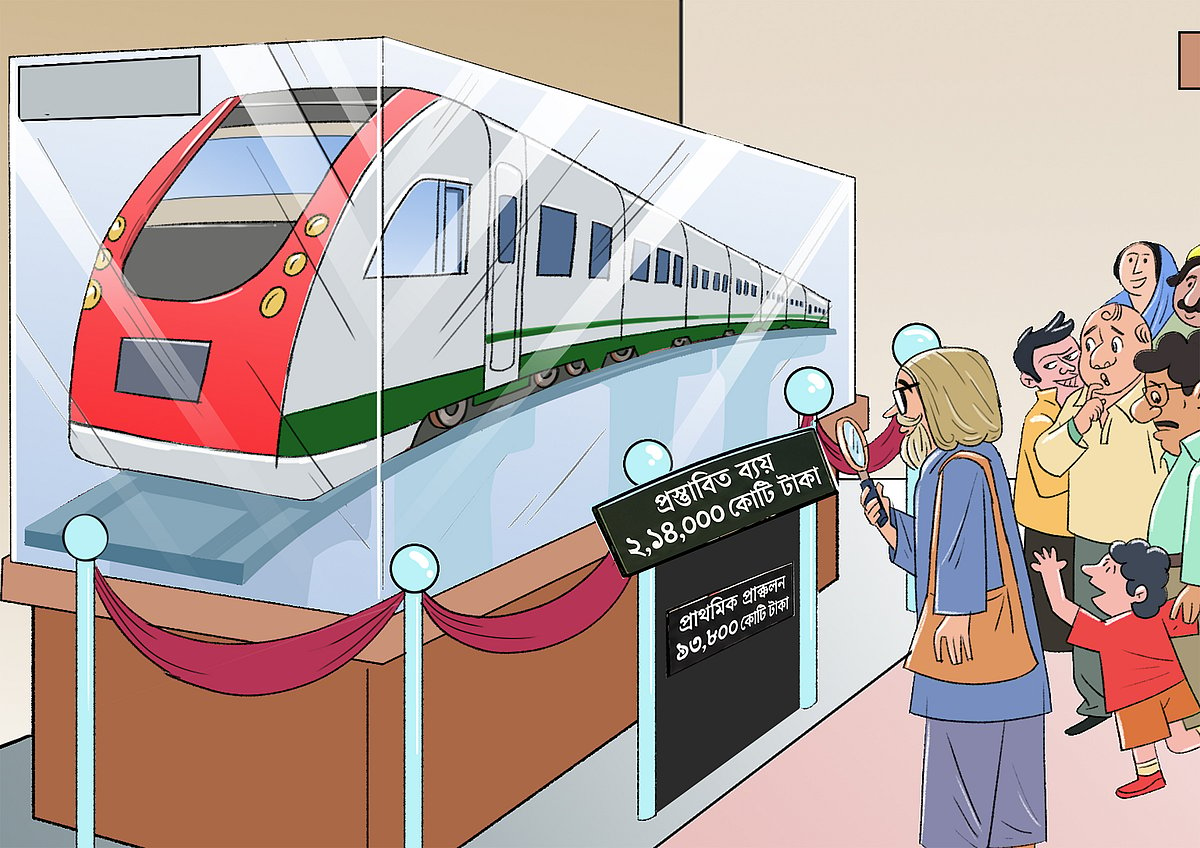
On 30 August, I saw a report in Prothom Alo that stated the cost for two new metro lines would be Tk 2,140 billion. A few other newspapers reported on this too, and the tone of all the reports was that this cost is excessive. The initial estimate of the project was Tk 938 billion. Even before the work began, the cost increased by over 100 per cent. A government-formed technical committee reported this cost increase as logical!
Over the 16 years of the Awami League government, we have become somewhat accustomed to overpriced projects. Our elevated MRT Line 6 cost Tk 1 5.74 billion per kilometer. Around the same time, the Delhi Metro was constructed at roughly Tk 3 billion per kilometer. The initially estimated Tk 100 billion for the Padma Bridge ended up at Tk 310 billion. Even more surprising is the railway connection of the Padma Bridge. Building a 172-kilometer railroad cost around Tk 400 billion or Tk 2.32 billion per kilometer.
In Europe, high-speed train lines are built roughly at this cost. This railway line was constructed with Chinese loans, and the Chinese build rail lines capable of running at 250 km/h at this rate in their own country. The revenue from the railway will never be able to repay this loan interest. Overall, it was a completely unnecessary project. Perhaps a market will develop for its services in 15 years, but the burden of the loan has started today.
Another unnecessary project saw massive spending. There was an excellent road from Kuril to Kanchan with four lanes in the middle and four lanes on each side, known colloquially as the 300-foot road. Making U-turns under the bridges would have sufficed, and there would have been no fear of traffic jams. There was no need to touch it for at least the next 10 years.
However, within a few months of the road's completion, it was being torn up to make the 14-lane Purbachal Expressway. After three years of suffering, the beautiful road has emerged. It feels great to drive on. However, every expenditure has an alternative use. I could not ascertain the actual cost of this project despite trying. I've heard Tk 200-220 billion were spent on this approximately unnecessary 12.5-kilometer path.
Back to the metro rail. Why does everything cost us so much more to accomplish? All metro rail projects have JICA as the lender. During my 33 years at the foreign ministry, I always heard that Japanese loans are very good, with very soft terms, etc. I have rarely had the chance to see up close; because these matters were handled by ERD, which likes to keep the foreign ministry as much in the dark as possible about their activities.
During my special duty of one and a half years, some related information came to my notice. In projects financed by JICA, the consultants are Japanese, and the contractors are Japanese too. There is a type of collusion among the contractors. Then there's the cost increase due to design changes.
The Prothom Alo report mentions two things about JICA's loans from ministry sources. One, various conditions are imposed on project financing. Two, the tender documents contain such methods and technologies that no one but Japanese companies can fulfill. In the third terminal project at the airport, a relatively expensive technology was said to be used for piling to complete the work quickly. After work began, it was said that this technology could not be used in the soil there, so a different technology had to be employed. Fair enough. But meanwhile, a company has already been given mobilisation money for piling with the former technology. So, pay damages! The same story has reportedly been used in the MRT-6 project to recover damages.
Now, with JICA financing, two metro lines are being proposed at a cost per kilometer at least three to four times higher than other ongoing metro projects worldwide. Running the metro rail won't generate any operational profit, and that isn't the target either. Then how will this illogical, huge loan be repaid?
Minister Sheikh Rabiul Alam has said that metro rail is necessary. Otherwise, Dhaka cannot be saved. It is understood that metro rail is needed, but the full meaning of the next sentence is unclear. What exactly does he mean by 'saving'? As per livability measures, Dhaka ranks among the worst in the world. One of the major problems of this city is severe traffic congestion. The average speed on roads is laughable, 4.8 to 7 kilometers per hour. Metro rail quickly gets passengers to their destinations in the city, but it serves only a very limited number of people.
Currently, the daily users of the MRT-6 line are only 382,000, while there are ten million bus users in the city. Then there are Uber, rickshaws, scooters, motorcycles, private cars. The two main components of Dhaka's traffic jam are one, the anarchy among bus drivers and owners, and two, the completely unruly behaviour of a vast number of rickshaws (a large portion of which are now battery-powered). And leaving out motorcycles altogether. Without addressing these issues, starting some metro rail at sky-high costs cannot 'save' Dhaka city.
What can be done then
1. Clearly, JICA has seized Bangladesh. Cancel the metro rail project at the current stage it is in. Tell JICA that when they can make a metro in Bangladesh at a cost comparable to or slightly higher than other countries in the world, then bring the project—we will welcome it. They may offer some lower-cost proposals, but agreeing to them would be foolish.
2. Urban transport should not be any profit-making business. Tell the bus owners to gradually wrap up this business over the next five years and focus on inter-district transportation. Some non-profit entity—government, private, or mixed—should take charge of urban transport. Bring in five thousand electric buses. The cost would be only Tk 250 billion. The buses would arrive gradually over three to four years. Charging a bus to run 250 kilometers would take 5 hours, doable between midnight and 5 am. It would require roughly 1,500 megawatts of capacity to charge 5,000 buses at once. Electricity demand drops more than this late at night.
3. Then there's the rickshaw. No one knows the true numbers, but over the last two years, all roads in Dhaka city have been covered with battery-powered rickshaws. Additionally, many pedal-powered rickshaws remain. Due to excessive numbers, these vehicles gather at street corners waiting for passengers, creating a nightmare for other vehicles. They go the wrong way wherever they like, creating dangerous situations for themselves and others. I saw in the newspaper that there is a policy being made for motor rickshaws. Limiting the number and mandating licences should be part of this policy. Training for drivers should also be included. Measures for traffic law violations should apply to rickshaws too.
4. If the city is to be saved, there is yet another aspect to concentrate on. Footpaths are for people to walk, roads are for vehicle movement, not for running shops, operating food hotels, or even for greening. Encroachment under local political leadership has now exceeded all limits. Pull its reins.
#Md Touhid Hossain is former foreign advisor
* The opinions expressed here are the author's own
#This article, originally published in Prothom Alo print and online editions, has been rewritten in English by Rabiul Islam