Analysis
A possible outline of Bangladesh–India relations
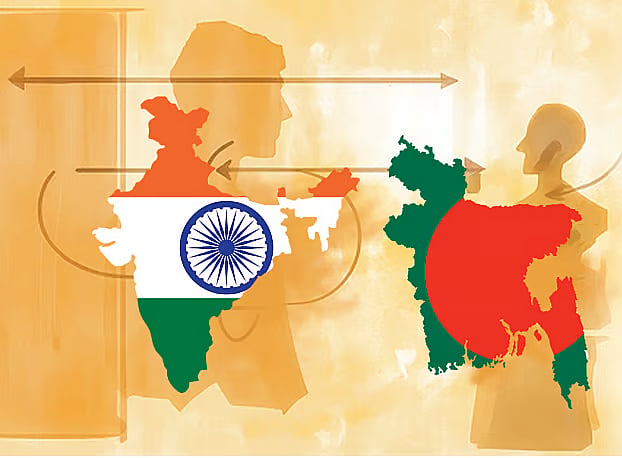
For Bangladesh and India, 1971 is not just a history of friendship or cooperation—it is much more than that. But no relationship can remain the same forever. Hasan Ferdous has written about India–Bangladesh relations in two parts. The final part has been published today.
More than five and a half decades after the Liberation War, India–Bangladesh relations now stand at a critical crossroads—what former UN Secretary-General Kofi Annan once described as a ‘fork in the road.’ One direction leads to friendship and cooperation; the other inevitably leads to conflict. Which path they will take is a decision that not only India, but also Bangladesh must make.
The question of shared sovereignty
Let us begin by acknowledging a reality. There is a clear reason behind the unequal relationship between Bangladesh and India. India is not only the largest country in South Asia; it is also a regional power. Comparing the strength and capabilities of the two is unreasonable. However, the comparison between two sovereign states cannot be made based solely on their power or influence. Both are sovereign, and under international law, both are entitled to equal rights and dignity. For this reason, each has one vote in the United Nations. Yet India’s attitude toward Bangladesh often creates the impression that, because of its size and significance, it expects greater respect—or deference—from Bangladesh.
The renowned American scholar Stephen P. Cohen worked extensively on South Asian affairs. Assessing India’s position in the region, he wrote that this large South Asian country expects special respect from its smaller neighbours. In his 2001 book India: Emerging Power, Cohen observed that while India is indeed becoming an increasingly powerful regional force, if it expects ‘deference’ from its sovereign smaller neighbours on that basis, resentment and rejection—if not now, then eventually—are inevitable. This is exactly what has happened in the case of Bangladesh.
Structural inequality
During Sheikh Hasina’s 15 years in power, India undeniably secured additional advantages from its smaller and structurally unequal neighbour, Bangladesh, in areas such as trade, transport, border security, and electricity distribution. Even Indians themselves acknowledge this. The most prominent example is India’s stance on water-sharing. The cases of the Farakka Barrage and the Teesta River are well known. Despite repeated negotiations, no agreement has been reached on Teesta’s water-sharing to this day. The situation is so glaring that former Indian Foreign Secretary Nirupama Rao had to admit that the Teesta issue has cast doubt on India’s sincerity.
Another major and visible issue is the unequal trade deficit. India exports nearly 16 billion dollars’ worth of goods to Bangladesh annually, whereas Bangladesh’s exports to India barely reach 1.5 billion dollars. There is no doubt that, as a large economy, India enjoys a naturally advantageous commercial position. However, it cannot be denied that India’s imposition of various non-tariff barriers on imports from Bangladesh—such as delays in tariff decisions, unpredictable quality-control checks, and port restrictions—has also contributed to this imbalance.
A need for a change in perspective
To change the current situation, the minimum requirement is a shift in India’s attitude toward its neighbour. Instead of relying on leaders it prefers, India must place trust in the people of the country—this would be the proper expression of a constructive outlook. In fact, India would benefit if it refrained from interfering in Bangladesh’s political leadership and showed greater respect for Bangladesh’s democratic processes. Instead of a ‘client,’ India would then gain a democratic partner. For this, India needs a kind of strategic humility in its policymaking—something still absent from its behaviour.
In a 2021 speech, Indian commentator Vinod Khosla said that India is excessively self-confident, even arrogant, toward its neighbours. This does not always produce good outcomes, and today’s Bangladesh is one such example. Khosla remarked that if India can show respect toward its small neighbour instead of ‘lecturing,’ it would bring benefits for both sides.
Anti-India sentiment in Bangladesh
It is no secret that there is resentment toward India in Bangladesh. This stems not only from India’s perceived hegemonic behaviour but also from several interconnected social and cultural factors. In fact, anti-India sentiment in Bangladesh is not temporary—it is structural. To change this reality, India must craft a new narrative: instead of demanding gratitude for 1971, it must present Bangladesh as a genuine partner. Alongside this, effective steps must be taken to resolve the complex and multidimensional issues—such as water-sharing, trade imbalance, connectivity, land transport, and border disputes. The first move must come from India.
The reset button
Tanvi Madani, an expert at the Brookings Institution, has written that to overcome the current distrust, India must demonstrate that Bangladesh is not merely ‘a corridor or a security buffer,’ but a partner with its own priorities. After the 2024 mass uprising, Bangladesh has structurally changed, and India must acknowledge this.
Indian commentator Sanjay Kapoor (editor of Hardnews) has noted India’s current failures regarding Bangladesh, writing that Delhi has failed to understand that trying to keep Sheikh Hasina in power at any cost has created ‘a potential explosion’ in the country. Former Indian Election Commissioner SY Quraishi has been even more explicit: he states that electoral manipulation during Hasina’s tenure is no secret. By continuously protecting her instead of acknowledging this fact, India has in effect undermined its own credibility.
There are many in India who still believe that Sheikh Hasina can be returned to power. The public political participation allowed to ousted Awami leaders in Kolkata and Delhi seems to be part of such a project. Abandoning this approach would undoubtedly help rebuild relations. Returning Hasina to power is a major political decision, and the current realities are not conducive to such a transfer. However, at a minimum, India can curb the political activities of the Awami League on Indian soil. Even better would be taking initiative regarding the return of second- or third-tier Awami leaders who are accused and facing trial. This, in fact,
would serve as a true ‘reset button.’
In short, to change the current trajectory of bilateral relations, India must lay the first brick. To address the existing structural imbalance, it must rebuild trust with Bangladesh while offering meaningful concessions where appropriate (such as on water-sharing, trade equality, and border security). If, early next year, a meaningful election forms a government in Bangladesh, reducing the current distance between the two neighbours will become easier—a possibility several Indian experts consider likely.
Perspectives on Bangladesh–India relations
One of them is Professor Ankita Dutta from Jindal University. In an interview with The Daily Star in Dhaka, she said that once elections are held, the situation will change, and it will be possible to reorganise the bilateral relationship. Professor Dutta believes that so far, both countries have focused on a stance of I want this, I don’t want that. But if both sides proceed with mutual needs in mind, change becomes inevitable. This, she argues, would be a true reset—not a Hasina-dependent relationship, but an institution-based one.
Fundamentalism and communalism
Here, it is not only India that must take initiative; Bangladesh must also act. If anti-India sentiment becomes a politically profitable card—which is increasingly evident in Bangladesh—it could deal a long-term blow to bilateral relations. Within and outside the Bangladeshi government, there are individuals who are willing to leverage anti-India sentiment for political gain.
Professor Yunus himself has occasionally made remarks that, from India’s perspective, do not support improved relations. His comments on the so-called ‘Chicken’s Neck’ and Bangladesh’s claim to be the sole ‘guardian’ of the Bay of Bengal have heightened Indian unease. An advisor once posted a map on Facebook including Indian territory as part of Bangladesh (later removed), which also did little to calm tensions. Frequent visits by Pakistani military officials to Dhaka and their warm receptions have not gone unnoticed in India either.
Currently, India has at least two immediate concerns: first, the resurgence of fundamentalist politics in Bangladesh; and second, rising communalism. Religion-based politics is now a daily reality in Bangladesh, and denying it is impossible. Some, such as Milan Vaishnav from the Carnegie Endowment, have argued that the rise of fundamentalism in Bangladesh is linked to the rise of religion-based politics in India—they feed off each other.
Attempts have been made in Bangladesh to sideline religion-based political parties from the mainstream, sometimes even using authoritarian measures. However, these efforts have not succeeded; instead, the crafty promotion of an imagined moral superiority has strengthened such politics. Today, it is a reality, and in the ‘new arrangements’ in Bangladesh, religious political parties have been given legitimacy. This may be seen as a mistake in theory, but in practice, the evidence is lacking. One could argue that legitimising religion-based politics allows these parties’ activities to come under greater civic oversight, making it possible to hold them accountable.
If anti-India sentiment becomes a politically profitable card—which is increasingly evident in Bangladesh—it could deal a long-term blow to bilateral relations. Within and outside the Bangladeshi government, there are individuals who are willing to leverage anti-India sentiment for political gain.
The issue of communalism is even more complex. For its internal needs, India cannot ignore the persecution of Hindus in Bangladesh; at the same time, Bangladesh cannot allow India to use this issue as a political weapon. Religious minorities are citizens of Bangladesh. Therefore, Bangladesh must take initiative to protect the rights of minorities as part of its own state responsibility, not merely in response to Indian criticism. This cannot be denied: like all vulnerable communities, minorities in Bangladesh face discrimination and persecution. Through its actions and the implementation of declared policies, the government can build trust among minority communities.
Close neighbours, close friends
As the saying goes, we can choose our friends, but not our neighbours. One does not need to be a rocket scientist to understand that Bangladesh and India need each other. Even though a 4,000-kilometer border separates them, they share a thousand-year-old common history and cultural heritage. Most importantly, they share the collective memory and achievements of 1971—something that cannot be erased.
To manage the existing structural imbalance between the two countries, emotions are not enough; realistic, practical measures are required. Stable relations are built on predictable, institution-based systems—not on personal chemistry or historical memory. Bangladesh needs processes that safeguard its sovereign decision-making—such as transparent water-sharing agreements, rules-based transit protocols, and fair commercial access. India, likewise, needs arrangements that reassure it about security and connectivity.
1971: Witness to a birth moment
For Bangladesh and India, 1971 is not just history—it is a bond of blood, a witness to their birth moment. Yet no relationship can remain confined to its origin story. More than half a century has passed; realities have changed, generations have shifted, and interests have evolved. Bangladesh wants to shape its future through its own sovereign decisions—not through chains of perpetual gratitude. India too seeks stability, but that stability cannot be sustained through nostalgia alone; it requires mutual respect and fairness. Honouring 1971 does not mean turning it into a political weapon, but rather embracing its core lesson—upholding sovereignty, dignity, and justice.
If both countries truly value that legacy, they must rebuild their relationship not based on past glories, but on the needs of the future. The past united us—but to build the future, establishing new trust on the foundation of equality is now the most urgent task.
#Hasan Ferdous is a journalist
*Opinions are the author’s own