Helal Mohiuddin’s in-depth analysis
Is the govt hearing warning bells of a political catastrophe?
The announcement that “Sheikh Hasina will return to the country in December” can no longer be dismissed as mere emotional wishful thinking. It is a clear text—and its subtext is now firmly established. Since the first week of November, crude bomb explosions, arson attacks on parked buses, road blockades at dawn, and flash processions by the banned organisation have become daily occurrences.
In Faridpur, bus driver Kalachand Sheikh burned to death in his sleep. In Netrokona, a train carriage was set ablaze. Crude bombs exploded on the Dhaka University campus. Grenade-like objects were recovered outside Rajshahi Airport. In Gopalganj, a police vehicle was overturned and torched. All of these are the subtext to the primary text. Deciphered, the core message is clear: a political catastrophe is knocking at the door. At this juncture, seeking answers to several critical questions is imperative.
Is a third party testing capabilities of intelligence agencies?
The concept of a “test case” must be kept in mind. In political sociology, concepts such as “probing” and “reconnaissance by fire” exist within discourses on military rule and insurgency. These signify measuring an adversary’s response through minor strikes before a major blow, low expenditure before heavy spending, and small investments before committing large-scale resources—much like tasting a curry for salt or pressing a grain of rice to check if it is cooked.
The objective of reconnaissance is not destruction, but intelligence gathering: How many minutes did it take the police to arrive? In which districts are law enforcement forces weak? Do intelligence agencies receive advance warnings? Who gets arrested—the masterminds or hired hands? Does the government overreact or remain indifferent? How effectively can the administration contain the fallout? How vocal are talk shows on the matter? How much traction do these incidents gain in newspapers? How terrified or apathetic is the public?
Suppose a domestic or international actor is actively seeking to ignite a civil war in a particular country. First, they will assess the viability. They will pay no heed to public resentment against the operatives they use to initiate the disruption; their sole objective is to gauge state capacity—observing how swiftly and accurately the state detects and suppresses violence. This insight is not mine, but that of political scientists James Fearon and David Laitin, who argue that testing an opponent’s capacity is a logical step in any organised violent enterprise.
The April 1975 bus attack in Ain el-Rammaneh is widely regarded as the spark that ignited the Lebanese Civil War. However, in the preceding months, various factions had tested the inaction and internal divisions of state forces through isolated skirmishes. Similarly, in Rwanda, three months prior to the genocide, reactions were measured through minor acts of violence and radio propaganda. In January 1994, UN peacekeeping force commander Roméo Dallaire sent a warning cable to New York reporting that lists of Tutsis were being compiled, weapons stockpiled, and militias trained. Ignoring that warning led to catastrophic consequences.
In Kenya, post-election violence in 2008 claimed over 1,000 lives. Later, the Waki Commission revealed that reconnaissance for violence had been underway well in advance, criminals were organising, and funding was increasing; despite receiving early warnings, state intelligence failed to take effective action. Eastern Ukraine experienced a comparable pattern: in 2014, initial reconnaissance operations to seize government buildings in Donetsk and Luhansk were relatively small. Large-scale armed operations began only after assessing how quickly Kyiv responded and which way local police leaned.
“Sheikh Hasina will return”—alright. Yet what connection does this have with 49 crude bomb explosions and seven vehicle arson attacks in the capital during the first eight days of November alone? What is the link with the “burn down factories” campaign infiltrating ready-made garment workers’ protests? What explains the nationwide arson attacks on Grameen Bank branches and the burning down of an NCP female leader’s home? What drives the spread of violence nationwide—padlocking courts and educational institutions, petrol bombs, explosions, arson, and vandalism?
Law enforcement agencies have set up 252 checkpoints across the capital and nationwide. Police state that some individuals are leaving their own localities to commit sabotage elsewhere, and several have been identified and arrested.
Multiple indicators suggest these are “test cases”:
First, the nationwide spread of violence. Within a span of just one or two days, incidents erupted from Cox’s Bazar to Rajshahi, and from Khagrachhari to Barguna. Isolated grievances do not spread simultaneously and uniformly across so many districts.
Second, the diversity of targets. Not merely buses and trucks, but trains, the Padma Bridge entrance, areas outside airports, UNO offices, courts, universities, and the symbolically significant Dhanmondi 32. Each target corresponds to a distinct security capability marker of the state—probing highway police, railway security, Key Point Installation (KPI) protection, airport security, and administrative security infrastructure.
Third, symbolic messaging. Targeting Grameen Bank branches is no coincidence; it probes how strongly the government reacts when symbols associated with Muhammad Yunus are attacked.
Fourth, hired operatives. Those caught setting off explosives do not know one another, nor do they know who hired them. This is a textbook example of probing, allowing perpetrators to keep their core network intact.
Fifth, border reconnaissance. The government itself could not determine how former MP Ranjit Sarkar entered Sunamganj to hold a meeting. The Inspector General of Police (IGP) has instructed Superintendents of Police (SPs) across all districts to step up patrols and intelligence surveillance in border areas to prevent infiltration. The Home Minister himself alleged in Parliament that vast sums of money and incitement are flowing in from across the border.
Is there an active attempt to spark a civil war?
This hypothesis is not meant to spread panic, but to alert the state apparatus after observing clear signs of probing. The violence remains at an embryonic stage, yet within this probing, one senses a concerted effort to provoke the opposing side and drag the country toward confrontation.
The nation is visibly polarised into two camps: staunch supporters of Sheikh Hasina on one side, and staunch anti-Hasina forces on the other. In other words, the gunpowder for a fratricidal civil war is already laid; it merely awaits a lit matchstick.
I see a real risk—and what is the reasoning? The reasoning lies in the lessons of history:
First, Loss of Power and Status: In her book How Civil Wars Start, Barbara Walter demonstrates that civil wars are most frequently initiated by groups that once sat at the centre of power and suddenly lost their authority, status, and strength. Being banned, excluded from elections, and facing a death sentence for their top leader are all hallmarks of such loss.
2. Anocracy (Intermediate Transition): Barbara Walter’s research also indicates that countries transitioning from one political system to another—rather than full democracies or full autocracies—face the highest risk. Following the 2024 Mass Uprising, the interim government, the February 2026 election, and a major party losing its right to contest elections, Bangladesh serves as a textbook example of an anocratic transitional phase.
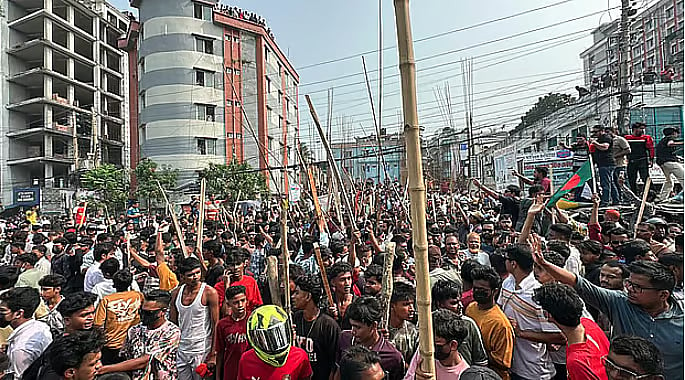
3. Counter-Violence and Vigilante Patrols: Retaliatory attacks have occurred on the homes of Awami League activists in Netrokona, while activists of the BNP and allied parties have patrolled streets with bamboo poles in Mirpur, Mohammadpur, Farmgate, and Tejgaon in Dhaka. When party cadres assume security duties in place of the state, a vicious cycle of action and retaliation ensues.
4. Symbolic Timing: December is the month of Victory, and it also marks the anniversary of attacks on Prothom Alo, The Daily Star, Chhayanaut, and Udichi following the death of Sharif Osman Hadi. Moreover, it is the first Victory Day during the tenure of the incumbent BNP government. The symbolic weight of choosing this timeframe is undeniable.
5. Strategic Exploitation of Economic Grievances: The Home Minister has surely spoken knowingly in stating that funds from “fallen forces” are infiltrating even the legitimate protests of garment workers. When grievances have an economic foundation, political incitement easily gains traction.
6. Easy Availability of Firearms: A portion of the weapons looted from police stations in August 2024 remains unrecovered. Ignoring this threat would be foolish.
7. Overt Provocation: India’s BJP MP Nishikant Dubey has spoken of “taking back” Noakhali, Sylhet, and Chattogram Port. While he is not a spokesperson for the Indian government, such remarks serve as direct provocation to inflame ultra-nationalist tensions inside Bangladesh.
Is Sheikh Hasina’s return actually possible?
For Sheikh Hasina to return normally through an airport as a free citizen with a passport is entirely impossible. Realistically, only two avenues remain open to her: returning as a prisoner via extradition, or returning voluntarily to surrender and face arrest. The reasons are crystal clear.
On 17 November 2025, the International Crimes Tribunal-1 sentenced her to death in absentia, with the full verdict published on 13 January. Under Section 21 of the Tribunal Act, the timeframe for filing an appeal is 30 days, and Section 21(3) bars the acceptance of belated appeals. No appeal was lodged on her behalf within the stipulated period.
This means she has exhausted all legal remedies; upon returning or being arrested, the sentence will take effect. If she returns, she must surrender, yet returning does not guarantee the right to appeal. She might have glimpsed a faint ray of hope for a minor exception, but recent violence orchestrated by her party has extinguished even that last glimmer. Abul Kalam Azad, convicted by the same tribunal, filed a petition seeking condonation of delay for a late appeal, which remains pending before the Appellate Division. A favourable ruling from the Appellate Division could have set a precedent applicable to Sheikh Hasina. But the court may no longer be inclined toward leniency.
Sheikh Hasina has fallen into the trap of laws crafted by her own administration. The original 1973 Act contained no provision for trials in absentia; in 2012, the Awami League amended the law specifically to cripple opposition politics. Without that amendment, the court could not have tried or sentenced her to death in absentia—or if it had, the verdict would have rested on weak legal footing.
Similarly, in the 2013 amendment, Sheikh Hasina’s government introduced the state’s right to appeal against verdicts to eliminate political adversaries—an amendment used to convert Abdul Quader Molla’s life sentence into the death penalty. Even if Sheikh Hasina’s death sentence were somehow commuted to life imprisonment through a legal loophole, it would yield little benefit, as the state could exercise that very right of appeal to reinstate the death penalty.
Nor do international bodies or human rights organisations hold any jurisdiction to commute Hasina’s sentence to life imprisonment. Numerous anti-death penalty organisations and the UN Human Rights Council itself urged her government in 2013 to abolish capital punishment or commute tribunal death sentences to life terms—requests Sheikh Hasina’s government flatly rejected. Had even a single precedent been set back then, she could have benefited from it today.
Furthermore, Sheikh Hasina has forfeited the legal right to obtain a passport, travel pass, or National Identity Card. A state is under no obligation to issue travel documents to a convicted fugitive. Without a passport or travel pass, she has no legal avenue to travel to a third country unless that nation issues her exceptional documentation on its own initiative—something no country will do given that a UN investigation has corroborated her culpability in the killing of citizens.
Could India grant her citizenship? That, too, is impossible. Under Section 6 and the Third Schedule of India’s Citizenship Act, 1955, naturalisation requires continuous residence in India for the 12 months preceding application, plus at least 11 years out of the previous 14 years. Hasina has been in India for just over two years. Meanwhile, the Citizenship Amendment Act (CAA) of 2019 reduced the residency requirement to five years exclusively for Hindus, Sikhs, Buddhists, Jains, Parsis, and Christians from Afghanistan, Bangladesh, and Pakistan—completely excluding Muslims. As a Muslim, the CAA route is entirely closed to her.
India’s assertion that she has been sheltered on “humanitarian” grounds has also complicated her extradition. Even if New Delhi wished to hand her over to reset relations with Bangladesh or honour the extradition treaty, it would struggle to do so. International human rights bodies would fiercely condemn India, arguing that sending a “humanitarian” asylum seeker to face an “inhumane” death penalty is not only unethical, but unjust and unlawful.
Although Article 6 of the extradition treaty permits refusing extradition for offences of a “political character,” India cannot invoke that clause either, because the same treaty explicitly excludes murder, attempted murder, and incitement to murder from the definition of political offences. Thus, India cannot publicly claim she was granted refuge as a victim of “political vendetta.” This Catch-22 situation puts India in a bind as well: legally, the treaty obliges India to extradite Sheikh Hasina, yet doing so remains practically impossible.
Do Awami League activists truly believe Sheikh Hasina will return?
Most party activists and supporters firmly believe that Sheikh Hasina will inevitably return, though none possess a clear idea of how. Back in July, Prothom Alo noted uncertainty even within party ranks over whether this was a genuine plan or merely a tactic to keep grassroots morale alive. Despite calls after the parliamentary election in February for exiled leaders to return home, not a single senior leader responded.
In his book When Prophecy Fails, social psychologist Leon Festinger observed a religious cult and demonstrated that when a prediction fails to materialise on the appointed date, followers do not abandon their faith—instead, they proselytise even more fervently to resolve their “cognitive dissonance”. Once December passes without Hasina’s return, a segment of her most dedicated followers will grow disillusioned and drift away. However, another faction will construct a new narrative: “She was prevented from returning by a conspiracy.”It is this second faction that risks becoming the vanguard of violence.
Suppose she actually returns, faces arrest, and meets execution. What follows? The first possibility is the fate of the Muslim League (political irrelevance). The second possibility is armed civil war—her demise viewed as martyrdom by devoted cadres, sparking armed retaliatory groups fuelled by unchecked emotion. Some quarters may actively desire this very “pretext,” as a death sentence generates an emotional surge that no organisational programme could ever match. The third possibility is even more perilous: escalating orchestrated chaos, leading to greater bloodshed and, ultimately, the spectre of military rule.
How prepared is the govt to confront the danger?
The Home Minister remarked that a single crude bomb exploding on a car roof outside a university at midnight does not signify a breakdown of law and order. A few weeks earlier, following a flash procession, he stated there was no scope to label the police’s role a failure.
I am not suggesting the government lacks preparation or is underprepared. The IGP has convened meetings with SPs across all 64 districts and Range DIGs, issuing directives to intensify patrols, border surveillance, and intelligence operations. Additional police have been deployed in Gopalganj, Shariatpur, Madaripur, and Faridpur, alongside six platoons of Border Guard Bangladesh (BGB) in Gopalganj. Nationwide, 252 checkpoints have been set up, while Industrial Police and BGB are operating jointly in industrial zones. What truly needs examining is the nature of the state’s preparedness.
Thus far, the government’s response has been predominantly reactive—arrests and checkpoints after incidents occur. There is little visible evidence of a proactive, intelligence-led strategy focused on tracing and severing financial pipelines.
In security policy, “saving face” is the most expensive luxury. Experiences in Kenya and Rwanda demonstrate that a major reason warning signs were ignored was political leaders’ fear that visible, large-scale mobilisation might make the government appear weak or fearful, inviting public ridicule.
A reliable government remains steadfast in the principle that “prevention is better than cure.” The administration must undertake comprehensive security preparations, yet without adopting a belligerent posture.
Crude rhetoric insinuating that “the government has the legal authority for crossfire or police killings if it wishes” must cease immediately. As an analysis in Asia Times aptly warned, if authorities respond with indiscriminate arrests or excessive force, a security challenge can swiftly morph into another full-blown political conflict. The Home Minister himself has stated that conspiracies will be foiled strictly within the bounds of human rights.
Human rights boundaries must certainly not be crossed by even a fraction. However, in crafting a “preparedness policy,” the word “conspiracy” ought to be discarded. The casual, meaningless overuse of this word has become something of an ailment among Bangladeshi politicians.
For effective preparedness, politics must be viewed as a chessboard. When one player makes a move and the opponent plans a counter-move, do we say the opponent is “conspiring”? Likewise in politics, rivals are not “conspiring”—they are calculating which counter-move will checkmate their adversary.
An indispensable goal of this preparedness policy must be elevating Bangladesh’s intelligence capabilities to international standards. Recent acts of violence have starkly exposed intelligence failures.
Lastly
Sheikh Hasina’s return as a free citizen is virtually impossible. While the suspicion that a third party is seeking to instigate a civil war may sound somewhat hyperbolic, it cannot be ruled out entirely. For now, the violence remains low-intensity and within manageable limits—yet “protracted low-intensity political violence” can easily spiral into a “vicious cycle of revenge.” The risk is real.
Whether the current wave of sabotage forms part of a third party’s capability-testing project remains unproven, even though government spokespersons themselves are pointing fingers at a third party. Consequently, the state’s preparedness must match the adversary move for move. The danger lies not in any isolated incident, but in a chain reaction of events—each provoking the next.
Historically, almost every civil war began following a trigger event, escalating through overreaction, counter-reaction, and bloody struggles by military or civilian political factions exploiting chaos to seize state authority. If a third party desires a civil war, their sharpest weapons will be state miscalculation, complacency, overconfidence, and utter indifference.
* Helal Mohiuddin is a faculty member in Liberal Arts at Mayville State University, North Dakota, USA
* Views expressed are the author’s own