Opinion
Will the agreement with the US resolve Bangladesh's energy crisis?
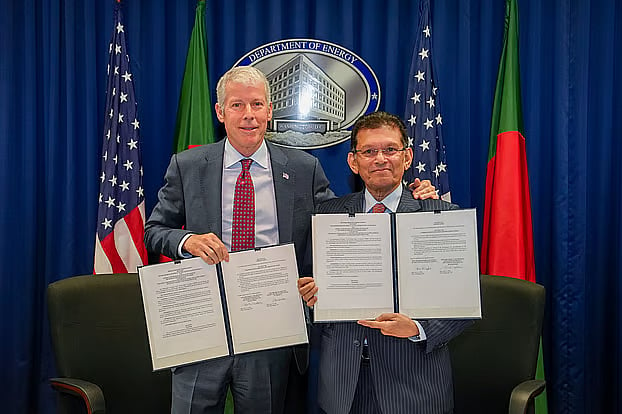
Bangladesh and the United States signed a Memorandum of Understanding (MoU) on strategic energy cooperation on 14 May. According to the agreement, the MoU is expected to strengthen Bangladesh’s long-term energy security by ensuring affordable prices, establishing a sustainable supply system, and diversifying energy sources.
The agreement will facilitate capacity building, knowledge and expertise exchange, and research cooperation between the two countries in the fields of oil, natural gas, geothermal energy, and bioenergy. It is also expected to support Bangladesh’s imports of LNG, LPG, and other energy products from the United States at competitive prices.
The question is, why were these particular energy sources chosen for strategic cooperation? And how does this relate to Bangladesh’s own sustainable energy future?
Just before this memorandum was signed, the Gas Exporting Countries Forum (GECF) published a report (an expert opinion paper). The report stated that the global LNG market is entering a structurally different phase, driven not by resource scarcity but by rising marginal costs and capital constraints.
Although LNG trade is expected to expand significantly over the coming decades, the cost of bringing additional supply to the market is actually increasing.
While the liquefaction costs of existing and currently under-construction projects are generally below US$3 per MMBtu (million British thermal units), the costs of proposed projects are increasingly exceeding US$4 per MMBtu, representing an increase of approximately 45–55 per cent. In other words, the gap between past and future production capacity is widening.
According to the report, the rising costs are being driven by a shortage of low-cost LNG production sources, increasing project complexity, escalating engineering and construction expenses, and expansion into remote, offshore, and higher-risk regions. As a result, future LNG supplies will increasingly depend on more expensive projects that require higher prices and secure revenue structures to be financially viable.
In other words, there are concerns that new LNG supplies may prove significantly more expensive than many policymakers currently expect.
The GECF analysis serves as a warning for Bangladesh. Long-term purchase agreements with the United States could make Bangladesh increasingly dependent on costly LNG imports, potentially exposing the country more deeply to the volatility of the global gas market.
This raises an important question: how reasonable is it to present LNG and related infrastructure in the memorandum as an affordable pathway to achieving “long-term energy security,” when the market itself is highlighting the associated economic risks?
Another concerning aspect of the memorandum is that it identifies bioenergy and geothermal energy, rather than solar power or electricity, as two of the primary energy sources for this strategic cooperation.
Bioenergy comes in three main forms: heat generated by burning wood or biomass, biogas (methane) produced from waste, and biofuels such as ethanol made from crops like corn or sugarcane.
With the exception of energy produced from waste, bioenergy directly competes with forest conservation and food production. It increases pressure on land use, can contribute to higher food prices, and may negatively affect rural livelihoods.
The Food and Agriculture Organization (FAO) has long warned that expanding bioenergy production can undermine food security and harm the environment. These warnings are particularly relevant for Bangladesh, where agricultural land is already shrinking due to urbanization, infrastructure expansion, river erosion, and salinity intrusion, all of which are emerging as threats to food security.
Any international cooperation involving Bangladesh should be aligned with independently determined national priorities, not with the commercial interests of foreign actors
In this context, any form of bioenergy other than waste-to-energy projects could jeopardise Bangladesh’s food security. Furthermore, Bangladesh’s geological and hydrological characteristics are generally not well suited for geothermal energy development.
In a densely populated delta such as Bangladesh, where the potential for solar and wind power is substantial, prioritising bioenergy and geothermal energy, at the possible expense of agriculture, raises concern rather than reassurance. Commitments to such forms of cooperation may therefore be unsettling rather than encouraging.
At a time when public dissatisfaction over trade agreements with the United States is growing, diplomatic efforts are simultaneously underway to engage with various stakeholder groups.
Against this backdrop, a delegation of 25 Bangladeshi business leaders recently attended the SelectUSA Investment Summit in Washington, DC, led by Bangladesh’s ambassador to the United States. The ambassador also held discussions with senior executives from Chevron and LNG infrastructure companies.
This raises a question as to whether this focus on the business community is intended to help international exporters and investors establish a local support base? For Bangladesh, is the strategic relationship with the United States becoming a means of entrenching expensive and environmentally risky technologies under the banner of energy security?
Expert analyses of today’s global gas market suggest that an LNG-centered pathway is costly and carries long-term risks. At the same time, bioenergy and geothermal energy also present significant social and economic risks. Before making any major commitments, it is important to assess whether they align with national interests, domestic capabilities, technical expertise, and food security priorities. Where is that assessment? Parliament does not appear to be raising the issue for discussion.
Since the formation of the new government, it has been encouraging to see the Minister for Power and Energy placing greater emphasis on renewable energy. If the government genuinely intends to expand the use of renewable energy and safeguard national interests, it should have refrained from entering into agreements or memoranda that require rapid import commitments or create long-term pressures on future budgets.
Any international cooperation involving Bangladesh should be aligned with independently determined national priorities, not with the commercial interests of foreign actors. Otherwise, such agreements may work against the commitments publicly declared by government ministers. They could push Bangladesh toward environmentally harmful and costly technologies that are contrary to the country''s long-term interests.
Bangladesh has struggled for years to overcome its energy crisis, in part because it has allowed other countries to shape its energy planning. Through poorly planned foreign agreements, debt-financed mega-projects, and the purchase of expensive energy imports, the country has become increasingly dependent on imports and burdened with debt, while failing to resolve its electricity and energy shortages. One crisis follows another, yet planning based on national interests and coordinated input from domestic experts does not become the primary consideration.
Bangladesh will remain trapped in this cycle of dependency if one ministry advocates for sustainable energy, while another signs agreements that contradict sustainable energy policies. Any agreement with foreign countries should be consistent with the country's own predetermined energy strategy.
That means the sequence should not be: first sign agreements and then formulate an energy strategy. Rather, the energy strategy should come first, followed by agreements with foreign states. That is a hallmark of an independent nation.
* Moshahida Sultana is Associate Professor, Department of Accounting, University of Dhaka, and energy researcher. She can be reached at moshahida@du.ac.bd
* This article expressing the author's own views