Opinion
Will Islamic forces form an electoral unity, what will happen if they do?
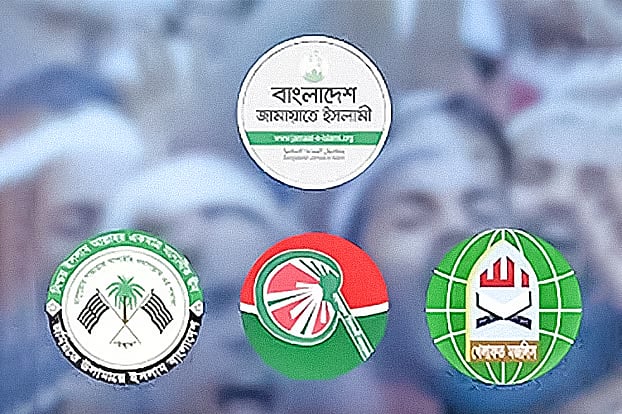
The possibility of unity among Islamic parties is emerging anew in the current political context. Sk Tawfiq Haque, Syeda Lasna Kabir and Mohammad Isa Ibn Belal look into the issue, as to whether this unification effort will actually succeed, and what impact such a unity might have on the upcoming election.
The winds of national elections have begun to sweep of the country. The chief adviser of the interim government has announced plans to hold the election in either February or April. With Awami League likely to be absent due to a ban on its activities, Islamic parties are seeking to position themselves before the voters as an alternative to BNP. They aim to contest the upcoming election united under one umbrella. However, given the troubled history of past unity efforts among Islamic parties, speculation abounds over whether such an alliance will truly succeed or whether it will collapse at the very outset.
At present, there are 10 registered Islamic political parties in the country, along with several smaller unregistered ones. These parties are broadly divided into three ideological streams. The largest of these is Jamaat-e-Islami, representing the 'reformist' stream.
The second stream comprises parties based on the Deobandi school of thought, rooted in Qawmi madrasas, such as the Islami Andolan. Hefazat-e-Islam, also based on the Qawmi system, is an ostensibly a non-political organisation, though it includes representatives from various Islamic parties.Beyond these two streams, there are several other groups aligned with the Razavi or Barelvi school of thought. These parties, historically speaking, have always been through bity unity and division. Just as unity begins to take shape, there is the inevitable fragmentation.
History of electoral alliances and divisions
During the Liberation War in 1971, there were ten Islamic political parties in the country. After independence, both these parties and religion-based politics were banned. When the ban on religion-based politics was lifted in 1976, the Democratic Party, Nezam-e-Islam Party, Khilafat-e-Rabbani Party, and Jamaat-e-Islami came together to form a coalition platform called the Islamic Democratic League (IDL).
This platform contested in the second national election in 1979 and won six seats. It was the first attempt at unity among Bangladesh’s Islamic political parties. However, due to internal disagreements over the coalition’s future direction and leadership, the alliance broke up later that same year.
In 1981, Islamic parties made another attempt at unity to contest in the presidential election. When Hafezzi Huzur announced his candidacy, leaders of various Islamic parties and some non-political clerics responded to his call. Jamaat-e-Islami wanted to join the alliance, but Hafezzi Huzur demanded they revise some of Maududi’s ideologies and agree to publish statements about this in the press. Jamaat refused to comply, and the alliance was formed without them. The four-party alliance became known as the Ulama Front, but it failed to achieve any significant success in the election.
After Hafezzi Huzur’s death in 1987, unity among the Qawmi madrasa-based parties could not be maintained. His political successors -- Fazlul Haque Amini, Azizul Haque, and Syed Muhammad Fazlul Karim -- split into three separate parties. Among them, Fazlul Karim’s party later became known as Islami Andolan Bangladesh.
Ahead of the 1991 election, a coalition called the Islami Oikya Jote was formed on 22 December 1990, comprising six parties. In that election, the alliance won one seat and received 0.8 per cent of the total vote. However, due to internal disputes and power-sharing issues, the alliance began to unravel ahead of the 1996 election. While Jamaat-e-Islami failed to build an alliance with other Islamic parties in 1991, it contested the election independently, winning 18 seats and 12.2 per cent of the total vote.
Will there be an alliance?
Currently, the term “unity among Islamic parties” largely refers to a possible alliance between Jamaat-e-Islami and Islami Andolan. Historically, these two parties have never come under the same umbrella and have maintained a certain distance.
Looking at the past four and a half decades of Islamic unity efforts, one thing stands out: although various Islamic parties have occasionally joined forces, since 1979 no other Islamic party has shown interest in forming an alliance with Jamaat-e-Islami. The main reason is doctrinal differences between Jamaat and the other Islamic parties. If these issues are not resolved, the prospects of any new alliance being successful remain doubtful.
Notably, even while talking about an alliance, Jamaat has already nominated candidates for nearly all constituencies. This raises questions about how much it would be willing to compromise if it were to form an alliance. On the other hand, the other Islamic parties that have long kept Jamaat at a distance due to doctrinal differences, may not be willing to accept Jamaat’s leadership. For these reasons, the alliance effort may well fall through before it even begins.
What if there is an alliance?
The fundamental question is that even if the Islamic parties manage to unite, what are their chances of winning, or how much of the vote could they attract?
In the 1991 election, all Islamic parties combined secured 14.4 per cent of the vote. In 2001, the Islami Oikya Jote received just 1 per cent. Historically, therefore, the maximum combined vote bank for these parties, Jamaat included, has been around 16 per cent. This is not enough to form a government. As a result, they may need to reach out to younger and undecided voters to improve their chances.
Many analysts believe that predicting the outcome of the 2026 national election is particularly difficult. The results this time may differ significantly from previous elections due to four unique factors:
One. In the absence of fair elections for the past 16 years, it’s hard to determine which party has gained or lost support and where that support currently stands.
Two. If Awami League does not participate in this election, it is still unclear where its supporters will turn.
Three. Four out of every ten voters this time are young. It remains uncertain which party these new voters will trust.
Four. The mass uprising has brought about changes in public thinking and consciousness, and these shifts are likely to influence the election results.
Considering these factors, if the Islamic parties can adopt the right strategy, they may be able to expect better results.
State of the election arena
As the national election approaches, voters are raising various questions about the political parties, with corruption emerging as a key concern. In this context, public trust in Islamic parties appears to be somewhat higher compared to other parties. Although Islamic parties have never held power directly, during the rule of the four-party alliance, allegations of corruption or profiteering through land-grabbing were relatively limited against them.
On the other hand, the relationship between Islamic parties and India has historically been somewhat distant.
Over the past 16 years in particular, India, through the Awami League, has been accused of putting consistent pressure on Islamic parties. As a result, there is little likelihood of them being perceived as “pro-India.” The “India issue” is currently a significant factor for Bangladeshi voters, and Islamic parties are expected to hold a favourable position in this regard.
Despite these general perceptions, voters remain curious about the stance and plans of Islamic parties regarding women. They want to know, if given the opportunity to govern, will these parties focus not only on religious freedom but also on expanding access to education and employment for women? What will their role be in enhancing women’s economic, political, and social participation?
Another noteworthy issue is that the organisational structures of Islamic parties provide little to no space for religious minorities and indigenous communities. What are the parties’ views on this? How do they plan to work toward the welfare and development of all citizens equally?
Conclusion
Although past efforts to establish unity among Islamic parties have repeatedly failed, the political developments and shifting realities since 5 August have created a renewed possibility of unification. Whether this effort will ultimately succeed, and if it does, what their performance will be in the upcoming election, remains to be seen. The answer will only come with the next national election.
* Sk Tawfiq Haque is Professor and Director, South Asian Institute of Policy and Governance (SIPG), North South University; Syeda Lasna Kabir is Professor, Department of Public Administration, University of Dhaka; and, Mohammad Isa Ibn Belal is Research Associate, SIPG, North South University