This region has seen many dictators in recent history, like Ayub Khan of Pakistan, Park Chung-hee of South Korea, Lee Kuan Yew of Singapore, Suharto of Indonesia, and Ferdinand Marcos of the Philippines. Ayub, Suharto, and Park came to power through military coups. Lee and Marcos became heads of government after winning elections. All of them were dictators. Yet there was one major difference among them.
The extraordinary development achieved by South Korea and Singapore over the past several decades owes much to the contributions of Park Chung-hee of South Korea, Lee Kuan Yew of Singapore. In the eyes of their citizens, they are known as “developmental dictators.” Within a remarkably short period, they elevated their countries to the level of Europe.
On the other hand, Pakistan, Indonesia, and the Philippines were unable to come close to achieving the same. The reason is that their rulers were not only dictators; they were also corrupt. They established kleptocracies in their respective countries. They themselves amassed enormous wealth.
The irony of history is that today it is difficult to find any landmark in Pakistan named after Ayub. He died in relative neglect and isolation.
Suharto and Marcos were overthrown by popular uprisings and fled their countries. They remained in exile for the rest of their lives.
Even after them, we have seen many dictators. In our own country, the most recent example was Sheikh Hasina. In her determination to remain in power, there was scarcely any misdemeanour she did not commit. She was joined by a group of plunderers and loyalist followers. Together, they sucked the country dry, squeezing it until little was left. Nearly all of the country’s institutions are now struggling with deep, festering wounds. The banking sector is one of the hardest hit.
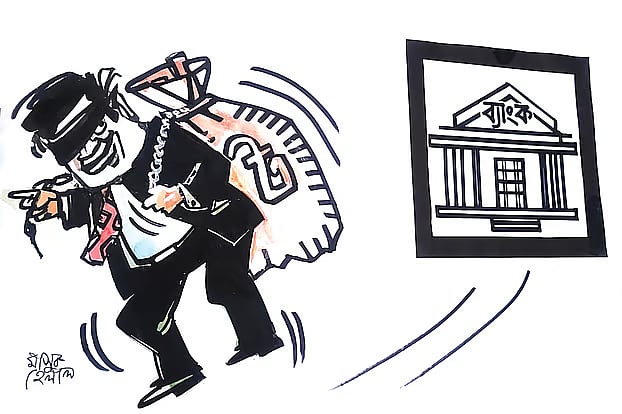
At a post-budget press conference on 12 June, the Governor of Bangladesh Bank made what could be described as a “confessional” statement, saying that “one-third of the money in the banking sector has been stolen.”
The money that was stolen from the banks belonged to lower- and middle-income depositors. Wealthier individuals do not leave their money sitting idle in banks. What was stolen was the depositors’ money. Ordinary people had entrusted their savings to banks based on the belief that they would be able to withdraw their funds whenever they wished. The state and the government, through Bangladesh Bank, are responsible for safeguarding the interests of depositors.
From the statement of the Governor of Bangladesh Bank, it appears that the institution primarily responsible for fulfilling this duty has confined itself to merely describing the crime after it occurred. The Governor declared that theft had taken place, but he did not disclose whether any theft cases had been filed against those responsible.
Among the banks from which money was allegedly stolen, readers have learned through newspaper reports about various incidents involving the loss of depositors’ funds at Islami Bank Bangladesh PLC. Based on the details presented in those reports, the offence related to the change in ownership of the bank does not fall within the legal definition of “theft” under Sections 378 and 379 of the Penal Code. Rather, the elements described appear to correspond more closely to the legal definition of “robbery” under Sections 391 and 395 of the Penal Code.
Whether the crime is called theft or robbery, I have not heard that any of those who were entrusted with depositors’ funds, and from whose custody that money disappeared, have filed a theft or robbery case in connection with the offence. Should we then assume that bank officials or owners were unaware that when depositors’ money is stolen, a criminal complaint for theft must be filed against the perpetrators?
Some may argue that cases concerning the misappropriation of funds have already been filed and that, in at least one instance, a court has even imposed punishment. What I am saying is that no case was filed specifically on charges of theft or robbery. The cases that were filed concerned other types of offences.
I am discussing two serious crimes that are familiar to everyone: theft and robbery. There is no need to explain what theft and robbery are. Everyone understands these concepts very well.
If the dramatic accounts published in newspapers regarding the replacement of the chairman of Islami Bank Bangladesh PLC during the tenure of Sheikh Hasina are accurate, then I see no reason why a robbery case should not have been filed over that incident. The then-chairman, who would have been the victim of that event, does not appear to have filed any robbery case from that time until now. Likewise, there is no indication that any subsequent governors filed theft or robbery cases either.
Nor have I heard that any of the officials or board members of the banks from which money was stolen or looted fulfilled their legal responsibilities by filing theft or robbery cases.
Under existing law, anyone who was aware that a theft or robbery had occurred but failed to report it may have committed an offence punishable by imprisonment or a fine under Section 176 of the Penal Code. Readers should remember that, under criminal law, there is generally no statute of limitations barring the allegation, investigation, or prosecution of criminal offences.
The supreme law of the country is the Constitution. Article 21 of our Constitution identifies the protection of national property as a civic duty of every citizen. Scholars may continue to debate whether the private deposits held by bank customers should be regarded as national property. However, the money lost through theft or robbery constitutes evidence of a crime.
The governor has said that the money lost by depositors through bank thefts or robberies will be repaid. But this money ultimately comes from the taxes paid by the country’s 180 million people. In this country, even the poor contribute through VAT and other taxes. How ethical, then, is this decision?
Under our country’s Evidence Act, the statement made by the Governor of Bangladesh Bank would be admissible as strong and highly valuable evidence for identifying the culprits and conducting an investigation or trial. The Governor and the officials of Bangladesh Bank working under his supervision have presumably already identified both the theft and those responsible for it. All that remains is to file a case in court and provide testimony; once that is done, the perpetrators can be brought within the reach of punishment.
Judges of our criminal courts could, if they chose, bring such a case under expedited trial on their own initiative. If an enterprising judge were to arrange for the swift prosecution of the offenders, there would be no need to use money earned through the labor and sweat of our farmers and workers to reimburse depositors.
There are very few examples of one-third of a country’s banking-sector funds being lost through theft or robbery. Had the government performed its assigned role properly, and had Bangladesh Bank fulfilled its regulatory responsibilities effectively, such theft or robbery should not have occurred.
For that reason, the possible involvement of influential figures in the government of the time warrants scrutiny. If theft or robbery cases were filed, that issue would naturally come before the courts on its own.
The judicial system currently in force in the country was originally introduced by a foreign trading company. The military commander who led that company’s conquest of Bengal received such an enormous sum of money from what was then the country’s most powerful businessman, often described as the “Banker of the World”, that, after returning home, Robert Clive became one of the wealthiest men in Europe.
India was regarded as the “Jewel in the Crown” of the British Empire. After Clive conquered that jewel, the British ruler who later expanded and consolidated imperial rule was Warren Hastings. Both Clive and Warren Hastings were subjected to impeachment proceedings by their own country. They were publicly tried. Among the allegations against them was that they had plundered the wealth of Bengal and India.
Meanwhile, we have confined ourselves merely to declaring that theft has occurred. More regrettably, even the theft of Bangladesh Bank reserves has not been brought to justice. Will kleptocracy continue unabated?
* Mohiuddin Ahmad, writer and researcher
* The opinions expressed here are solely those of the author.