Altaf Parvez's analysis
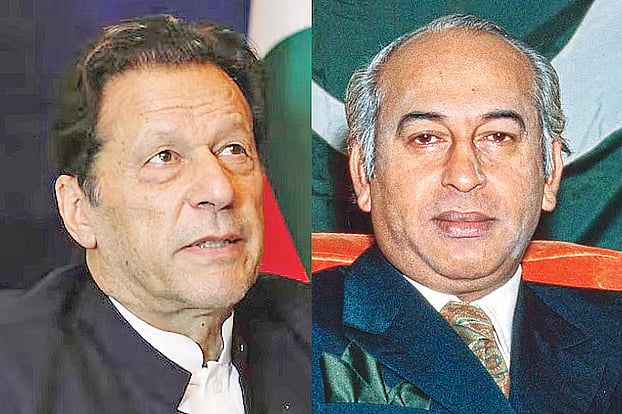
Is Imran Khan going to meet the same fate as Bhutto?
Bhutto was removed from the political arena by the 'establishment'. Is Imran facing a similar fate? Altaf Parvez searches for answers
Like Imran Khan, Zulfikar Ali Bhutto was once a favourite of Pakistan's military bureaucracy. Bhutto ran into trouble when he clashed with Kissinger over the nuclear bomb. As a consequence, in July 1977, he was first ousted from power and shortly thereafter imprisoned. Just a few hours before the military coup, Bhutto was having a chat with General Zia-ul-Haq. Even after his ouster, he couldn't comprehend what was about to happen.
In September 1977, Bhutto was detained. The world knows what followed. In March 1978, he was sentenced to death. The order was finally confirmed by the High Court on 24 March of the following year. It was executed in the second week of the following month at Rawalpindi Prison. Tyrants have a fear of history. General Zia demolished that prison in Rawalpindi in 1988, replacing it with what is now ‘Jinnah Park’.
The military bureaucracy does not favour overly popular politicians in Pakistan. It impedes their old dominance on many policy decisions.
The military bureaucracy, along with the Bhutto and Sharif families, formed a powerful triangle that became unbeatable with Washington's blessings.
After Bhutto's death sentence verdict, general Pakistanis believed it would change. Bhutto, too, held such beliefs. But before his execution, Bhutto witnessed the cruelty of his once-favoured general. During his detention and the period between arrest and execution, he was slowly being killed in prison. He was kept in a room without light or air for months, and glass powder was mixed into his food to cause mouth sores. By the time of his execution, he was nearly dead, having lost a significant amount of weight and deprived of medical care. At the same time, activists of the People's Party were being persecuted.
A somewhat similar history is now visible in Imran's case. The country's youth once dreamed of ‘Haqiqi Azadi’ (true freedom) under his leadership. But the military bureaucracy devised a strategy to use him against the Sharif and Bhutto families. Now, those two families are being used to ensure his imprisonment and persecution.
Imran as a victim of revenge
A new prison was built 13 kilometers from the old district jail in Rawalpindi where Bhutto was executed, in 1986. It is there that Imran now resides. Locals call it ‘Adiala Jail’. Just this past August, Imran completed three years of imprisonment here.
For politicians, life in prison is not novel. However, in Imran's case, the concern is his deteriorating health. Many in Pakistan believe he is on the verge of losing vision in at least one eye. Despite court orders, he is being denied medical treatment. A ban is also in place on disseminating information about his health condition. Recently, renowned cricketers issued an unprecedented statement demanding proper medical treatment for Imran, yet the situation remains unchanged.
Imran has faced over a hundred cases. Some occasionally result in convictions; these convictions are often suspended or overturned in higher courts, but the beloved 'Captain Khan' of Pakistanis is not released. He is clearly facing targeted revenge. His wife is also not spared from cases and detention.
The many facets of misfortune for popular politicians
The military bureaucracy does not favour overly popular politicians in Pakistan. It impedes their old dominance on many policy decisions. However, the military bureaucracy cannot reign in such politicians on its own without external support. Just as General Zia obtained such assistance during Bhutto’s time, Imran’s situation is similar. Such repetition is quite surprising, and quite sorrowful.
Even though Henry Kissinger became unfavoured over nuclear bomb technology between 1976-77, the response of the then-US Secretary of State to young Bhutto during the 1971 Bangladesh Liberation War was entirely different. Recalling a meeting with Bhutto on 11 December during the war, Kissinger wrote in his memoirs (White House Years), “I found him brilliant, charming, of global stature in his perceptions … he did not suffer fools gladly."
Yes, it was Kissinger who deceived Bhutto.
In August 1976, Kissinger came to Pakistan to stop Bhutto from the nuclear programme and left with dissatisfaction. Their meeting took place on 10 August at the Lahore Governor's House, where Kissinger said, “A terrible example awaits if this programme is not abandoned.”
Within months of Kissinger's visit, Bhutto was ousted. During this interim period, anti-Bhutto political parties quickly formed coalitions. The influential religious group Ahl al-Sunnah issued fatwas stating that those dying in the anti-Bhutto movement were martyrs. At this time, demands for the introduction of Sharia law began to emerge. A movement for free elections suddenly morphed into a movement for an Islamic state. Zia-ul-Haq quickly seized the opportunity.
On the day of the bloodless coup, the United States expressed its reaction by calling it Pakistan’s 'internal matter'. The new rulers promised elections would be held within 90 days and power handed over to the winners. For 11 years, they remained in power. No such elections ever took place.
The fall of the Shah in Iran at the start of 1979 and the Soviet army's entry into Afghanistan towards the year's end increased Zia's strategic importance to Washington. To establish 'Islam', the new rulers started receiving support from influential groups like Jamaat-e-Islami and Maulana Maududi. This helped reduce the general’s public isolation.
Protecting General Zia-ul-Haq as a 'defensive bulwark' against the Soviets in Afghanistan and expanding religious politics in the country—both were crucial for the United States at the time. Four days after the Soviet forces entered Afghanistan, US President Jimmy Carter confirmed working 'together' with General Zia over the phone. Relations became even closer when Reagan succeeded Carter.
Tragedy 2. 0
Before coming to power, Imran was sympathetic to the Afghan Taliban. This aligned with the interests of the military bureaucracy. During NATO's expulsion by the Taliban in 2021, his government seemed quite elated.
During this time, Prime Minister Imran became excessively confident. In the latter half of 2021, he attempted to impose his preference in the chief appointment of the country’s much-discussed intelligence agency ISI. This earned him the disfavour of the military bureaucracy. From this point, they began waiting for a major ‘mistake’ from Captain Khan, allowing international patrons to support steps taken against him.
In 2022, the Ukraine war provided an opportunity. Amid the intense conflict between Russia and the US, Imran suddenly sought to become 'independent' in foreign policy. But he made this decision at the wrong time. After 23 years, a Pakistani prime minister visited Moscow on the very day Ukraine was invaded! This visit by a Pakistani prime minister on such a day was seen as defiance by Washington. The military bureaucracy did not delay in capitalising on this opportunity. For a long time, their structural growth has benefitted from US aid and cooperation. Imran fell victim to their strategic interests.
Subsequent events mirrored Bhutto's scenario with slight novel twists. Where opposition parties united in the field during Bhutto's time, in Imran’s case, the opposition formed a coalition in Parliament in April 2022. The PTI was defeated in a no-confidence vote. In typical 'fast bowler-style', Imran accused the US of instigating the no-confidence proposal.
Simultaneously, during this time, Imran's party began explicitly naming the generals as instigators of their political downfall. The Sharif and Bhutto families quickly grasped the immediate message of the situation. They put aside historical enmity and joined hands. The military bureaucracy, Bhutto, and the Sharif families formed a powerful triangle, which with Washington's blessings, became unbeatable.
As a consequence, Imran Khan is not only removed from power but his party is also torn apart. Despite gaining majority seats in the 2024 elections, they were not given power. His release is also uncertain, and the risk to his life is not entirely unfounded. Many commentators compare the then and now military bureaucracies, suggesting this phase of Pakistan's history could prolong like Zia-ul-Haq's era.
Zia-ul-Haq and Asim Munir have many similarities. Both are aggressive towards political opponents and are pro-US. Zia had a special relationship with President Ronald Reagan. A similar closeness is observed between Asim Munir and Trump. Both Reagan and Trump are leaders of the ultra-right wing of the Republican Party. Amid the Gaza genocide and brutal sanctions on Iran, Asim Munir recommended Trump for the Nobel Peace Prize last June. The direct impact of this duo's closeness is visible in contemporary Pakistani politics and foreign policy.
In pursuit of 'Haqiqi Azadi'
While Asim Munir anticipates a peace prize for Trump, political and ethnic unrest is quite intense in his country. Most of PTI's old leaders are either imprisoned or inactive out of fear. Amidst this, the party has called for a long march to Islamabad on 27 September to free their party chief.
In the absence of main leaders, there is confusion over the party’s declared political programme. Among the organisers in various provinces, there is a lack of coordination in political activities. There is also distrust surrounding many new leaders. Some believe this is happening due to state intelligence influence. PTI, although coming to power capitalising on Imran's popularity and the expectation of change, is not organised as a party. The old organisational structure has been dismantled due to government repression.
In this situation, if significant political pressure is not created, Imran Khan may have to spend further indefinite time in prison. However, though people are currently subdued, social sympathy for Imran Khan is growing. As a result, social-political fractures are also increasing.
Many in Pakistan believe that seeing the public’s sympathy for Imran entirely as support for PTI would be a mistake. It is actually a yearning for 'Haqiqi Azadi'. Even after 79 years of independence, civil society is not free here. After his ouster, Imran frequently spoke of Haqiqi Azadi before his arrest. In the early days of his political career, he may not have realised that changing governments through collusion with the military bureaucracy was not possible in the struggle for 'true freedom; however, now the words are becoming the main slogan of his liberation movement.
In all South Asian countries, the meaning of Haqiqi Azadi is quite discomforting for the ‘establishment’. Pakistan is no exception.
#Altaf Parvez is a researcher in history.
*The opinions expressed here are the author's own
#This article, originally published in Prothom Alo print and online editions, has been rewritten in English by Rabiul Islam