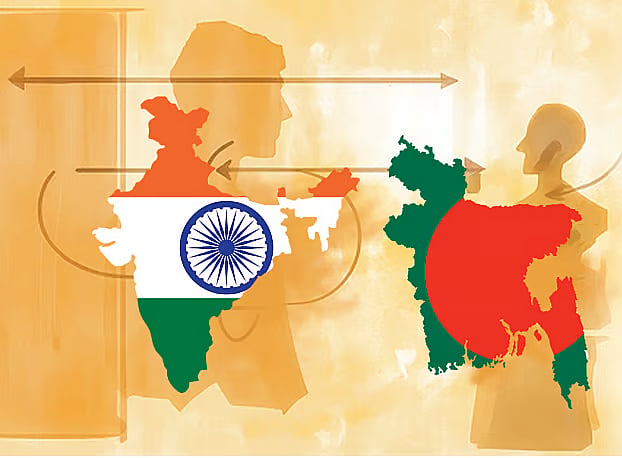
A critical economic issue has received little attention in Bangladesh’s media, caught up as it is in election alliances and anti-India politics. On 27 December, the country’s yarn mill owners called an emergency meeting. They appealed to the government to protect Bangladesh’s yarn mills from Indian imports.
Over 80 per cent of the yarn used in Bangladesh’s garment industry comes from India. In other words, Bangladesh’s garment factories depend on India for raw materials. But this does not mean we have no yarn of our own or that Indian yarn is our only option. There are nearly 500 yarn factories in the country’s industrial zones. Yet, cheap Indian yarn imports are pushing these domestic mills toward destruction. In the last fiscal year alone, Indian yarn imports increased by 137 per cent.
Indian yarn is cheaper than locally produced yarn—$2.70 per kilogram compared to $3 per kilogram for domestic yarn. When incentives were in place, the price difference was only 5 cents; now it has widened to 30 cents. Unsurprisingly, garment manufacturers are choosing to buy ‘Delhi’ yarn instead of ‘Dhaka’ yarn to reduce costs. The Bangladesh Textile Mills Association (BTMA) reports that over 50 yarn factories have closed in just one year, causing 150,000–200,000 workers to lose their jobs. In short, domestic yarn mills cannot compete with cheap Indian imports.
Why is the production cost of domestic yarn higher? Why is India’s cost lower? Is it because we are inefficient and incompetent, and India is skilled? But does this “efficiency” fall from the sky, or is it built? India benefits from state protection, sustained investment, and a long history of subsidies. Indian yarn mills receive incentives of up to 15 per cent and funding for technological modernisation. But what has our “anti-hegemonist” government done to protect local spinning mills from Indian yarn?
Previously, local yarn production received a 5 per cent cash incentive. This has been reduced to 1.5 per cent. Naturally, production costs have risen, and prices have gone up. Why would garment owners buy higher-priced domestic yarn? They may curse garment owners as “Indian agents,” but at the end of the day, a businessperson will buy the cheaper Indian yarn.
Creating “backward linkages” is not the responsibility of garment owners. It is not the job of the young people chanting anti-Indian hegemony slogans in Shahbagh. This is the responsibility of the state’s policymakers. In the harsh reality of global competition, industries survive only through government intervention. Yet, what a tragic irony: while $2 billion worth of yarn has been imported from India during the interim administration, enormous domestic yarn stocks worth Tk 120 billion remain unsold! The BTMA has recommended imposing at least a 30-cent duty on imported yarn to protect local mills. But so far, the government has not responded.
In other words, on one hand, we want to resist Indian hegemony, but on the other, we import Indian yarn while letting thousands of crores worth of domestic yarn stock go unused. Is this opposing Indian dominance, or is it a complete failure and short-sightedness in building our own strategic capabilities? The same situation exists in many other industries, not just yarn.
Wedding season: Dhaka or Delhi?
It is currently wedding season in the country, with hundreds of weddings happening daily, only in the capital. Look closely—whose sarees, lehengas, or kurtas are being worn at these weddings? Dhaka’s or India’s? Slogans alone will not help. A visit to Mirpur’s Banaraspalli reveals the sad state of Dhaka-made sarees.
Banaraspalli was originally established to protect local weavers. Yet 60 per cent of the sarees sold in this area now come from India. In the very heart of Dhaka’s weaving industry, Indian Kanjivaram and Banarasi sarees are being sold instead of local Dhakai cotton. The wealthy buy them, and the middle- and lower-income groups do too. The reason is simple: Indian sarees cost less to produce and are cheaper. But is this lower production cost accidental, or is it the result of consistent policies by India’s central and state governments?
India has made long-term investments to sustain its handloom industry, provided incentives, and offered loans on easy terms for technological modernisation. What have we done? We have left a highly promising industry, involving the livelihoods of a million artisans, entirely in the hands of the market. The country’s market is now dominated by Indian sarees. Skilled weavers, with decades of expertise, have lost their jobs; some are now working as street vendors, others have bought auto-rickshaws.
The irony doesn’t end there—auto-rickshaw parts are also imported from India! Engines, bearings, shock absorbers, joints—all come from Indian brands like Bajaj and Lumax. Local mechanics cannot compete with the cheaper Indian parts. The reason is the same: India’s auto-rickshaw industry has grown due to central government incentives (promoting environmentally friendly vehicles instead of diesel). Meanwhile, we import millions of Indian parts, and when poor people buy auto-rickshaws and take to the streets, it’s as if we are bulldosing our own economy.
Domestic jute mills shut down while India develops its jute industry
India is the largest market for Bangladesh’s raw jute. It has expanded its jute industry to such an extent that, even as a producer itself, India imports huge quantities of raw jute from Bangladesh. Yet, was the jute grown through the hard labour of Bangladeshi farmers ever meant to serve the country’s own industrialisation? We haven’t forgotten that a section of our media, economists, and intellectuals had, by promoting the narrative of subsidies, built public opinion in favour of closing 26 state-owned mills.
Now, however, the largest jute mills in Khulna, Jashore, and Demra have been deliberately shut down, forcing Bangladesh to depend on India for selling raw jute.
Meanwhile, India has used Bangladeshi raw jute to develop its own jute-processing industry, invested in value addition, made the use of domestic jute mandatory in government corporations, and secured a place for “high-end” jute products in the global market. It goes without saying that these are not isolated policies; rather, every political decision since Nehru’s time has aimed at building national capability.
In contrast, Bangladesh’s state-owned jute mills have seen no new investment in 50 years. Yet, agriculture-based industrialisation was supposed to be a core strength of agrarian Bangladesh—jute, sugar, dairy, poultry, fisheries, and agro-processing. Instead, we have closed functioning factories and sold off machinery worth thousands of crores at bargain prices (visit Khulishpur, Platinum, and Crescent jute mills).
On one hand, stories of millions of jobs are promoted; on the other, industries employing hundreds of thousands of workers—built on the country’s soil, water, climate, and local skills—have been handed over, along with machinery and infrastructure, to businessmen incapable of creating even 100 jobs. The result: the entire industrial belt in the south has collapsed.
Can economic hegemony be prevented without state investment?
If we wanted to resist Indian economic dominance, shouldn’t we have mobilised to save the jute mills and sugar mills employing millions of workers? Continuous recommendations from SCOPE and BGMEA suggested investing just Tk 12 billion, upgrading technology, replacing old charkha/hessian looms with modern ones, installing modern machinery in spinning and batching units, increasing production capacity, reducing corruption in jute procurement, and reforming the industry overall.
Without state investment, “modern” industries do not stand—this is historical reality. Those who believe the market is an apolitical “magic” and that industries will develop automatically under a “free market” should study the industrialisation histories of Europe, America, South America, South Korea, Singapore-Malaysia, or India.
By citing subsidies, Bangladesh’s raw jute has ended up in India. Yet behind India’s jute mills, paper mills, textile, pharmaceutical, shipbuilding, steel, petrochemical, fertilizer, aviation, and telecommunications industries lies decades of sustained state investment and political decisions on subsidies. In the United States, there is not a single food chain, manufacturing industry, or bank-insurance company that has not received substantial, continuous federal support. Companies like Walmart, JP Morgan, FedEx, Nike, Nestle, IBM, Intel, McDonald’s, Pizza Hut, KFC, Burger King, and Domino’s Pizza all benefit from federal subsidies.
When we dream of Amazon, Apple, Dell, HP, Samsung, Lenovo, or Google coming to Bangladesh, a quick search will reveal the extent of state subsidies these companies receive. If Bangladesh buys 14 airplanes from Boeing, does Boeing profit solely on its own, or does its survival depend on billions in federal subsidies? General Motors, Ford, or BMW receive subsidies to establish assembly lines. Tesla was incentivised to promote electric vehicles, and the company itself acknowledges that it could not have survived without federal support.
Countries like Finland, France, Norway, South Korea, and those in South America industrialised using public tax money. They provided continuous subsidies for key industries, offered low-interest bank loans, imposed tariffs on imports, increased budgets for technology, and ensured state ownership in strategic sectors. These policies were not about profit and loss; they aimed to build, sustain, and protect industries of national strategic importance. In other words, the industrial history of developed countries is not a story of an apolitical “free market,” but a history of political decisions, state investment, and strategic subsidies.
On the other hand, while talking about resisting hegemony, we have abandoned the market to the so-called “free market.” Whether it is Indian, Chinese, or American, is it possible to confront powerful economic hegemony without state initiative? Can an economy dependent on Indian markets, Indian raw materials, and Indian products stand tall against Indian hegemony?
Will we keep stockpiles of domestic yarn worth thousands of crores while importing garment yarn from India? Will our sugar mills remain closed while our refineries import raw sugar from India? Will our Banaraspalli sell Indian Banarasi sarees, auto-rickshaw parts and tractors come from India, and 80 per cent of our jute seeds be imported from India, yet we refuse to even discuss self-reliance—while paying lip service to anti-India slogans?
Millions of our workers have fought desperately to save domestic industries, losing jobs, livelihoods, and even facing imprisonment. Yet, we were not even remotely involved in their long struggle. We did not raise a finger to save the country’s jute mills. And now, maintaining an India-dependent economy, can we think we can resist Indian dominance with mere sloganeering?
“Dhaka, not Delhi” is a powerful slogan. We have long used it in anti-Hassina movements. We have consistently argued that to counter India’s subservient foreign policy under Hasina, the killings by the BSF along the border, the Felani murder, hegemonic trade deals in the energy sector, the unfair sharing of Teesta water, unjust transit agreements, and turning the Rampal power plant into a dumping ground for India’s low-grade coal—an economically self-reliant foundation is needed. National capability is required. Reducing dependence on India demands long-term policy. Handing over the backbone of the economy to Delhi while chanting “Dhaka Dhaka” is populist politics—it cannot stop hegemony.
#Maha Mirza is a teacher at the Department of Economics, Jahangirnagar University.
#Opinion expressed is the author’s own
*This article, originally published in Prothom Alo print and online editions, has been rewritten in English by Rabiul Islam