"Although our expectation is peace, our policy and objective are to arrange defence by all means according to our resources' capabilities." This historical statement by Thomas Jefferson, one of the founding fathers and the third President of the United States, seems to serve as a guiding principle for national defence and security policies of independent, sovereign, and democratic states in the modern world.
The commencement of Bangladesh's military strategy primarily began with our historical role as a nation during the Great Liberation War. Winning that unequal war imposed on us by the unilateral attack of the invading forces was not merely due to the singular role of the Armed Forces. Instead, it was the comprehensive participation of the freedom-loving general population that became the main determinant of victory, transforming the war from a helpless guerrilla resistance into a people's war.
In that war for national liberation, alongside the heroic historical contributions of the rebellious officers and members of the Armed Forces, the spontaneous role of the general populace was particularly significant. And this unforgettable experience effectively provides the foundational direction for our national defence policy and security strategy.
In that uneven war, combat operations were carried out under guerrilla tactics in 11 operational sectors comprising rebellious Bengali members of the military, paramilitary forces, and civilian citizens. Some fought with arms, some contributed by providing information, some with food and shelter, and others by aiding with medical treatment. This public involvement turned the Liberation War into not just a military conflict but a national people's resistance war, known in modern military terminology as ''people-centric warfare.'' In the context of Bangladesh, this concept is not merely theoretical but a historical truth written in the letters of blood.
Another essential foundation of Bangladesh's defence and security philosophy is Bangladeshi nationalism. It instills a deep sense of self-identity and responsibility among the people, which, in turn, encourages every citizen to be resolute. When the people of a nation deeply understand the value of their own history, heritage, culture, and sovereign independence, it fosters a strong commitment to territorial defence and national security within everyone.
In independent Bangladesh, the first initiative to organise and institutionalise this concept was undertaken by the martyred President Ziaur Rahman. He rightly realised that as a nation with a small economy and limited military resources, Bangladesh could not merely rely on conventional military power.
Therefore, he brought forward the idea of a 'Total People's War' as part of defence preparedness, with the core philosophy that the nation's defence is not just the responsibility of the Armed Forces but a collective duty of the entire nation. His philosophy was based on three pillars—1. Public awareness and participation; 2. A professional and skilled Armed Forces; 3. A self-reliant defence industry. As part of this idea, he reorganised the Bangladesh National Cadet Corps on 23 March 1979.
This integration involved consolidating the University Officers Training Corps, Bangladesh Cadet Corps, and Junior Cadet Corps. Simultaneously, programmes were initiated to familiarise the youth with discipline, leadership, patriotism, and basic military training through Ansar-VDP and the Scout movement. Unfortunately, after the martyrdom of this great leader, his visionary defence and national security plans experienced setbacks.
In reality, the relevance of this idea has increased in the current global context. Geopolitical competition, economic sanctions, technological dependency, etc., deeply impact the defence system of any country. The strategic competition of major powers in South Asia and the Indo-Pacific region is intensifying. In such circumstances, military-equipment dependency on other countries for the defence preparation of small or medium-power countries is undoubtedly a risky strategy. There are numerous examples where international and regional equations have rapidly changed during wartime or crises.
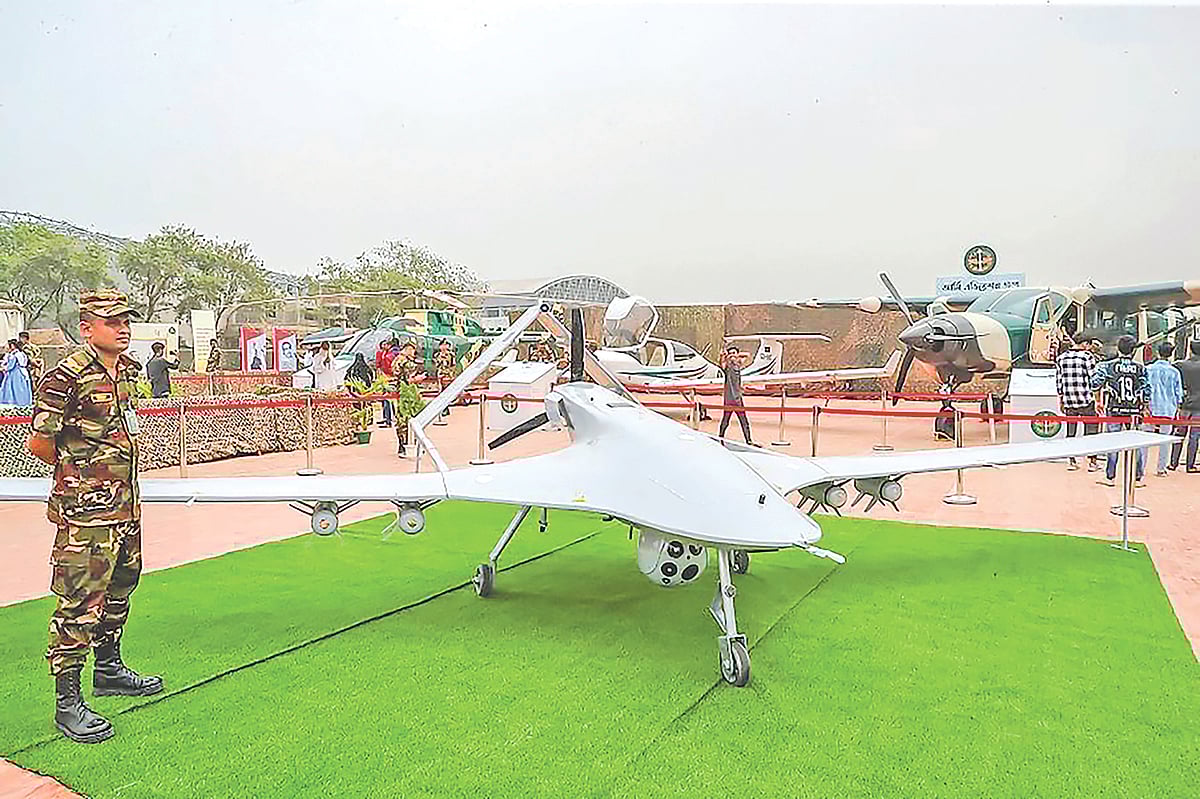
Many countries have realised this truth and have accordingly restructured their defence and security strategies. Over the past two decades, Turkey has achieved significant capability in drone technology, missile systems, and armored vehicle production. An impressive 93 per cent of the components for Turkey's much-discussed Bayraktar TB2 drone are produced domestically. South Korea meets approximately 70 per cent of its defence equipment demand through domestic production. Israel, too, has become self-reliant in its own military technology by giving strategic priority to its defence industry. These examples demonstrate that a self-reliant defence industry not only enhances military security but also plays a crucial role in technological advancement, industrialisation, and economic growth.
The concept of a domestic defence industry is not just about producing weapons or military equipment; it is about the broader strategic capability. When a country is capable of producing its own weapons, ammunition, communication systems, surveillance technology, and military equipment, its defence system becomes more independent and sustainable. This reduces foreign reliance and also allows for swift decision-making in emergency situations.
Our universities harbour thousands of talented students in science, technology, and engineering. Our information technology sector is rapidly growing. Alongside, there is an energetic vast young population. Advancing defence research and production through appropriate policies and long-term implementation plans could eventually lead to building a strong domestic defence industry, which is not at all impossible.
If accomplished, it would not only enhance our military capabilities but also open new horizons for technological self-sufficiency and industrialisation. However, the ultimate strength of defence lies with the people. No matter how advanced or modern weapons or technology may be, they are operated by humans. Therefore, the most crucial component of a strong defence system is a professional, technologically, and strategically skilled, and morally firm Armed Forces. In modern democratic arrangements, the Armed Forces are not just a military institution but become a symbol of the nation's confidence, trust, and reassurance.
Bangladesh is a country prone to natural disasters. The swift and effective role of the Armed Forces in situations like cyclones, floods, and river erosion has been repeatedly proven. Through these experiences, it's clear that a strong defence force is not only necessary for war but is equally important in addressing various national crises. However, in strengthening our overall defence system, the inadequacy of the budget in the 'Research and Development' sector is a significant limitation. According to the financial accounts for the fiscal year 2025-26, only 2.4 per cent of the total defence sector allocation is earmarked for the ''Research and Development'' sector.
Over 97 per cent of the allocation goes towards salaries and operating expenses. Meanwhile, neighbouring country India spends approximately 22 per cent of its overall defence budget in the 'Research and Development' sector, and Pakistan spends at least 10 per cent. This picture indicates that without emphasising research and development, realising the dream of building a self-reliant defence industry will not be easy. Yet, in the current global reality, establishing one's own defence industry is almost impossible without implementing an effective and modern defence policy and security strategy.
It should be remembered, as the first President of the United States and Commander-in-Chief of the Continental Army, George Washington said, "One of the most effective ways to maintain peace is to be prepared for war." Without a specific ''Defence Policy and National Security Strategy,'' it would surely not be difficult to understand that making adequate preparations to face any potential challenge will not be easy.
#AKM Shamsul Islam (Retired Brigadier General), Defence Advisor to the Prime Minister
#Monir Haider, Special Assistant to the Chief Advisor of the Interim Government
* The views expressed are the writers' own.
#This article, originally published in Prothom Alo print and online editions, has been rewritten in English by Rabiul Islam