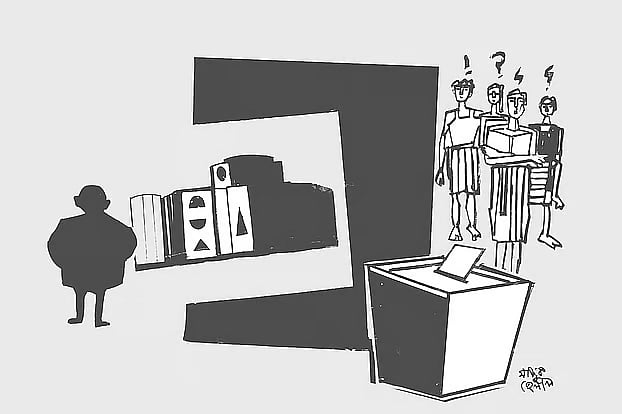
For all relevant reasons, discussions and deliberations on constitutional reforms prevail in the country. The limitations of a unicameral parliament are obvious. There is more or less consensus on a second House. The debate, only naturally, is over the process involving a bicameral parliament. Such debate is essential to mull over the nitty-gritty of any new system on the offing.
The problem in Bangladesh is the existing institutional vacuum and apathy to execute plans or policies. Simply imitating foreign models will not yield any solutions. It is a Bangladeshi homegrown solution that is essential in order to ensure a broad representation, effective lawmaking and the formation of an inclusive state, not a blind adoption of the Westminster or Washington systems.
There must be a well thought-out effort to democratise Bangladesh’s political reality. It is also necessary to slow down the rapid pace of constitutional transformation. Constitutional change cannot be brought about abruptly. History teaches us that sudden changes disconnected from reality may not lead to success, as seen in Nepal. The decentralisation process that began in 2008 had to endure a decade of instability.
Bangladesh must proceed with care, adopting well-planned steps along the way. It is essential for Bangladesh to undergo a prudent evolution grounded in its unique social fabric and historical advancement. The process will then take root in the country’s social realities and history-bound foundations.
Bangladesh is a delta of alluvial soil. This land has been formed gradually through the accumulation of layer after layer of sediment. Similarly, constitutional structural change can also become lasting if it unfolds slowly and in stages, like the sedimentary formation of this land.
This journey ahead must start from the grassroots. There may be a "local government" constitutionally, but in actuality there is no government at a local level.
The state is unevenly centralised. At the local level, there exists an administrative structure of the central government. As a result, local administration controls less than 5 per cent of national expenditure. If an Upper House is built on this hollow foundation, this will risk reinforcing a Dhaka-centric oligarchy. Genuine reform lies not in further centralisation, nor even in mere decentralisation.
People aspire to local self-government, through devolution or the transfer of power. In other words, power must first be distributed vertically, then horizontally. This ‘vertical democracy’ is a key step toward establishing people’s ownership over the state.
Priority must be given to building up local self-governance at the grassroots, not just increasing the present of the central state.
Articles 59 and 60 of the Constitution should be amended to grant the upazila parishad authority over local finances, security and legislative matters. It is essential to empower them in areas of public service such as primary healthcare and primary education.
This is similar to India after its 73rd constitutional amendment in 1992, or Indonesia after 2001. This reform in power transfer is not merely decentralisation or substitution, nor is it an imported model . It is a constitutional organic transformation. It is like preparing the soil before planting a tree.
Strengthening the foundation of the present parliamentary system
Reform should begin by firmly consolidating the existing national parliament. To enhance the government's accountability, the current unicameral legislature must be made more robust. There are many historical precedents. For instance, following the "Glorious Revolution" of 1688, the British Parliament gradually evolved into a bicameral system through the expansion of parliamentary committees, legal oversight, and pre-legislative scrutiny.
Strengthening parliamentary standing committees with independent research units, adequate staffing, and specialised legal expertise would enhance their ability to scrutinise bills and monitor government actions. Germany’s Bundestag Scientific Service and the US Congressional Research Service are notable examples.
A 'Council of Experts or Advisors' may be formed to provide consultative services.
They can offer informed, evidence-based recommendations before a bill is introduced in parliament. The concept could draw inspiration from France’s Conseil d’État, which Napoleon established in 1799 to ensure legal coherence in policymaking.
Citizen participation in the legislative process must be significantly increased. Mandatory public hearings and structured feedback mechanisms on proposed bills would help identify weaknesses, strengthen public support, and establish a sense of public ownership. Practices such as public hearings and structured opinion assessment, are common in many countries.
Most political parties are firmly committed to establishing strong local government and a bicameral parliament. Skeptics may raise objections regarding costs. But stable local government and a bicameral parliament are not a burden
Forming an interim bicameral framework
A phased approach may be adopted to lay the foundation for establishing a fully functional second chamber or house. An interim Upper House could be created during the transition period, comprising nominated representatives. Experts may also serve as members. In the initial stage, members of parliament and local government representatives would elect them. This chamber would have the authority to deliberate and raise objections, but not to block or veto any bill.
Based on the experience of this advisory structure, limited powers could be expanded through a referendum, similar to what occurred in Ireland in 1937. Such powers might include the right to recommend reconsideration of a bill or a qualified veto based on a supermajority. In addition, the chamber could be granted joint legislative authority over specified areas such as culture, environment, or inter-regional development.
To enhance legitimacy, the process of member selection should be gradually refined, with a focus on ensuring public recognition and approval. The example of Spain’s 1978 senate reform may serve as a reference.
Transition to a fully bicameral parliament
In the final phase, a fully bicameral parliament would be established. The Lower House, elected through the people’s direct mandate, would retain authority over financial matters and government formation. The Upper House would focus on legal review. A clear division of responsibilities is essential for an effective bicameral system - a principle recognized globally. In most bicameral parliaments, including Westminster, this division of labour is well-defined. Through struggles in the 17th and 18th centuries, the House of Commons established its financial supremacy.
To resolve parliamentary deadlocks, mechanisms such as joint sessions (as per Section 57 of Australia’s Constitution) or conference committees (used in the United States since 1789) may be adopted. At the same time, the lower house’s financial primacy should be enshrined in the constitution. The UK’s Parliament Acts of 1911 and 1949 could be reviewed in this regard.
Just imagine a scenario where a Garo leader debating climate policy with a Dhaka-based economist. True democracy lies in transforming democratic imagination into democratic practice.
Bold changes
Winds of hope are blowing. Most political parties are firmly committed to establishing strong local government and a bicameral parliament. Skeptics may raise objections regarding costs. But stable local government and a bicameral parliament are not a burden. They are guarantees for the protection of democracy. Local self-governance and a bicameral system are not luxuries, they are like shields protecting against democratic erosion.
Bangladesh did not achieve independence overnight. Similarly, steady progress is needed for bold constitutional changes. Close observation, evolution, balance and expanding accountability are essential. The aspiration the people expressed in the July 2024 uprising must be reflected in the structure of popular governance.
* Dr. Rashed Al Mahmud Titumir is Professor, Department of Development Studies, University of Dhaka
* Opinions are the author’s own